• TalkBass has been independent since 1998. Add your voice.
    Create a free account to reply to discussions, view embedded media, and browse with fewer display ads.
    Join freeLog in
    Want zero display ads or expanded classifieds tools? Compare plans.

Double Bass Homebuilt EUB build thread

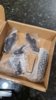
In other news, My bridge arrived. (Yay) unfortunately they did a crap job of packaging it and the finish on several of the pieces are dinged and scratched. (Boo) The seller is being very responsive though and sending me a replacement for free - hoping that I will re-write my Amazon review (Product 4.5 stars / Shipping 0 Stars) waiting to see if they improve their packaging when I get the new bridge.

2021-01-11 18.10.15.jpg 2021-01-11 18.12.45.jpg
 
  • Like
Reactions: Beersurgeon
My sisters is in Virginia, so that's a little complicated.

The part that worries me a bit is the scalloping in the middle to accommodate the string vibrations, but AFAIK that is very much a trial and error fiddly bit even for professional luthiers (which I am not). I found this article to be particularly enlightening. Fingerboard Geometry | Looking at the radius - Joey Naeger Basses

Ebony is going to be right out of my budget for this project (a 3/4"x5"x36" piece of ebony can cost well north of $100) So I am looking for something available off the shelf from Woodcraft or another hardwood supplier, maybe a piece of Paduak, Purpleheart, or Wenge as they tend to be MUCH cheaper ($30-$50).

This is exactly why I chose the bridge that I did, because I knew that I was going to have to radius the bridges to match the fingerboard. Each pair of bridges out from center will be at a different height (heck, I may find that every bridge is at a different height!) to accomodate string height, and neck angle.


That Joey Nager piece is article is an excellent reference, good due diligence. A good piece of ebony will be way far north of $100 , I think there have been good results reported around here for other, even synthetic materials, if you have good ventilation.
It'll be interesting to see your bridge work!

No guarantees on usefulness, but music is an essential human function like language , so it'll be around until we lose the brain hardware for it.
And what singer said "you can live without the melody but you can't live without the bass line " ?
 
  • Like
Reactions: Videojunkie
These were the tuners I was planning on using, they have a nice slot, and are fairly beefy. I think they should be more than adequate.

GB707 - G-GOTOH
No, the post is too thin. The FB30 from the same page would be better.
You need a post that is at least as thick as an old Fender tuner. Better would be real DB tuners, the cheapest from Rubner are better than the „better“ ones from anybody else.

If you want to use DB strings you also need a DB bridge. Forget the BG bridge. They are made for BG strings. DB strings won’t fit. Also for bowing you need the curvature on the bridge from string to string and be able to change it if needed.

I strongly recommend to have a look at other EUBs and DBs, how they are constructed and what kind of construction doesn‘t exist (probably for a good reason).

If you have enough time and money to build three EUBs go ahead, if not check existing ones and only do things differently if you are absolutely sure it would work.

If you want it cheap, buy a used Stagg (RDL preferred) or a Palatino and tune them a bit. People even added a fifth string, but there is not much use on a DB/EUB.
Bowing on an EUB without some kind of resonance chamber or vibrating top is possible but harder than on one with it. It is mostly related to starting the string but also the sound is a bit sterile.

I know it sounds rather unfriendly, but you might better take a year to learn what a good EUB needs, collecting some more money for good parts than to build something with limited resources and limited knowledge that becomes ... something.
Personally I collected a lot of my current knowledge by reading through a lot of threads in Talkbass over the last years.

If I would had a project like yours I would have read even more. You can ask and ask, but at some point writers might get tired. Try to collect as much knowledge as possible about DBs and EUBs. That would help you more than asking detail questions that might no longer be relevant after getting informed by studying.

It is clear that your first instrument would be far from being perfect, but how far depends how well you understand how a DB and EUB is built and why!
 
I feel like I am getting a little off track turning one design into another. I am not trying to re-invent the 3/4 EUB. If I am doing anything I am trying to duplicate something like this Omni Bass | Extraordinary 34" Scale EUB by Ned Steinberger | NS Design as a fretless, hollow body EB that can be bowed and played (mostly) in the vertical position.

I really appreciate all of the input especially all of the string information, I may well wind up building the backbones for two different basses, a shorter 34" scale following the original design, and a second backbone for the larger 41.5" scale length using regular double bass strings. (the backbone materials are a pair 1x8 x8' with some 1x4 x4' pieces as fillers. roughly $50 per backbone) with a few hours of work I could have them side by side for comparison as to how they feel, and with a little work could even wire up a simple pickup for each one and try them side by side to see what I think. and from there chose to finish one (or both!) of the basses.

A bit of history from me, I built my first guitar before I learned how to play guitar. Like this one, I used inexpensive parts (although my budget for that guitar was waaay less than I am spending on this one) cheap wood (It was made from some scrap 2x10 and a leftover fir stud). Knowing absolutely nothing about playing guitar I built a pretty ok starter guitar. Then I built another and spent more money on better woods, electronics, etc. I understand that I could buy someone else's EUB for less money, but there is something unique about building your own instrument and playing it.
2020-02-23 13.43.08.jpg
 
My two cents: by all means, go for it. You are clearly smart, resourceful, and willing to take advice. Will your first EUB be perfect? Probably not, but it will absolutely be a valuable learning experience. You will get plenty of good advice here. One of our resident geniuses here, @Passinwind, has I believe, built his own EUB; perhaps he will chime in.
 
  • Like
Reactions: Videojunkie
My sisters is in Virginia, so that's a little complicated.

My original plan was to buy a replacement 3/4 fingerboard from overseas. That's become complicated for 2 reasons, a) the relief carving on the back, while necessary for a fingerboard hanging over the body of an acoustic bass complicates the joinery to attach it in a manner to avoid odd sounds from the hole in the middle of the fretboard. and b) I am not sure that with the extra size that it would work anyways, in the original plan, I was going to leave the free end alone, and cut the nut end to get the additional width for the 5th string.

Carving a multi-radius fretboard doesn't worry me too much, there are a number of simple jigs out there to help manage it (I like the one from the aussie that built a fingerboard out of poly cutting board material) I think the standard taper is from 7-8 inches at the nut to 18-24 inches at the bridge end. The part that worries me a bit is the scalloping in the middle to accommodate the string vibrations, but AFAIK that is very much a trial and error fiddly bit even for professional luthiers (which I am not). I found this article to be particularly enlightening. Fingerboard Geometry | Looking at the radius - Joey Naeger Basses

Ebony is going to be right out of my budget for this project (a 3/4"x5"x36" piece of ebony can cost well north of $100) So I am looking for something available off the shelf from Woodcraft or another hardwood supplier, maybe a piece of Paduak, Purpleheart, or Wenge as they tend to be MUCH cheaper ($30-$50).

This is exactly why I chose the bridge that I did, because I knew that I was going to have to radius the bridges to match the fingerboard. Each pair of bridges out from center will be at a different height (heck, I may find that every bridge is at a different height!) to accomodate string height, and neck angle.
Good on ya Videojunkie. I admire you tackling a project like this (I'm the "here's one I carved earlier" Aussie). Will be following your progress with interest :)
 
  • Like
Reactions: Videojunkie
Is any EUB perfect? probably not:)

Never let "perfect" stand in the way of "good". - Voltaire.

All instruments are compromises based on design decisions someone made at some point. Why is a violin the size and shape that it wound up, why didn't it wind up with a triangular shape like a balalaika? or a round shape like a sitar? Someone somewhere along the line came up with the shape and many would argue Stradivarius perfected it. But clearly it was a compromise otherwise there would be no need for the different sizes (1/4, 3/4, 4/4) the Viol, the Viola, etc.

The important thing I am taking away from the design discussions was that the decision to go back to the 34" scale length precludes using 'real' upright bass strings on it, and it will sound like a 'bowed EB' which is probably adequate for my purposes. By designing it from go to be a bowed instrument I am hoping to avoid the pitfalls of trying to bow a 'flat' fingerboard found on a normal EB. It should play a bit like a cello.

I think based on some reading I did (there's a few dozen threads here on TB) that using these strings Thomastik-Infeld Jazz Round Wound Bass Strings - 5-String 34" Long Scale .043-.118 I would come very close to an upright sound for pizzicato and they may sound pretty decent bowed as well (most of the folks in the threads were using them on standard EB's and weren't able to bow the strings properly.)

I will probably wind up fighting with the piezo pickups to get the sound I want out of this, but I am hoping much of that can be solved with tone and eq. Once I get things constructed and start down the road of the electronics for it we'll see how far down that rabbit hole I climb.
 
Good on ya Videojunkie. I admire you tackling a project like this (I'm the "here's one I carved earlier" Aussie). Will be following your progress with interest :)

I am totally stealing your string trimmer line strings idea. That was brilliant!

I am also borrowing your idea for the router jig, but turning it upside down and mounting it to a sled because my router table is part of my table saw. Do you think it would work to carve side to side as you move the sled along the router, or did you lock the fan in place and then run a straight cut the length of the board?
 
It‘s OK to habe the 34“ as a kind of Cello pitch wise (with a different tuning perhaps). But BG strings including the Thomastik jazz flats all have a solid thick wire as the string core. Decades ago this was also the case for DB steel core strings, but nobody plays these strings nowadays and for a good reason.
Current steel core strings have a steel wire cable (like aircraft cable) as the core. It is much more flexible, less stiff, and sounds much more pleasant with the bow than steel wire DB strings which are extremely bright and don’t start as easily as cable core DB strings. And even some of them (like the popular Spiro Medium) are not really easy to bow.

I think your idea to have two different instruments for different functions is a good idea. If you use strings like with the OmniBass for the small one you get an electric bowable cello-bass and can check how well BG strings can be bowed. Then you might get more motivation for a better bowable small EUB with DB strings.

BTW, DB pegs are not perpendicular to the neck, they are a bit angled like the pegbox cheek, but they are long and have a hole on both sides in the pegbox cheek to distribute the string tension to the pegbox. Talk to your sister about that and have a look at some pictures of unfinished DB necks/pegboxes.
The pegs have different lengths, so better design the pegbox after the tuning machines when you have them in your hands. They are not in groups of two like on classical guitar but alternating left and right (both possibilities are used in practice).
But that’s for the bigger one.
 
  • Like
Reactions: Videojunkie
@DoubleMIDI, when I build the long scale one I will be sure to use a tailpiece and arched bridge. I think the geometry will work for that design change.

I can also incorporate something like these: Rubner Double Bass Machines 5-String – Thomann United States
into the design of the headstock to better accommodate the DB strings. But I agree with you that I would want them on hand before I cut anything so I can make sure they will fit correctly.
 
  • Like
Reactions: DoubleMIDI
So I did some quick sketches of fingerboard radii. And it looks like at the nut end of the fingerboard I would want something about 2.25" and at the bridge end it would be 3.75".
That seems really really small.

Vertical lines indicate where strings would be. All of this is planned on a 3/4" fingerboard with 3/16" vertical sidewall.

20210122_130359.jpg
 
Last edited:
  • Like
Reactions: Beersurgeon