
Enjoy the benefits of a premium membership!
Upgrade Account
-
TalkBass has been independent since 1998. Add your voice.
Create a free account to reply to discussions, view embedded media, and browse with fewer display ads.
Join free Log in
Want zero display ads or expanded classifieds tools? Compare plans.
You are using an out of date browser. It may not display this or other websites correctly.
You should upgrade or use an alternative browser.
You should upgrade or use an alternative browser.
Double Bass Homebuilt EUB build thread
- Thread starter Videojunkie
- Start date
-
- Tags
- build a bass diy bass eub
More options
Who Replied?
Sorry if I missed it earlier, are you throwing in pickups too?
I plan on putting pizeo pickups under the bridges. I haven't quite figured that piece out. initial thought was to put something like this: https://www.amazon.com/dp/B07HVFTGTH/?ref=idea_lv_dp_ov_d
next to or on each bridge piece and then wire them up in parallel to an onboard pre-amp like this one: https://www.amazon.com/dp/B01N77TIYZ/?ref=idea_lv_dp_ov_d
to give me minimal control over shaping the sound. I know that the low B is around 30hz, and the 'bass' on the eq is 60hz so it may be of modest use, and may well be a waste of $17. The other feature of this particular pre-amp is a microphonic input, and I was thinking that might be a neat thing to have to 'blend' in some of the acoustic nature of the instrument.
I'm not making these decisions yet, but I have some thoughts about doing some crazy things like building small tone control circuits for each piezo, and building a small mixer circuit so that I can tune the sound of the instrument to be precisely what I want it to sound like - with a controllable 3 band eq for the mix to the output.
But I am more interested in getting to the point where I can start turning lumber in sawdust. (If it wasn't going to be in the 20s and snowing this weekend in my workshop, I might get started sooner...)
As an Amazon Associate, TalkBass may receive commissions from qualifying purchases made via links on this site.

Found a nice piece of purpleheart for the fingerboard. I have some purpleheart veneer left over from an old project that I plan on incorporating into this project. It should be plenty hard (Janke ~2500) and the color will pop next to the maple.
Now to wait for above freezing temperatures in my garage....
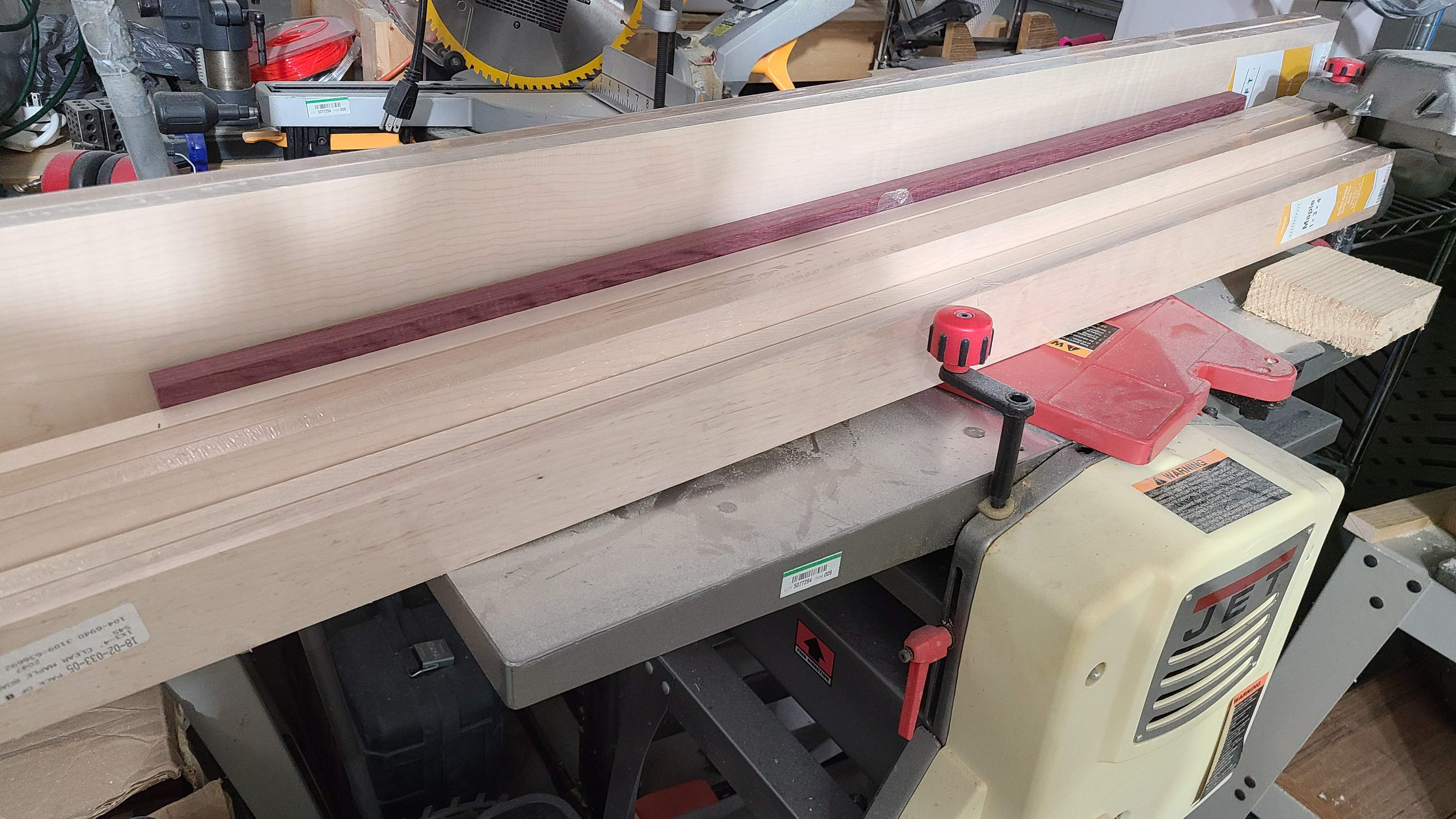
Now to wait for above freezing temperatures in my garage....
Doing some sleuthing online (my google fu isn't too shabby.) it looks like an optimal arch fo a bowed bridge / fingerboard is about 73mm (2 15/16") so my earlier radii aren't too far off. I may tighten up the bridge radius, as I can see some issues trying to bow the 2nd and 4th strings by themselves. Not quite sure what I will do about the bottom of the fingerboard, as I will roll right off the edge of the board. (I wish a 1x was really 1" not .75") basically I will lose the 3/16" I was reserving as a 'side' to the fingerboard. That shouldn't be too big of an issue though, as there will be solid maple underneath, as opposed to a DB where that part is floating in the middle of space.
Changing the radius of the bridge really opens up the middle strings on both sides, and that makes a lot of sense to me.
Changing the radius of the bridge really opens up the middle strings on both sides, and that makes a lot of sense to me.
Links for electronics reading.
A 5-channel mixer / preamplifier for piezo disks by Godfried-Willem Raes
Piezo Bass Preamp - MIMF
A 5-channel mixer / preamplifier for piezo disks by Godfried-Willem Raes
Piezo Bass Preamp - MIMF
Does anyone have an opinion on the flexible braid piezo Vs the disc style of piezo for under the saddle use? I know for my guitar I like the flexible style.
I am thinking that installing the braid style would be better a cleaner install, but I have concerns just using the end of the pickup and having issues with the remaining braid hanging out.
I am thinking that installing the braid style would be better a cleaner install, but I have concerns just using the end of the pickup and having issues with the remaining braid hanging out.

Piezo wire is better suited to pressure differences than piezo disks. Piezo ceramic (maybe also piezo foil) is optimized for bending, not pressure. Piezo wire is optimized for pressure applications.
The difference is the amount of voltage level. Both is possible, but the output of piezo disks under the bridge/saddle is a bit weak.
Piezo disk also often need a higher input impedance (10 MegOhms) than piezo wire (perhaps 1 to 5 MegOhms).
I put a piezo disk below the bridge/saddle of my bass guitar in parallel to the output of the active electronics (not a good idea, just an experiment) and the output was weak and not buffered.
I also used piezo disks in a homemade two-element bridge foot pickup for my Clevinger EUB with a similar bridge string angle to a double bass (on most EUBs the angle is smaller) built in a double impedance buffer and phase inverter on one side and a passive mixer followed by another buffer and the signal is still a bit weak in voltage level. But it sounds good. An amplifying opamp would be needed after the mix, but there is no room in the electronics compartment.
If I would had piezo wire or thicker pressure oriented ceramic like used for DB bridge wing pickups, they probably would work better.
The difference is the amount of voltage level. Both is possible, but the output of piezo disks under the bridge/saddle is a bit weak.
Piezo disk also often need a higher input impedance (10 MegOhms) than piezo wire (perhaps 1 to 5 MegOhms).
I put a piezo disk below the bridge/saddle of my bass guitar in parallel to the output of the active electronics (not a good idea, just an experiment) and the output was weak and not buffered.
I also used piezo disks in a homemade two-element bridge foot pickup for my Clevinger EUB with a similar bridge string angle to a double bass (on most EUBs the angle is smaller) built in a double impedance buffer and phase inverter on one side and a passive mixer followed by another buffer and the signal is still a bit weak in voltage level. But it sounds good. An amplifying opamp would be needed after the mix, but there is no room in the electronics compartment.
If I would had piezo wire or thicker pressure oriented ceramic like used for DB bridge wing pickups, they probably would work better.
Last edited:
@DoubleMIDI Thanks! Since I can't make sawdust, I am spending my project time looking at the electronics piece.
I found a bunch of reasonably priced (<$10ea) flexible under saddle pickups through either Ebay or Amazon. I am thinking that I can run the pickup along the length of the bass saddles with a hole at each end to contain the length of piezo wire. I am thinking the along the front brace of the bridge area, I can attach the internal electronics (as a hollow body, I don't have the same space limitations as a solid body instrument).
I am still debating how far down the rabbit hole I want to go on this, but the Richter PPX5 mixer makes a lot of sense to me, allowing me to individually control the mix of the strings (and could be very useful when I wind up changing types of strings) I'd also built at least a 2 band boost/cut tone circuit to give me a bit of control when playing live.
I found a bunch of reasonably priced (<$10ea) flexible under saddle pickups through either Ebay or Amazon. I am thinking that I can run the pickup along the length of the bass saddles with a hole at each end to contain the length of piezo wire. I am thinking the along the front brace of the bridge area, I can attach the internal electronics (as a hollow body, I don't have the same space limitations as a solid body instrument).
I am still debating how far down the rabbit hole I want to go on this, but the Richter PPX5 mixer makes a lot of sense to me, allowing me to individually control the mix of the strings (and could be very useful when I wind up changing types of strings) I'd also built at least a 2 band boost/cut tone circuit to give me a bit of control when playing live.
I got the truss rods for the neck from StewMac, 24" Hot Rod Low-profile 2-Way Truss Rod | stewmac.com I plan on installing these adjustable at the neck, with them aligned as an "A" along the neck, so that I can adjust any twisting from the strings. It does add a bit of complexity to the neck joint, but they are fairly low profile, and I don't think they will compromise the joint too badly.
Nut and fingerboard radius details:
I will wind up fitting this with strings to get the proper action, but this sketch is a starting point.

I will wind up fitting this with strings to get the proper action, but this sketch is a starting point.
The second and fourth string are too close to the middle one. The bowing angle for the middle one is much too small. I‘m not sure if a cutout of a circle would work here.
You need more distance from the fingerboard for the lower strings than for the higher ones. Typically increasing 1 mm at the end of the fingerboard.
You need more distance from the fingerboard for the lower strings than for the higher ones. Typically increasing 1 mm at the end of the fingerboard.
The second and fourth string are too close to the middle one. The bowing angle for the middle one is much too small. I‘m not sure if a cutout of a circle would work here.
You need more distance from the fingerboard for the lower strings than for the higher ones. Typically increasing 1 mm at the end of the fingerboard.
I was wondering about that. I am planning on making the bridge removable so I can try it a couple of different ways to get it right. The final one will be out of purpleheart.
Good idea.I was wondering about that. I am planning on making the bridge removable so I can try it a couple of different ways to get it right. The final one will be out of purpleheart.
Did some more work. if I match the end radius of the FB, and correct the spacing (if I get this within 5 thousandths of a cm I will be amazed!) The green lines are tangents for bowing lines. it's fairly narrow, but workable(?).
Keep in mind that each of the saddles has several mm of vertical travel to adjust string heights for thickness and dial in each string very precisely.

Keep in mind that each of the saddles has several mm of vertical travel to adjust string heights for thickness and dial in each string very precisely.
Looks good in general (bowing angles), but the height difference over the fingerboard from G to E should be at least 3 mm. I think this is beyond height adjustment range and should be incorporated into the bridge shape.
Each saddle has adjustability from .445" - .670" in height (.225" or 6.7mm) The thickest string that will fit through the bridges is .130" (3.3mm) which is about what a typical B string is (some are thicker so I have to watch it if it doesn't have a small ball end on it! - the TI strings B is .136" the G is .033")
In other news, I bought these as pickups
https://www.amazon.com/dp/B07C2WRSGP/ref=cm_sw_r_cp_apa_fabc_H9TCTA6ANT7P7WKQ8M7W
The price is right, and I think I know how to install them under each saddle.
https://www.amazon.com/dp/B07C2WRSGP/ref=cm_sw_r_cp_apa_fabc_H9TCTA6ANT7P7WKQ8M7W
The price is right, and I think I know how to install them under each saddle.
As an Amazon Associate, TalkBass may receive commissions from qualifying purchases made via links on this site.


