• TalkBass has been independent since 1998. Add your voice.
    Create a free account to reply to discussions, view embedded media, and browse with fewer display ads.
    Join freeLog in
    Want zero display ads or expanded classifieds tools? Compare plans.

Double Bass How best to reduce speaking length on large flatback

GeoffBass

Guest
Apr 25, 2012
23
2
Hi - this is my first post on this forum.
I have an old German flat back DB (trade bass) of proportions: LOB 1102cm; width upper bouts 54cm; width lower bouts 71cm; depth of lower ribs 22cm; stop (e flat) at approx 40cms from the scroll; string length is approx 111cms.
This bass is too much of a handful for me and as it needs to be opened up and repaired properly (lots of splits, and recurring buzzes) I am thinking of biting the bullet and also reducing the string length so I can enjoy playing it – say to 106cm.
I have discussed repair with luthiers who want me to write them a blank cheque with now guarantee of what the instrument may then be worth - so I must consider doing the work myself. There is a woodcraft guild near me and if I join there are members who are instrument makers with experience glue, woods, tools etc. I expect to make clamps and such myself.
There are some excellent photos on the net showing many of the repairs that I may have to make to the sound box. And yers I have the Chuck Traeger book and the book of measurements on order to guide me.
So … my continuing concern is around how best to shorten the length of the strings. I currently have a false nut which has reduced the strength length to 109cms – still too uncomfortable.
I’m interested to hear what readers think about taking the neck out from the block, cutting it a little shorter then rebating it back into the block a little further – I think I can achieve a reduction of 4 cms but worried IO might end up with an e natural stop:rolleyes:.
I know your going to ask for photos – so while I’m getting this organised – has anybody had a similar challenge and would you care to share your experience – many thks!
GeoffBass, Australia
 
I try to explain what might be possible with a shortened neck or 5cm long false nut.
If I know the string length from the (false) nut to the beginning curvature of the neck to the body joint (neck stop), assuming this is 40cm. Then the rest of the vibrating string length (body part) is 111-40=71cm. Making the neck shorter by 5cm (but NOT by shortening the neck at the body joint!) you will get 35cm neck string length and 106cm total string length. Assuming you would have 70cm body string length (which is only 1 cm less than real) you have exactly 1:2 length relationship the relation ship of a pure fifth, so you will get a D neck then. The 1cm more body could be adjusted by 3mm more neck length. So go for a 106,3cm string length and 35,3cm nut to neck stop string length and you are fine with a perfect D neck.

If you try to make the neck to body joint smaller you risk a neck break and won't get a good neck stop somewhere between E flat and E (but closer to E flat). If you also use a false nut you can compensate a bit, but probably not much, getting an E flat neck again.

Worst case is you need a new neck for what you desire, but then you can be happy with a D neck. I'm not sure if shortening the current neck is possible at all for static reasons. The fingerboard may need adjustment too anyway.

BTW, I play a 109cm 4/4 bass now sometime even with 4 finger system in first and half position. I hated the long scale (and the higher tension Spiros) the first years, but now with Innovation 140B (they might be 2cm too short for you) and some more technique and practicing I can live with the scale.
The only thing that bothers me is the body length (114,2cm in my case, 3cm longer than yours) and being too short myself (172cm and rather short finger length). So I either get problems with my arm contacting the top in thump position (if I put the bass a bit higher) or not reaching the lower bowing positions (putting the bass a bit lower).
Now I lean the bass a bit more towards me in the higher endpin position (which means using an endpin vs. replacing it by a large rubber stop) and it works more or less for me.

Talk to a luthier about shortening the neck (or a new neck), don't do it yourself without being absolutely sure that it will hold the high string tension.
 
You have two options that involve no modifications to the neck heel, and will also maintain a perfect D or Eb neck (whichever you have now).

If you have a D neck, install a 1.67 mm false nut and move the bridge 3.33 mm closer to the fingerboard.

If you have an Eb neck, install a 1.85 mm false nut and move the bridge 3.15 mm closer to the fingerboard.

I thought you had to move nut and bridge equally to maintain the same heel note. :confused:

Also, since most of the readers here are US (I believe) inches is more understandable than mm for us.
 
I thought you had to move nut and bridge equally to maintain the same heel note. :confused:

Also, since most of the readers here are US (I believe) inches is more understandable than mm for us.

You have to maintain the 1:2 proportions (nut to heel:heel to bridge)for a D neck, or the 1:1.7 proportions for an Eb neck.

Also, I meant cm, not mm, my error.

There is another option I hadn't thought of. If the OP has an Eb neck but would like to convert to a D neck, he could install a very long 5.74 cm false nut and move the bridge 0.74 cm AWAY from the fingerboard. I believe this is what DoubleMIDI was getting at.
 
Where is "heel" measured from? The end of the neck, as in "overstand", or the top of the heel where your hand makes contact? Or the top of the fingerboard somewhere? Serious question...I'd really like to know how to deliberately plan a "D" neck, since my last one was an E-flat. Are these ratios pretty "hard and fast", or just ballpark figures?

I hope to build another bass this summer, modelling it after the "Panormo" plans I got from Peter Chandler. Can that be a D-neck? (abysmally ignorant about this specific topic)

Thanks in advance.

Chet Bishop
 
If the bass is "too much of a handful" for you, then I'd suggest you find a bass that suits your needs and leave this historic model at the original specs. Sell it to someone who wants a bass of those proportions.


Don't back off with the metric measurements. Folks around here need to be fluent with both. Remember: 1975 was the year that the US Congress passed the metric conversion act to make the switch!

j.
 
I used cm and mm because
a) the original poster used it and
b) because the numbers seemed to be simpler to understand in this case and
c) because it doesn't matter which measurement norm you use for understand the principle
(and d) because I use cm and mm in Germany so I am used to them).

tstone's idea is not exactly mine but a good idea based on mine. I just didn't want to ask for moving the bridge.

And yes, it might be a good idea not to change these things to the bass but get a different one instead. I thought this was obvious when I made my comments to shortening the neck. At least the luthier that was asked first thought like this too. When asking for the cost of the neck modification this might get obvious for the owner of the bass (this is not a do it yourself option, I have warned before!).
 
Where is "heel" measured from? The end of the neck, as in "overstand", or the top of the heel where your hand makes contact? Or the top of the fingerboard somewhere? Serious question...I'd really like to know how to deliberately plan a "D" neck, since my last one was an E-flat. Are these ratios pretty "hard and fast", or just ballpark figures

I measure the "heel" in the above calc thus ... slide finger and thumb down fingerboard, opposite each other. It matters not which finger. When you feel the heel, comfortably, stop. For a D neck that point is 1/3rd the string length.

That's the way I do it; but for some people the D stop seems to be right where the middle finger would be, when the first finger and thumb are opposite each other and at the heel stop. This doesn't make sense to me.

To plan a D neck, decide on your target string length, measure a third down from the nut, and draw in your heel cutaway slightly above this point. (You can always remove wood later to fine tune).

Then, simply make your neck and set it correctly for the string length, projection and overstand!
 
Hi again, thanks for comments (and cautions) re changing dimensions - pls be assured I have owned the bass for 20 years now and don't take lightly the ramifications of altering the instrument.
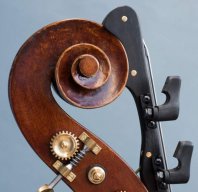
Chuck Traeger's book arrived today and shows how a scarf joint is an economical (for students!) way to shorten the neck. Given the age of my bass (100+) I'm guessing the neck is not original - there are signs of damage and repair in this area - see attached image.

Am I right to assume that necks are far less integral to the original design of the bass?
Certainly on old violins they are routinely replaced while preserving the scroll with a scroll graft. By using a scarf joint to shorten the neck, I would not have to interfer with how the neck is attached to the block, leaving the way clear for both a neck replacement and scroll graft at some future time. I may also be able to get a D stop - which would be nice as I want to use the bass with a big band and a D stop just seems to be more intuitive for me.
 

Attachments

  • WP_000049.jpg
    WP_000049.jpg
    90.1 KB · Views: 149
  • WP_000053.jpg
    WP_000053.jpg
    83 KB · Views: 139
Sorry, didn't answer your question - I have approx 40 cms from where the tip of mt thumb meets the heel of the scroll in the half position, to where my thumb rests in the neck when feeling for an e flat (on the g string).
Here are two more pics:
 

Attachments

  • WP_000048.jpg
    WP_000048.jpg
    77.2 KB · Views: 104
  • WP_000052.jpg
    WP_000052.jpg
    92 KB · Views: 183
Geoff a simple scarf joint will result in a good string length but it won't automatically fix the "stop" to D or Eb ... you'll have to carve away at the heel to get that, or move the bridge, or set the neck deeper. It doesn't look like there's enough wood on the heel to be able to carve much away without weakening that spot so yeah, set the neck deeper IF the block is in good condition, and big enough. Otherwise you'll have to replace or otherwise beef up the block.

Secondly, on the tricky matter of "what the bass will be worth", isn't it a little unfair to expect anyone, even a luthier, to guarantee a sum?

What any bass is "worth" in cash terms is almost invariably less than the owner thinks, if only because the market is small. Practically, what a bass is worth, is what someone is willing to pay for it, and for that you need a willing buyer! I see plenty of people who come in saying hey, this is my bass, it's worth $20,000. But in my opinion, it rarely is. There are simply not people queueing up outside to buy it at that price. Drop the price until you get tire-kickers and then drop it again and unfortunately THEN you're closer to the cash "worth" of the bass!

And "worth" means different things to different people. Replacement value (for insurance purposes) is not necessarily the same thing. Sentimental value will push up the "worth" factor a lot too, as will "pedigree" (who made it, who had it before you etc) ... but won't necessarily push up the sale price.

So ... maybe give the luthiers you spoke to, a break on this one? They don't have a crystal ball ...

(And ... are you saying no-one would actually quote you on repairs to the bass?)
 
lowfreq33 - your suggestion has its attractions, and the Chinese basses which we are now getting here are reportedly getting much better, with good woods (alpine) and excellent craftsmanship featured in more expensive models. Believe me I've considered this ... a good sounding practical instrument that can be amplified is really what I need at the moment. But I do have a bit of history with this bass and I don't have a whole lot of money ... hence my post. Thks for being straight up.

Matthew Tucker - I wasn't thinking when I wrote guarantee - my bad and not my intention to put down luthiers. It was about 6 years ago that I last tried to get a quote to open up the bass up. Maybe the guy I spoke to (in Sydney) just didn't want the work, since then cracks and seams have been repaired (in Melbourne) working from the outside and it doesn't take long before buzzes start to re-appear. With such a long scale I have also been loath to put spirocores on it. When its up to the mark the bass sounds great. Would you like to take a look at it in Sydney?

GeoffBass
 
If the bass is "too much of a handful" for you, then I'd suggest you find a bass that suits your needs and leave this historic model at the original specs. Sell it to someone who wants a bass of those proportions.

Thank you for posting that. It always makes me sad when people cut down a long mensure bass. There are those of us who prefer large basses, but they're hard to find.
 
Geoff a simple scarf joint will result in a good string length but it won't automatically fix the "stop" to D or Eb ... you'll have to carve away at the heel to get that, or move the bridge, or set the neck deeper.

I must disagree. If you currently have a perfect Eb neck with a string length of 111 cm, and if you shortened the neck by 6.1 cm with a scarf joint, you would end up with a perfect D neck with a string length of 104.9 cm with no movement of the bridge and no alterations to the heel or neck joint.

Whether this is a good idea considering the age, history, and quality of your bass I will leave to you and your luthier, but the modification works mathematically.
 
If you shorten the neck, all the notes will move down toward the bridge. Will you be able to play the G octave without over-reaching? Try this experiment: take a piece of leather or similar and slide it under the strings between the nut and the body until you get the string length you want. Now how does it feel? Most people shorten from both the neck and bridge ends to arrive at a comfortable string length. Sometimes that involves cutting down the upper bout of the body because the distance between the neck joint and f-holes is too long. BTW, what does your bass measure there?
 
Back again!
I hope to meet up with Matthew Tucker this week.
Arnoldschnitzer – I have tried your suggestion but using a cable tie and guitar capo – see pic. With speaking length set at 106cms I get a very handy D stop and from there can reach to an F natural. The length of the back is 1102cms and it has a break sloping to the neck so for me reaching to the end of the fingerboard is OK. I’m just under 6 feet tall. The arrangement shown in the pic does not give an upper B natural, but if I do decide to shorten the neck and preserve the fingerboard (as opposed to increasing the false nut from the existing 2cms to 5cms and further reducing the fingerboard length ) then the existing fingerboard length should give me back my B natural and possibly the upper C. I guess if I do decide to extend the false nut to 5cms then the fingerboard should be taken off and re-positioned or replaced. The thing is even with the existing false nut (2cms) I am never really sure that I am in the half position – as the small rise to the chin of the peg-box is not there for reference. I wouldn’t consider reducing the upper bouts as I like the look of this bass, and my technique is not sufficiently advanced in the thumb position.
 

Attachments

  • WP_000056.jpg
    WP_000056.jpg
    50.2 KB · Views: 300