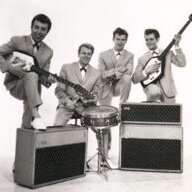
Their bass tone (and production in general) got a bit more polished from album to album, so I guess it depends on which specific song/album you're referring too.
If you're referring specifically to the live version of Guess I'm falling in love, well to me that just sounds like a mic'ed amp that's played LOUD in a less than ideal "room". It might be a J-bass (with the neck pickup soloed), it might be a P-bass, or it might be something else. Bassman? Maybe, but it could also be something else. If I had to make a wild guess, I would say it's at least cab with 15" speakers, but I might be wrong. Of course, a MODERN bass cab, even with 15" speakers, won't sound even remotely like that. Modern bass cabs are way too tight, "hi-fi" sounding and have far too much high frequency extension for that kind of tone. Modern bass amps will also be too tight/"hifi" sounding. And of course, any kind of digital modelling or amp-in-a box pedals won't get you there either. They always end up sounding way too "perfect" and polished for this type of tone.
A Bassman with an original 2x15 cab would probably get you close. But as a cheaper option, even a 70s Peavey solid state amp with a matching 2x15 will probably get you closer than any modern bass amps/cabs (even though modern bass amps/cabs are significantly better from a purely technical perspective).
Of course, a period correct Bassman is only 50w, which isn't much by today's standards. Maybe something like a 100w Showman could be a better choice? Even back then many bass players left the Bassman amps to guitar players and used the more powerful Showman for bass.
And of course, how the bass guitar is perceived for songs like these will also depend on the tone/tuning of the kick drum (and in the case of their first album also the toms) and how it interacts with the bass, especially the attack of the notes.
I honestly don't really hear anything out of the ordinary with the bass tone on any of their studio albums. If anything I would say it sounds like a slightly poorly recorded/mixed bass (by modern standards) at least on their earlier stuff. But it WORKS and it sounds great, even though it's not really a fantastic tone from a purely technical perspective. In addition to using period correct equipment, the key element to getting this kind of tone is probably to not get too obsessed about tone...
Of course, when playing songs like this at live gigs today, the quality of modern PA systems might even work against you, because THEY will also sound too "hi-fi" and modern for this type of music. If you want to recreate the sound of "vintage" VU at a live gig today, you would probably have to either bring a crappy, period correct PA system or it would have to be in a small venue where you don't mic the amps, just CRANK them and go for it.
If you’re referring to the version of GIFIL in post #5, that is
not a “live” version, just merely a demo or studio outtake matched with a collection of random footage of the band, some of it from a gig. There was an officially released live version, pretty much on a bootleg level, that was included in the expanded
White Light/White Heat release, but that ain’t it.
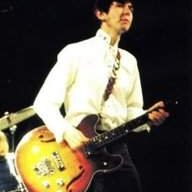
I will reiterate, and as shown in the archival photos above, during his time in the Velvets Cale used a Precision, with a brief dalliance of a Vox Phantom, and a what appears to be a British Vox AC-50 tube head and a single 18” cab, better known as the Foundation rig…
Bill Wyman used those as well in the early days of the Stones, sometimes with two cabinets. It would stand to reason that Cale, from the U.K.(well, Wales)would gravitate towards that brand. When the American Vox company gave the Velvets gear in an endorsement deal, Cale might have ended up with the US solid state equivalent, the Westminster, or a Super Beatle, and perhaps used other amps in a one-off situation, but I’ve not seen any conclusive photos of that.
During the 1993 reunion tour of Europe, Cale certainly used a Jazz Shaped Object, and what looks like an SVT…
The rawness of their studio recordings was a result of circumstance, but it actually enhances their music, and what they were all about. The 1970 album
Loaded, the only one recorded for Atlantic Records at their studios, has always been the odd man out of the VU catalog, as it was almost
too clean, supervised by Beatles/Liverpool associate Adrian Barber. Still a great collection, with classic tunes, it showcases Doug Yule’s growing contributions, but at the same time, Lou had his foot out the door. Mo Tucker was actually not on that album.
If you check out Cam Forrester’s recreations of their material, it turns out he was using Marshall solid state emulator amps housed in Vox head cabs, as well as the old Vox VTX/AD “blue” series heads.