I usually have no problem when singing and playing guitar. But when i try to sing and play bass all kinds of wires get crossed in my brain, just can't do both melody and rythm. Do you guys have any tips to overcome this?

Enjoy the benefits of a premium membership!
Upgrade Account
-
TalkBass has been independent since 1998. Add your voice.
Create a free account to reply to discussions, view embedded media, and browse with fewer display ads.
Join free Log in
Want zero display ads or expanded classifieds tools? Compare plans.
You are using an out of date browser. It may not display this or other websites correctly.
You should upgrade or use an alternative browser.
You should upgrade or use an alternative browser.
How did you manage to start singing?
- Thread starter GPett
- Start date
More options
Who Replied?

Here's a suggestion - Pick a song you really like. Ideally something you already know all the words and bass to, or one that you'd really like to. Level of difficulty should not be too much of an issue if you are already able to play the bass and remember the words. The fact that you like the song may provide impetus to work on it, as mastering it would bring, perhaps, a greater sense of accomplishment than simply learning something as an exercise. My first vocal was "Smoke On The Water" over 50 years ago. It wasn't easy, and I sucked even more at both bass and vocals than I do now, but I loved the song and the joy I felt from being able to do that, however flawed, just stuck and I wanted to try more. Good luck with your new musical adventure!
BBB
BBB

I would watch Sting when he is playing the bass of course. And If you want more challenging then you can go And watch Esperanza Spalding
One requirement even if you are just a backup singer, you need to be at a level you can play without looking at the bass. This may mean you play simpler lines
One requirement even if you are just a backup singer, you need to be at a level you can play without looking at the bass. This may mean you play simpler lines


I feel like it comes naturally to me for the most part. When I feel like it’s tough, it’s because of a syncopation in rhythm where the vocals fall on a rhythm very different than the bass. Then you make a conscious effort to align those difficult parts. The vocals may be the harder part, or the bass rhythms may be the problem. If it’s very difficult that’s when I really slow it down and figure out what my hands need to do vs my mouth lol
it's interesting i play bass guitar, guitar, and mandolin and on each instrument I sort of have to relearn how to deal with singing. I think a lot of it has to do with the register of each instrument on bass I hear the harmonic content much more prominently and those overtones can interfere with my singing which I have to do through my ear I can't like make a note in my voice without my ear

In one of my bands, we were booked for several gigs in different cities and then our singer unexpectedly left. The question was whether to cancel the concerts or find someone else to take over the vocals. I was chosen. I have no idea why, because I don't consider myself a singer. So I had four weeks to learn to play bass and sing simultaneously. Something I'd never done before - apart from some background vocals. It wasn't a question of how I would learn it; I simply had to learn it. The gigs went really well, and the audience feedback was positive. Nevertheless, I was glad we found a new singer shortly afterwards.


It IS difficult. Like many things (sight-reading piano from a brand-new score, for instance), you need to split your brain into separate simultaneous functioning parts. As noted already, that takes lots and lots of practice (and likely some frustration).
How? Because I had to, I developed my own approach during the learning curve that I call “polling”. While training both parts of the brain, I consciously shifted attention back and forth between the bass and the vocal; the more complex the patterns, the more frequent the switch. This is awkward, but as you proceed you’ll find the technique becoming autonomous, and the polling less frequent until it eventually becomes sub-conscious.
If you then stay in practice, you’ll be able to play + sing even new material the first time through (with a little “polling”). It becomes a learned skill. As your split brain learns both parts with repetition, the polling piece goes away.
I was thrown into it the hard way - 6 nights/wk quartet and you HAD to sing. …so I figured this technique out just to survive. I wish you luck and hope this is helpful along with great tips above.
How? Because I had to, I developed my own approach during the learning curve that I call “polling”. While training both parts of the brain, I consciously shifted attention back and forth between the bass and the vocal; the more complex the patterns, the more frequent the switch. This is awkward, but as you proceed you’ll find the technique becoming autonomous, and the polling less frequent until it eventually becomes sub-conscious.
If you then stay in practice, you’ll be able to play + sing even new material the first time through (with a little “polling”). It becomes a learned skill. As your split brain learns both parts with repetition, the polling piece goes away.
I was thrown into it the hard way - 6 nights/wk quartet and you HAD to sing. …so I figured this technique out just to survive. I wish you luck and hope this is helpful along with great tips above.
Last edited:
This is a very important point. The end of each bass note is as important to the rhythm as the start.2. Bass usually requires a lot of aftertouch, while rhythm guitar frequently does not. However, IMHO vocals tend to require quite a bit of after touch as well.
Aftertouch is whatever you do to shape notes after the initial attack.
You also bring up a good point about singing. People say how hard it is to cover songs by The Police but listen to Message In A Bottle and it highlights how rhythmically Sting sings. Phil Collins is another rhythmic singer even when he's singing smoothly.

A hidden suggestion here, songs written by someone who sings & plays bass at once might be easier to sing & play bass at once.I would watch Sting when he is playing the bass of course. And If you want more challenging then you can go And watch Esperanza Spalding

real world Case study: The group I play with is Covering Arctic Monkey's Are You Mine and I'm attempting backup vox.
The bass line and the vocal line are most definitely rhythmically at odds, with vox on 8th note up beats but the bass hitting 16th note anticipations.
So I notated it all out, against reference 16th notes, to find out precisely where both parts align and alternate:
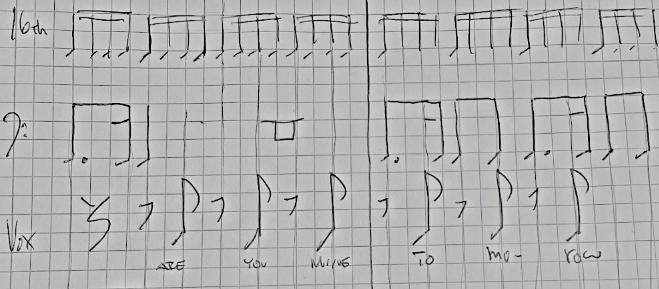
The plan is to slow this down until I can nail it precisely, then gradually bring it up to speed.
The bass line and the vocal line are most definitely rhythmically at odds, with vox on 8th note up beats but the bass hitting 16th note anticipations.
So I notated it all out, against reference 16th notes, to find out precisely where both parts align and alternate:
The plan is to slow this down until I can nail it precisely, then gradually bring it up to speed.
Last edited:
well, geddy lee and les claypool exist, so it may not always applyA hidden suggestion here, songs written by someone who sings & plays bass at once might be easier to sing & play bass at once.


