
Enjoy the benefits of a premium membership!
Upgrade Account
-
TalkBass has been independent since 1998. Add your voice.
Create a free account to reply to discussions, view embedded media, and browse with fewer display ads.
Join free Log in
Want zero display ads or expanded classifieds tools? Compare plans.
You are using an out of date browser. It may not display this or other websites correctly.
You should upgrade or use an alternative browser.
You should upgrade or use an alternative browser.
How do I fix the mid scoop on a PJ?
- Thread starter Elmstreet
- Start date
More options
Who Replied?
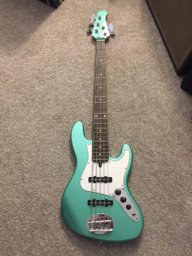
How do I fix the mid scoop on a PJ?
When I'm at home practicing and messing around with my tone, I like the clarity and the way drive/grind sounds when P and J are both on full.
When I get to rehearsal or to a gig I just disappear in my band that has 2 distorted guitars. I end up just favoring the P pickup for the gig or rehearsal.
The problem with this, is that my overall tone and drive sound way different with just a P pickup, so all time I've spent messing with my tone and getting my "grit" just right is all changed. Everything gets muddy, I have less note definition, it's like I turned on a fuzz pedal and increased the gain.
I'm learning about the "scoop" that happens with J basses and PJ basses, which makes sense as to why I'm disappearing in the mix. As I'm doing research on how to potentially fix this issue, I've come across a few different potential solutions, but I would love some feedback.
- Series / Parallel switch mod
- Swapping to mid heavy PJ set (Dimarzio Model PJ)
- Increase mids on amp/preamp to counteract the scoop
For context, I'm referring to a parts bass that has EMG Geezer PJ pickups.
I was just about to order a set of Dimarzio Model PJ pickups thinking that was the problem but I figured I better ask the experts.
Any and all feedback would be appreciated.
Consider an active pre to boost low mids and tame highs while in PJ mode to overcome the disappearance of meat!
compressor pedal might help too to round out the low and pull up those mids. I love the keeley bass limiter. I used a dbx 160a once and it really rounded out and made me more present with a J in a rock setting.

The frequency range of the scoop(s) changes with the length of the string (ie position on the fretboard) and the pitch the played note is tuned at- so the frequencies that are notched out or boosted via phase cancellation/reinforcement are different with every different note across the fretboard. Since the pickup locations are fixed but both the pitch of the notes played and length of the string change as you move across the fretboard so too do the frequencies affected. This is why the J-bass frequency plots show the scoop move depending on the open string being played, but it will move in different ways when you move up and down the fretboardGraphs on this page. Of course specific dips will change depending on pickups and location but gives you a visual.
Make a J bass sound like a P bass
Last edited:

The link below has the math to show that the scoop is different for each string, but the same for different positions on the same string (also seems to be the source for the graphs of the previously linked page, so more graphs to support this as well):
What is the "Jazz Bass Mid Scoop"?
What is the "Jazz Bass Mid Scoop"?


Interesting and informative article, @Rootzilla, thanks for posting it. I didn't suspect the mid scoop would stay at about the same freq when playing different notes along the same string.
The author actually mentioned the solution of removing the mid-scoop in one sentence. "When the pickups are set to different volumes, the scoop goes away and the mids return." And most of us have experienced that. But he never followed up on that statement.
In other words, by providing some resistive isolation (which is what backing off one pot does) between the two pickups, you get the mids back.
So it seems by adding a fixed resistor to the output of one, or the other, of the pots would provide a permanent electrical isolation between the two pickups. Crank both Volume knobs to 10 and there will be an isolation resistor already in place to keep the mid freqs.
Personally, I'd use a trim pot as an adjustable resistor. If the player makes any changes to the bass (change pickups, change wiring, etc), the mid-scoop freq might shift. The trim pot would allow a quick adjustment to get the proper isolation again. Sure beats removing and replacing a fixed resistor LOL.
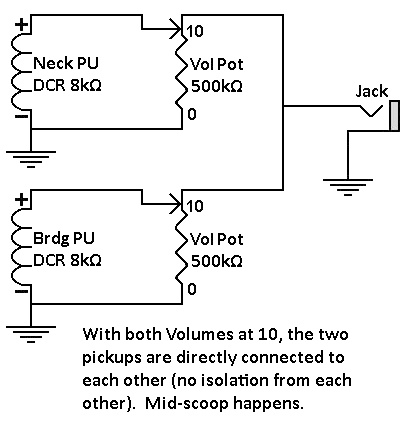
Ok, so this schematic of a very simple two pickup parallel circuit shows both Vols at 10 where the mid-scoop happens. That's because the two pickups are directly connected together (no intervening resistance/isolation from each other.).:
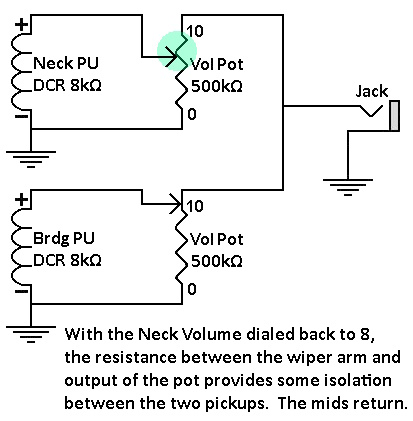
Next pic is with the Neck dialed back to, say, 8. Dialing back either Volume pot restores the mids. That's because dialing back now puts a resistance between the two pickups. With a linear pot of 500kΩ dialed back to 8, resistance would be about 100kΩ measured between the wiper arm and pot output terminal. Listen to those lovely, lovely mids.:
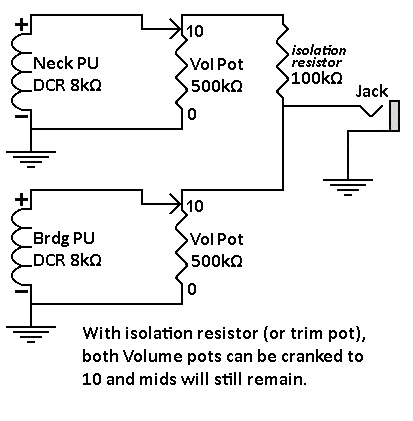
So, it follows that adding a fixed resistance (or trim pot), approximately equal to 100kΩ, will provide a permanent 'mids keeper' function when both volumes are cranked to 10.:
Anyway, the reasoning and logic are solid. The numbers I used are pulled out of thin air for ease of explanation. Each bass will be different, so the player has to determine the isolation resistor value for their own bass. Determining that value is easy to do, but since this post is getting long, I'll explain later if asked.
So, instead of spending money on a preamp or changing to new pickups, adding a resistance on one volume output leg would be among the least expensive things I'd try to keep the mids when both volumes are full on. Just costs a couple of bucks and some soldering time.
The author actually mentioned the solution of removing the mid-scoop in one sentence. "When the pickups are set to different volumes, the scoop goes away and the mids return." And most of us have experienced that. But he never followed up on that statement.
In other words, by providing some resistive isolation (which is what backing off one pot does) between the two pickups, you get the mids back.
So it seems by adding a fixed resistor to the output of one, or the other, of the pots would provide a permanent electrical isolation between the two pickups. Crank both Volume knobs to 10 and there will be an isolation resistor already in place to keep the mid freqs.
Personally, I'd use a trim pot as an adjustable resistor. If the player makes any changes to the bass (change pickups, change wiring, etc), the mid-scoop freq might shift. The trim pot would allow a quick adjustment to get the proper isolation again. Sure beats removing and replacing a fixed resistor LOL.
Ok, so this schematic of a very simple two pickup parallel circuit shows both Vols at 10 where the mid-scoop happens. That's because the two pickups are directly connected together (no intervening resistance/isolation from each other.).:
Next pic is with the Neck dialed back to, say, 8. Dialing back either Volume pot restores the mids. That's because dialing back now puts a resistance between the two pickups. With a linear pot of 500kΩ dialed back to 8, resistance would be about 100kΩ measured between the wiper arm and pot output terminal. Listen to those lovely, lovely mids.:
So, it follows that adding a fixed resistance (or trim pot), approximately equal to 100kΩ, will provide a permanent 'mids keeper' function when both volumes are cranked to 10.:
Anyway, the reasoning and logic are solid. The numbers I used are pulled out of thin air for ease of explanation. Each bass will be different, so the player has to determine the isolation resistor value for their own bass. Determining that value is easy to do, but since this post is getting long, I'll explain later if asked.
So, instead of spending money on a preamp or changing to new pickups, adding a resistance on one volume output leg would be among the least expensive things I'd try to keep the mids when both volumes are full on. Just costs a couple of bucks and some soldering time.
Last edited:

Get your grit right at home with just the P pickup. You know this to be an issue, don't wait for rehearsal to address it.How do I fix the mid scoop on a PJ?
When I'm at home practicing and messing around with my tone, I like the clarity and the way drive/grind sounds when P and J are both on full.
When I get to rehearsal or to a gig I just disappear in my band that has 2 distorted guitars. I end up just favoring the P pickup for the gig or rehearsal.
The problem with this, is that my overall tone and drive sound way different with just a P pickup, so all time I've spent messing with my tone and getting my "grit" just right is all changed. Everything gets muddy, I have less note definition, it's like I turned on a fuzz pedal and increased the gain.
I'm learning about the "scoop" that happens with J basses and PJ basses, which makes sense as to why I'm disappearing in the mix. As I'm doing research on how to potentially fix this issue, I've come across a few different potential solutions, but I would love some feedback.
- Series / Parallel switch mod
- Swapping to mid heavy PJ set (Dimarzio Model PJ)
- Increase mids on amp/preamp to counteract the scoop
For context, I'm referring to a parts bass that has EMG Geezer PJ pickups.
I was just about to order a set of Dimarzio Model PJ pickups thinking that was the problem but I figured I better ask the experts.
Any and all feedback would be appreciated.
That said, try backing off the gain. A lot of players use too much and lose the attack on their sound.
Or, don't run the pickups 50/50. Favor one or the other and you will reduce the mid cancellation quite a bit

Amongst all the other really cool electronics features of the venerable Fender Roscoe Beck basses (and their Stevens predecessors), you can pull one of the pots to engage a resistor inline with the neck pickup, effectively reducing the neck pickup volume and favoring the bridge pickup. It's really kind of genius because the bass has a 3-way pickup select, but this gives you a 4th option in the mid position that's equivalent to backing off the neck pickup just a tad. For a PJ, I would favor the P pickup in that configuration.
Always fire the drummer first, then fire the guitarists. Play with your scooped tone in your bedroom. Profit!Fire the guitarists.
Get your grit right at home with just the P pickup. You know this to be an issue, don't wait for rehearsal to address it.
That said, try backing off the gain. A lot of players use too much and lose the attack on their sound.
Or, don't run the pickups 50/50. Favor one or the other and you will reduce the mid cancellation quite a bit
It's true, I should just dial things in for the P pickup and then adjust EQ with the band.
Thanks for the feedback everyone! I got a ton of good info and suggestions, TalkBass rules. 
The 34 seconds from the moment demo should start at (7'16") is a delicious demonstration of how well either of these will work:As @ctmullins suggests, rolling off one of the volumes will reduce the effect. I usually reduce the bridge J-pickup volume a tad, but reducing either one will work.
I was curious about their switchable resistor solution and found a schematic for the Roscoe Beck 4 (solution is same for the 5 version). Here's a schematic and wiring diagram from Cadfael's magnificent bass compendium.:Amongst all the other really cool electronics features of the venerable Fender Roscoe Beck basses (and their Stevens predecessors), you can pull one of the pots to engage a resistor inline with the neck pickup, effectively reducing the neck pickup volume and favoring the bridge pickup. It's really kind of genius because the bass has a 3-way pickup select, but this gives you a 4th option in the mid position that's equivalent to backing off the neck pickup just a tad. For a PJ, I would favor the P pickup in that configuration.

It's a simple solution (I like simple LOL). When Neck or Bridge are solo'd, the resistor can't be used. Only when the Pickup Selector is set to Both can the resistor be selected (no mid scoop) or deselected (mid scoop). The Tone push/pull switch and resistor combo is called a Mid-Shaping Circuit according to literature I read.
Found out the pickups were designed by Bill Lawrence for Fender and they are rather unique, which may be the 'secret sauce' behind the sound.
The Lawrence pickups and Mid-Shaper function are the only special items in the bass. The pickup's two coil selection switches, the pickup selector switch, and the cap and pot values are common fare.
Thanks for mentioning the Roscoe Beck bass. Nice learning experience for me.

For folk passin' thru, adding a resistance to one (of two) legs of a parallel circuit will keep your mids when both volumes are maxed or a blend pot is centered (post 106 for explanation). There were some other methods mentioned in this thread to prevent mid-scoop, so explore your options.
Of course, the simplest way is to dial one volume back or un-center the blend pot LOL. But some folk might find it more convenient by just actuating a switch than futzing with knobs.
Last edited:


Hey Fig, I rewired my PJ like a P but with both pickups in series. There is almost no scoop and it maintains a more tradition P sound but with some added clarity on the top end and more meat on the bottom end. I find that going with a 250k pot for volume works great like a low pass filter rolling of some of the very top end, like just past fret noise. Rolling the tone down 30% brings the sound of the 2 pickups in series back to a more traditional P sound.I was curious about their switchable resistor solution and found a schematic for the Roscoe Beck 4 (solution is same for the 5 version). Here's a schematic and wiring diagram from Cadfael's magnificent bass compendium.:
View attachment 5490229
It's a simple solution (I like simple LOL). When Neck or Bridge are solo'd, the resistor can't be used. Only when the Pickup Selector is set to Both can the resistor be selected (no mid scoop) or deselected (mid scoop). The Tone push/pull switch and resistor combo is called a Mid-Shaping Circuit according to literature I read.
Found out the pickups were designed by Bill Lawrence for Fender and they are rather unique, which may be the 'secret sauce' behind the sound.
The Lawrence pickups and Mid-Shaper function are the only special items in the bass. The pickup's two coil selection switches, the pickup selector switch, and the cap and pot values are common fare.
Thanks for mentioning the Roscoe Beck bass. Nice learning experience for me.
For folk passin' thru, adding a resistance to one (of two) legs of a parallel circuit will keep your mids when both volumes are maxed or a blend pot is centered (post 106 for explanation). There were some other methods mentioned in this thread to prevent mid-scoop, so explore your options.
Of course, the simplest way is to dial one volume back or un-center the blend pot LOL. But some folk might find it more convenient by just actuating a switch than futzing with knobs.

