• TalkBass has been independent since 1998. Add your voice.
    Create a free account to reply to discussions, view embedded media, and browse with fewer display ads.
    Join freeLog in
    Want zero display ads or expanded classifieds tools? Compare plans.

How do you combat Neck Dive?

I read your explanation of your situation and gave my opinion. It wasn't meant to bash you or your bass in any way. From my perspective, I don't play basses that neck dive, period. There are many that don't. I hope the suggestions regarding straps and or tuners in this thread alleviate your issue. Clearly that would be the best solution. However, if it doesn't, and you find that the neck dive with this particular bass hampers your enjoyment of playing bass, finding a different instrument that works better for you is a real option. That's all I was trying to convey.

Best Wishes,
Bones
 
  • Like
Reactions: SteveCS
I once owned an exceptionally light P-Bass that would dive unless I used a plain old split leather strap. You know, the type that is rough on one side. With that strap, it balanced, teetering on the front strap button, but never dove.
 
The only bass I own with any significant neck dive is my US Peavey Fury. I use a wide soft leather padded strap and this does the job for me.

I'm usually pretty particular about what I buy and try to avoid neck dive basses.
 
You can't compare fender style basses to les paul, jaguar, explorer, thunderbird etc, with short or no upper horn. Fender style basses have strap buttons located between 11 and 12th fret. No neck dive at all with the strap on. But sitting down with no strap on, even fender style basses neck dive.

look for a bass with the upper horn to be in line(or further to the headstock) w/ the 11th fret-wire. Unfortunately, this leaves out Les Paul and Jaguar shapes(which I happen to like quite a bit) and many P and J shaped basses as well. Anything else is really a band-aid. And before I get flamed for this, I know you'll disagree and I've heard it all before:
I know straps can help hold the bass up. They "help", but they don't solve the problem of the natural balance of the bass.
A heavier body(or bridge or anything on that side) does alleviate the balance problem, but has the severe downside of extra stress on my shoulders.
Lighter tuners also adjust the balance w/out extra stress, so they'd be the best option if you're really intent on fixing a "bad" balance.

But I've found nothing as effective as an "extra long" upper horn. And "Extra long" is usually nothing more than 1/2" longer than most standard shapes(except the LPs... :-(). It's such a shame, really...

Oh, and I bet headless designs are more balanced, but I've only ever picked up a Traveler headless and it's body is so light and with such a short horn that it neckdived too.
 
I've been considering the strap buttons (bringing that back one a bit higher) to my very neck-divy bass. How much does it change balance? If it makes only a little difference I won't bother since it woudln't be enough to balance that bass
It's definitely worth it. It's not just about releasing your fretting hand from the job of holding the neck up- even if you balance things out by using a grippy strap, there's still a force constantly pulling at your neck and shoulder.

Dingwall recently started offering a fix that I'm planning to implement on my other basses. Very simple, and one $14 pair of Dunlop flush-mount straploks will take care of two basses.

Make sure that you give Sheldon the credit!

Here's a repost from another thread:

"Recently got a lightweight bass that balances perfectly and has strap buttons placed so that it can hang securely at about a 40-45 degree angle.

This allows the bridge end of the bass to ride lower (looks cooler than wearing my bass like a necktie, also uncranks my wrist on the plucking side), pulls the headstock in closer to my body (reduces stress on my neck and shoulder, lets me play a bass with a longer, better-sounding bottom string), and keeps the headstock high (reduces stress on my fingering hand).

I've gone from having chronic back and shoulder pain on longer gigs to having none, overnight. Without buying weird-looking, expensive specialty straps."

3c455292-e18f-4dab-91a0-837308473550_zpsba92a5df.jpg


Dingwallonstrap1_zpsd8a94a89.jpg
 
You can't compare fender style basses to les paul, jaguar, explorer, thunderbird etc, with short or no upper horn. Fender style basses have strap buttons located between 11 and 12th fret. No neck dive at all with the strap on. But sitting down with no strap on, even fender style basses neck dive.

Sitting down is a different situation and I agree that LP, Jag and Thunderbirds are all awful from the point of neck dive.

However, in my experience, Fenders also have the same problems. Like you said, it's between 11 and 12. My contention is that it should be between 10 and 11. It's not a huge adjustment, but it makes a huge difference.
 
  • Like
Reactions: DavesnothereCA
How do I combat Neck Dive? The short answer is; I don't. Out of 16 basses, I have only 2 that do this; I knew that they would when I bought them. I simply live with it.

The long(er) answer - and I'm speaking for ME, not trying to preach the Gospel, here:
-What is Neck Dive? Different things to different people, judging from what I've read (this comes up a lot!). On one extreme are people who think that any bass that moves at all when they let go of it and jump around like a loon, has Neck Dive. On the other extreme, are people (like me) who think Neck Dive means a bass whose headstock heads for the floor all by itself, when you stand still and take your hands off it. Everything else, like "it wants to settle parallel to the floor", is somewhere in between. Pick any bass ever made, and somebody here on TB has complained "it's neck heavy!" Or, they will soon. ;)
-Who is right? We all are. It's a personal thing. All of us are different heights, weights, and builds; of course any bass will feel different for me than it does for you. If you think a particular bass has Neck Dive, then, of course, it does- for you. Not neccessarily for me, or anyone else, though.

Personally, most of my basses stay pretty much where I want them; but, I tend not to move around a lot when I play, anyway. The P-Bass, the Carvin, and the 2 Ricks, are the "parallel to the floor" crew; I think the Kramer Forum III will be another, when it's restored. However, that's close to how I play sometimes, and the right strap will keep them where I want them, anyway. I even have a bass that's (for me) Butt Heavy; a Kramer Duke. Weird feeling, lemme tell ya! The Neck Divers? Gibson Thunderbird (Duh!) and a Kramer 450B. Holding up the T-Bird is about like holding up a Big Mac; I'm not too feeble for that - yet. The Kramer? That's like holding up an iron skillet; not something any sane person wants to do for long. I think the tone is worth a little suffering, though; it's not called Lucifer's Hammer for nothing.:D
 
  • Like
Reactions: markroman
I apologize if there is a better section for this to be in.

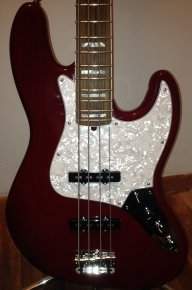
I love my bass, and I'm not sure if its common with all basses, but my guitars never did this. There is a bit of neck dive that causes the bass to settle about parallel with the ground. The neck is at that point too low for me to comfortably play, so I end up holding the neck up which I'm sure ultimately hurts my potential in playing.

What do you do to fight it?
What do *I* do to fight it? I play headless basses. ;o)

But if you really like the bass you have, your options are:
  1. Use a wider, grippier strap, possibly with a contour for the shoulder. Probably your best bet if you've only got slight drop.
  2. Modify the bass to make the headstock lighter, i.e. change tuners.
  3. Add weight to the tail of the bass. Rather than modify the bass itself, I prefer the idea of hanging a small pouch full of lead shot off the tail strap button.
  4. Move the strap buttons - not always possible, but it would work.
  5. Play the bass oriented more vertically. I've never had much luck here, but there are Gibson EB- players who swear that so long as they hang the bass with the body low and the headstock high, the neck drop isn't a problem.
 
I see threads like this all the time and to be honest, I don't see what the big deal is. I own Fenders, Alembics and Spectors and they all dive a little but not to the point where I feel like I am holding them up to play them properly. A wider strap with a suede backing can help but there really is no way to avoid it.
 
I see threads like this all the time and to be honest, I don't see what the big deal is.

LOL! Try living in my body with its upper spine injuries and related osteoarthritis coupled with TMJ. The extra weight that the leverage of a less than perfectly balanced instrument puts on my shoulder and neck is a real big deal. One thing TalkBass is never short of is people ready to judge the rest of us based exclusively on observations of their own personal needs and perception of reality.
 
  • Like
Reactions: DavesnothereCA
I think this would benefit me. How much higher should the bridge strap button be moved? A small amount like 1/2 inch, or something along the lines of 2 inches?

Well, when it comes to neck dive every little bit helps, but moving the rear button up really only helps a little bit. I have a Carlo Robelli 8 string that had major severe T-bird level neck dive. I moved the rear button up about an inch and a half. I got a wide sticky strap and they both helped a little bit. But the only real cure is to change your balance point. Think of your bass as a set of scales (You know like blind lady justice is holding) The balance point will be the front strap button. If you support the bass by the strap only on the front button and the neck tilts down you'll have "dive". Since it's a balance, removing weight from the headstock (using lite tuners) will help tilt it back.

But the only real true fix is to move your balance point forward toward the 12th fret. On a proper bass that is what the upper horn is for. Basses without an upper horn (my Carlo, T-bird etc.) have just too much weight beyond the balance point. So on mine I got a 3" piece of tubing and a super long screw and moved the strap button out away from the bass and toward the 12th fret. It isn't quite there, but with the total of all the things, neck dive is all but gone!

A button extender looks a bit hokey, but as far as I'm concerned it sure beats holding the neck up with your left hand all night! One of these days I"ll get a decent 8 string and I can forget about the problem.
 
  • Like
Reactions: DavesnothereCA
...moving the rear button up really only helps a little bit.

...If you support the bass by the strap only on the front button and the neck tilts down you'll have "dive". Since it's a balance, removing weight from the headstock (using lite tuners) will help tilt it back.

...on mine I got a 3" piece of tubing and a super long screw and moved the strap button out away from the bass and toward the 12th fret.

...A button extender looks a bit hokey, but as far as I'm concerned it sure beats holding the neck up with your left hand all night!

Agreed about moving the rear strap button up. The regular button on my Dingwall is a few inches north of the normal Fender position, and it only shifts the balance point slightly.

But that doesn't mean that you can ignore the rear button (unless you hang your bass by a single loop from the front button, like it's a tenor sax).

The flush-mount Straplok on the back of my ABZ is closer to the center line than the rear button. What really matters though, is that it's moved forward, closer to the 12th fret. This moves the whole bass to the right a few inches, and puts some of the body mass PAST the rear strap button, as if you had extended the body.

This moves the balance point just as much as extending the front button, shortening/lightening the headstock, or hanging a counterweight off the back end of the body. The extra Straplok socket only weighs a few grams, and it's safer and better-looking than leaving an unsupported screw sticking three inches out of the upper horn...
 
It's definitely worth it. It's not just about releasing your fretting hand from the job of holding the neck up- even if you balance things out by using a grippy strap, there's still a force constantly pulling at your neck and shoulder.

Dingwall recently started offering a fix that I'm planning to implement on my other basses. Very simple, and one $14 pair of Dunlop flush-mount straploks will take care of two basses.

Make sure that you give Sheldon the credit!
3c455292-e18f-4dab-91a0-837308473550_zpsba92a5df.jpg

I've done something similar (but not quite) to a neck-heavy Jaguar. Works great! The whole bass is shifted to my right (to the plucking hand side), and it's great for left, as for right hand.

But now I have a problem: Where do I put the cable through, so it doesn't unplug if I step on it? The strap location before worked great for it :-\
 

Latest posts