• TalkBass has been independent since 1998. Add your voice.
    Create a free account to reply to discussions, view embedded media, and browse with fewer display ads.
    Join freeLog in
    Want zero display ads or expanded classifieds tools? Compare plans.

Double Bass How do you deal with loud rooms?

The gig of these times -- you hope no one shows up! I like to wear earplugs in these situations. It makes everything softer, including the band, but I find that I can zone in on the music more if the sound is not overwhelming and have a shot at enjoying myself. Playing louder just feeds a vicious cycle. The band needs to play softly for themselves. Think of the old days when the unamplified bassist had to really dig into the sound to hear themselves. FWIW these are the earplugs I have. They're cheap and seem to attenuate frequencies fairly evenly and accurately.
Etymotic Research ETY-Plugs High Fidelity Earplugs - Standard Fit | Sweetwater Invalid Link Removed
 
My band, a five-piece with two saxes and clarinet, has a regular gig in a 50-seat bar. A key factor for us is the reliable participation of partner dancers, who typically occupy most of the space near us and, important point, are usually dancing, and chatting less. Our bartenders need to be able to hear their customers clearly for good service, and I've learned that if I can't hear people talking in the back of the bar during the set, we're too loud. I've also learned that we play better when we play softer. This is physically challenging for my sax players, but they've learned that when we all back off we can hear each other better and get a smoother blend. So playing softer and pitching the set for dancing has been win-win for us.
 
My usual process is to EQ the bass to the space, sweep the mids for clarity, and add a bit of high end to taste. Though in louder rooms, that high end tends to get swallowed pretty quickly.
If you are looking for clarity and presence for your own monitoring, you might find the PJB Ear Box useful...

 
  • Like
Reactions: Michael Drost
The gig of these times -- you hope no one shows up! I like to wear earplugs in these situations. It makes everything softer, including the band, but I find that I can zone in on the music more if the sound is not overwhelming and have a shot at enjoying myself. Playing louder just feeds a vicious cycle. The band needs to play softly for themselves. Think of the old days when the unamplified bassist had to really dig into the sound to hear themselves. FWIW these are the earplugs I have. They're cheap and seem to attenuate frequencies fairly evenly and accurately.
Etymotic Research ETY-Plugs High Fidelity Earplugs - Standard Fit | Sweetwater Invalid Link Removed

Yes! I was just going to say to try earplugs. Cuts down on the chatter, and I can focus in on the bass better.
 
Yes! I was just going to say to try earplugs. Cuts down on the chatter, and I can focus in on the bass better.
Another vote for earplugs, and these specifically. I've used Etymotic and Hearos Hi-Fi plugs and they do a good job of turning down the inevitable roar on these types of gigs. A longtime bassist and friend of mine here in town calls these gigs 'Combat Jazz' gigs - where you're going into battle to hear yourself and make music.
 
When I started playing professionally back in the 60s I played ampless for several years. Something that seems counter-intuitive is that when I did start using an amp on the club gig I had been playing I couldn't hear myself as well as before and a couple of the older guys in the band said the same thing. I know there have been equipment improvements, etc. but there's something about the way we perceive the sound of the bass that is different IMO. I'm not saying we should go back, but as an experiment I would suggest playing briefly with the amp off and see what you think. It might be an ear opener and give a different perspective on what the amp really does. JMO
 
When I started playing professionally back in the 60s I played ampless for several years. Something that seems counter-intuitive is that when I did start using an amp on the club gig I had been playing I couldn't hear myself as well as before and a couple of the older guys in the band said the same thing. I know there have been equipment improvements, etc. but there's something about the way we perceive the sound of the bass that is different IMO. I'm not saying we should go back, but as an experiment I would suggest playing briefly with the amp off and see what you think. It might be an ear opener and give a different perspective on what the amp really does. JMO

It's weird trying to do un-amplified gigs these days for sure. Being un-amplified CAN work if the room is small, you can wedge yourself in the corner to get the benefit of the low-end bump by doing so, and everyone you're playing with (especially keyboardists and guitarists) can keep THEIR volume down. Usually that's the deal breaker. I love playing totally un-amplified in a great room where I can truly hear myself. It's a joy. Sometimes there's a node or phase issue and the amp causes more problems than it fixes. Been there before. A drummer and a keyboardist can easily and quickly render us inaudible to ourselves, especially since we don't have the benefit of hearing ourselves out in front of the bass for the sound to develop the way the audience, etc hears us. Keyboardists with that thick, chunky low end with their left hand can really do a number on that volume/tone perception.

The amp usually, in my case anyway, is there mostly to give a little extra support right in the low end, with a sculpted midrange so I don't play too hard to be heard, and I can preserve my fingers for the length of the gig by not digging in so much. I also ended up adding an Aguilar DB316 midrange EQ pedal to my rig so that I have at least 2 different sweepable EQ controls at hand (including the one on my Radial ToneBone PZ Deluxe), so I can REALLY dial things in to the room without necessarily having to raise the volume.
 
Last edited:
Another factor to consider is that the band can be the instigator of crowd noise, aggravating the situation. Many (imho, most) combos just play too loud for the room, and it mightn't hurt to try backing off on the volume to see whether it helps.
I remember my first gig with my dad. Up to that point I was playing rock gigs, I was a kid. My dad’s thing was Jazz combo. So I jump in on the first tune kinda blasting not understanding this was supposed to be at dinner and drinks conversation level. After that song my dad tells me to put my volume back, I am too loud. But he also tells me, “don't worry, we’ll get ‘em on the second set after the drinks hit!” Sure enough after the first couple of songs in the second set they were asking us to tune up for what appeared to turn into the dance set 😊
 
  • Like
Reactions: fdeck
I remember my first gig with my dad. Up to that point I was playing rock gigs, I was a kid. My dad’s thing was Jazz combo. So I jump in on the first tune kinda blasting not understanding this was supposed to be at dinner and drinks conversation level. After that song my dad tells me to put my volume back, I am too loud. But he also tells me, “don't worry, we’ll get ‘em on the second set after the drinks hit!” Sure enough after the first couple of songs in the second set they were asking us to tune up for what appeared to turn into the dance set 😊
 
I've always found a high/low pass filter to help with shaping the sound to a room. Not always a complete fix. But better with it.

 
My band, a five-piece with two saxes and clarinet, has a regular gig in a 50-seat bar. A key factor for us is the reliable participation of partner dancers, who typically occupy most of the space near us and, important point, are usually dancing, and chatting less. Our bartenders need to be able to hear their customers clearly for good service, and I've learned that if I can't hear people talking in the back of the bar during the set, we're too loud. I've also learned that we play better when we play softer. This is physically challenging for my sax players, but they've learned that when we all back off we can hear each other better and get a smoother blend. So playing softer and pitching the set for dancing has been win-win for us.
My duo (bass, acoustic guitar, vocals) has found this works at open mics and afternoon pub gigs. We use a single LDC mic to lift the volume a bit, but with the clarity of playing unplugged. It really catches the audience's ear - after that, it depends if they decide this is a song for listening to or talking over 😄 But being quieter and clearer than people are used to can be a good strategy.

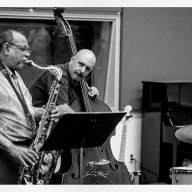
 
When I started playing professionally back in the 60s I played ampless for several years. Something that seems counter-intuitive is that when I did start using an amp on the club gig I had been playing I couldn't hear myself as well as before and a couple of the older guys in the band said the same thing. I know there have been equipment improvements, etc. but there's something about the way we perceive the sound of the bass that is different IMO. I'm not saying we should go back, but as an experiment I would suggest playing briefly with the amp off and see what you think. It might be an ear opener and give a different perspective on what the amp really does. JMO
Yes. When I was in high school (1967 or so), the only double bassist there always played the school's bass, a Kay, in a variety of contexts. It was never amplified, and I could always hear it, even in our 1000-seat auditorium. or outside . Bass carries.
 
Often times earplugs actually help me hear the bass better, as the cymbal noise and crowd noise are diminished while the bass's pitch is still mostly audible.
My 11-piece band played yesterday evening. I removed my hearing aids - which tend to increase "crispiness" - and "heard better."
 
  • Like
Reactions: John Chambliss
Yes. When I was in high school (1967 or so), the only double bassist there always played the school's bass, a Kay, in a variety of contexts. It was never amplified, and I could always hear it, even in our 1000-seat auditorium. or outside . Bass carries.
Yes it does, depending on the venue of course.;) I can get a beautiful sound in small to medium sizeauditorium. By comparison, a small club can be a real challenge. All I can say is that " it really depends on "............ as Buckaroo Banzi so aptly put it "no matter where you go,..... there you are. "
 
  • Like
Reactions: AGCurry

Latest posts