10/10 joke haha. But thank you man!How do you Define a Position for Electric Bass?
Stage left, next to the drummer.
I play one finger/per fret at the upper positions, and down the neck when I'm playing a melody. Other than that, I sometimes omit the ring or middle finger at the lower positions depending on what I'm playing.

Enjoy the benefits of a premium membership!
Upgrade Account
-
TalkBass has been independent since 1998. Add your voice.
Create a free account to reply to discussions, view embedded media, and browse with fewer display ads.
Join free Log in
Want zero display ads or expanded classifieds tools? Compare plans.
You are using an out of date browser. It may not display this or other websites correctly.
You should upgrade or use an alternative browser.
You should upgrade or use an alternative browser.
How do you Define a Position for Electric Bass?
- Thread starter RT25897
- Start date
More options
Who Replied?


In the Simandl double-bass method, each 'position' encompasses 3 notes covering a single whole tone. The only exception is the "Half' position which covers 4 notes because it includes the open strings:
On the G string
...
II: Bb, Cb/B, C
There is an 'intermediate' position between II and III that covers B/Cb, C & Db/C#
III: C, C#/Db, D
There is an 'intermediate' position between III and IV covering Db/C#, D, D#/Eb
IV: D, D#/Eb, E
...
Whoa! What edition of Simandl are you using? Mine's "Newly Revised and Edited by Stuart Sankey, Part I", copyright 1968. There are no intermediate positions. Omitting enharmonics for brevity:
2nd: Bb-Cb-C
3rd: Cb-C-Db
4th: C-Db-D
etc. all the way up chromatically.
-

I started on upright using the Simandl positions and fingering. Eventually I transitioned to one finger per fret on bass guitar and stayed with Simandl on upright.
I stopped thinking in terms of positions long ago. IMHO it's far better to simply now the finger board, so that you place your hand and know what will fall under your fingers at every fret. Scotts Bass Lessons expands this to +/- 1 fret I believe, although they call it 4+2.
I do think in terms of basic hand shapes or box patterns. The minor hand shapes starts with the root of the key under the index finger. So if you are playing in G minor your index finger would start on 3rd fret of the E string. With OFPF you can play an full octave natural minor or major scale without shifting
The major hand shapes starts with the root of the key under the middle finger. So if you are playing G major, your index finger would start on 3rd fret of the E string.
This idea can be expanded to cover the modes. I categorize them into either mostly major shapes or mostly natural minor shapes.
Major
Ionian
Lydian #4
Mixolydian b7
Minor
Dorian #6
Phrygian b2
Aeolin
Locrian b2, b5
I am using a bit of shorthand here to identify which mode degree varies from the Major or minor patter. # mean raised by 1/2 step and b means lowered by 1/2 step.
You can also derive additional modes from harmonic minor and jazz melodic minor. But I have never been able to keep all of the shapes straight in my head.
In all honesty, I don't generally think in terms of modes while playing, but I think it can be good to practice them for a range of reasons: Studying modes gives you a deeper and more intuitive understanding of key centers. Studying modes also teaches you useful finger patterns. Although you may not necessarily thing in terms of the mode, you still use the finger patterns.
I stopped thinking in terms of positions long ago. IMHO it's far better to simply now the finger board, so that you place your hand and know what will fall under your fingers at every fret. Scotts Bass Lessons expands this to +/- 1 fret I believe, although they call it 4+2.
I do think in terms of basic hand shapes or box patterns. The minor hand shapes starts with the root of the key under the index finger. So if you are playing in G minor your index finger would start on 3rd fret of the E string. With OFPF you can play an full octave natural minor or major scale without shifting
The major hand shapes starts with the root of the key under the middle finger. So if you are playing G major, your index finger would start on 3rd fret of the E string.
This idea can be expanded to cover the modes. I categorize them into either mostly major shapes or mostly natural minor shapes.
Major
Ionian
Lydian #4
Mixolydian b7
Minor
Dorian #6
Phrygian b2
Aeolin
Locrian b2, b5
I am using a bit of shorthand here to identify which mode degree varies from the Major or minor patter. # mean raised by 1/2 step and b means lowered by 1/2 step.
You can also derive additional modes from harmonic minor and jazz melodic minor. But I have never been able to keep all of the shapes straight in my head.
In all honesty, I don't generally think in terms of modes while playing, but I think it can be good to practice them for a range of reasons: Studying modes gives you a deeper and more intuitive understanding of key centers. Studying modes also teaches you useful finger patterns. Although you may not necessarily thing in terms of the mode, you still use the finger patterns.

Whoa! What edition of Simandl are you using? Mine's "Newly Revised and Edited by Stuart Sankey, Part I", copyright 1968. There are no intermediate positions. Omitting enharmonics for brevity:
2nd: Bb-Cb-C
3rd: Cb-C-Db
4th: C-Db-D
etc. all the way up chromatically.
-
It's old - 1904! But it makes no difference unless you think in terms of position, which I rarely do these days. The notes for a given hand placement are the same. But it does matter if you have a score with annotated positions! As @Wasnex says - better to just know the fingerboard. Just that the OP question was about 'positions'.

Sankey renamed the positions to just ascend by half steps, but he kept the naming of the position at Ab-A-Bb “half position”. The Zimmermann/Drew edition (which is mostly faithful to the first edition) retains the original position designations.Whoa! What edition of Simandl are you using? Mine's "Newly Revised and Edited by Stuart Sankey, Part I", copyright 1968. There are no intermediate positions. Omitting enharmonics for brevity:
2nd: Bb-Cb-C
3rd: Cb-C-Db
4th: C-Db-D
etc. all the way up chromatically.
-
If anyone here is confused about the logic of the Simandl positions, each change in whole number corresponds to the first finger being on a note that directly corresponds to the C major scale if you were to play that note on the A string (i.e. 1st position=B, 2nd position=C, 3rd position=D, etc.).
In Sankey's edition, he states about the original system that it "designates a position as an intermediate one if the 4th finger on the G string falls on a note which is a chromatic step in C major." Which maps an octave lower exactly as you described to 1st finger on the A string. Then he wrote "This was an unnecessary complication. ... By accepting the convention of Half Position, the numbering of the first three positions remains unchanged."If anyone here is confused about the logic of the Simandl positions, each change in whole number corresponds to the first finger being on a note that directly corresponds to the C major scale if you were to play that note on the A string (i.e. 1st position=B, 2nd position=C, 3rd position=D, etc.).
I'm not married to positions, in fact I never think position when playing. The Simandl book has been invaluable in providing a plethora of exercises forcing me to read standard bass clef notation. I also have Ray Brown's Bass Method, Vol. 1 No. 1, which serves the same purpose, but additionally presents chord-based scale and arpeggio exercises, plus idiomatic jazz bass licks. I inherited both books from a dear friend and mentor my father's age, who was a great professional guitarist and picked up bass books along the way in order to be able to cover bass guitar on occasion. I also inherited his old Kay 5965 bass guitar.
-
-
Last edited:
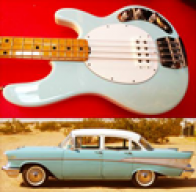
I’ve used the hybrid approach my whole life, using 1-2-4 to about the 7th fret then I switch to 1-2-3-4 at the highest frets. This is not easy to do on upright because of the angle, but for bass guitar it makes more sense. I tend to shift quite a bit as it seems more natural than stretching across frets, and I’d say I lead with my pinky more than my index finger, even when playing the lower notes. I also use open strings quite a bit when I’m playing lower than the 5th fret so that I don’t have to stretch to the 5th fret, but that also depends on the tone I’m going for. I’ve had people ask me how I’m able to play more notes than it looks like I’m playing, and that’s because of this style, which is actually a common technique when playing bass guitar
Last edited:

Short answer, yes, it works the same.Hello!
The title sums up my question. I'm new to electric bass and starting to work on scales and arpeggios. I'm primarily a guitar player. One of the popular methods for playing scales/arpeggios on guitar is the 12-position system. This is basically 1 finger per fret with stretches from the index finger and pinky if needed. So you're playing all 12 keys in each position. Is this possible to do on electric bass? What's the best way to think about scales and position playing?
Thanks!
I'm not a huge fan of Simandl technique. On double bass, Rabbath's technique is far more fluid and agile, while on electric bass, the scale length is short enough to use one finger per fret without much strain.
On both bass and guitar, I don't think in terms of position, but rather where I am in the scale (which mode, how it relates to the modes around it, keys it implies, and what chords I can build out of it). Position is kind of an unnecessary abstraction if you know all the notes on the fingerboard.
Last edited:
Could you provide more detail on Rabbath vs Simandl? I'd like a bit more before plunking down $50 for a copy of Rabbath's book. [Edit: I see it's multiple volumes.]Short answer, yes, it works the same.
I'm not a huge fan of Simandl technique. On double bass, Rabbath's technique is far more fluid and agile,
-
Last edited:
I'll let him do the talking:Could you provide more detail on Rabbath vs Simandl? I'd like a bit more before plunking down $50 for a copy of Rabbath's book. [Edit: I see it's multiple volumes.]
-
Rabbath is an insanely creative double bassist, who's completely redefined the instrument's technique.
Last edited:

One of the popular methods for playing scales/arpeggios on guitar is the 12-position system. This is basically 1 finger per fret with stretches from the index finger and pSo you're playing all 12 keys in each position. Is this possible to do on electric bass? What's the best way to think about scales and position playing?
Electric bass is the same as guitar in regard to position. Where the first finger is defines the position. First finger in fret 1 is position 1 and so on. It’s that simple.
Positions are more helpful to think about when there are a manageable number of them and physical landmarks you can orient yourself to by feel. An electric bass is not great in this regard. It's probably easiest to just learn the notes and orient yourself directly by fret feel, without any abstraction. Unless you're playing fretless, intonation is much less a concern (though clank and buzzing are problematic if your fingering position is sub-optimal).Electric bass is the same as guitar in regard to position. Where the first finger is defines the position. First finger in fret 1 is position 1 and so on. It’s that simple.
Here's another great example of Rabbath technique (and a beautiful piece of music too!):
Note: He's playing this at age 90. He's 92 now, and still trucking.
Last edited:
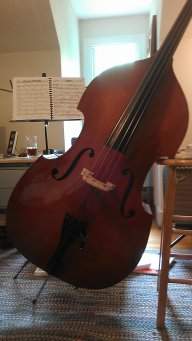
Hello!
The title sums up my question. I'm new to electric bass and starting to work on scales and arpeggios. I'm primarily a guitar player. One of the popular methods for playing scales/arpeggios on guitar is the 12-position system. This is basically 1 finger per fret with stretches from the index finger and pinky if needed. So you're playing all 12 keys in each position. Is this possible to do on electric bass? What's the best way to think about scales and position playing?
Thanks!
I would argue you could use your existing guitar knowledge to visualize the fretboard, with the exception that it is much harder to do those same stretches on the bass and you don't have the top two strings. You can totally replace the stretch with a full hand shift though. No need to reinvent the wheel for the bass.
Inspirational performance! Thanks for that.I'll let him do the talking:
But ... he's not talking. Does he (or someone) explain his system vis a vis Simandl? He's published books, so I assume there is a codified system.
-
Inspirational performance! Thanks for that.
But ... he's not talking. Does he (or someone) explain his system vis a vis Simandl? He's published books, so I assume there is a codified system.
-
Here's an article with a video. I have not read the article or viewed the video, but I think they will answer your question. There is also a nice graphic:
Rabbath vs Simandl - What's the best double bass position system? - Double Bass HQ
AFAIK the main difference is Simandl positions are fixed, and the hand maintains a fairly stable shape, until to transition into thumb position. I haven't studied Rabbath, but my understanding is the hand pivots up and down on the thumb...so one position covers more notes.
My guess is most players who study Simandl are taught to pivot on the thumb. I know I was. But I eventually abandoned the pivot on upright. However, I find that I naturally pivot on bass guitar. Happened without any sort of conscious effort
 ...I was a bit surprised when I became conscious that I was doing it.
 As I said earlier, I stopped thinking in terms of positions long ago. If I know what string and note is under one finger, then in general I know what notes are under the other fingers on every string. So if I want to play a note I think about placing one of my fingers on the note, rather than thinking about putting my hand in a specific position.
I believe the primary role of the positions is to facilitate communication between the student and teacher. I suppose they can also be helpful when working out fingering. The give you an way to notate the timing and distance of shifts.
By the way...I started on upright and have only studied Simandl. When I started playing bass guitar I used the same fingering system. However, a few years after turning pro, I developed my own one-finger-per-fret system for bass guitar and continued with Simandl finger on upright.
Scott's bass lessons uses a term: "4+2". The idea is you know the notes under your four fingers and you also know +1 fret and -1 fret. This video may be why I adopted the pivot on bass guitar...you pivot up or down one fret.
Here is the video:
While he is using a 4-finger fretting technique, it's not pure one-finger-per-fret. This is not intended to say it's better or worse...it's just an observation. IMHO the best technique (for you) is somewhat dependent on the size of your hand.
Scott's bass lessons uses a term: "4+2". The idea is you know the notes under your four fingers and you also know +1 fret and -1 fret. This video may be why I adopted the pivot on bass guitar...you pivot up or down one fret.
Here is the video:
While he is using a 4-finger fretting technique, it's not pure one-finger-per-fret. This is not intended to say it's better or worse...it's just an observation. IMHO the best technique (for you) is somewhat dependent on the size of your hand.
Positions are more helpful to think about when there are a manageable number of them and physical landmarks you can orient yourself to by feel. An electric bass is not great in this regard. It's probably easiest to just learn the notes and orient yourself directly by fret feel, without any abstraction. Unless you're playing fretless, intonation is much less a concern (though clank and buzzing are problematic if your fingering position is sub-optimal).
Here's another great example of Rabbath technique (and a beautiful piece of music too!):
Note: He's playing this at age 90. He's 92 now, and still trucking.
That goes for upright but not for guitar and electric bass. When you actually play you don’t think in positions anyway.
That's a nice graphic, thanks. But in my edition of Simandl, Half Pos. tops out at Bb, whereas the chart shows it (olive color) extending to B natural.There is also a nice graphic:
Rabbath vs Simandl - What's the best double bass position system? - Double Bass HQ
-
AFAIK 1/2 position is Ab to Bb (or enharmonic equivalents). To my eyes the chart shows open G to Bb. AFAIK, the color fields do not include the lines.That's a nice graphic, thanks. But in my edition of Simandl, Half Pos. tops out at Bb, whereas the chart shows it (olive color) extending to B natural.
-
I don't consider the open string part of 1/2 position.
Thanks, the B line not being inside the open position color block explains it. But Semandl definitely included the open strings to be in Half Position.AFAIK 1/2 position is Ab to Bb (or enharmonic equivalents). To my eyes the chart shows open G to Bb. AFAIK, the color fields do not include the lines.
I don't consider the open string part of 1/2 position.
-


