I don't consider the open string part of 1/2 position.
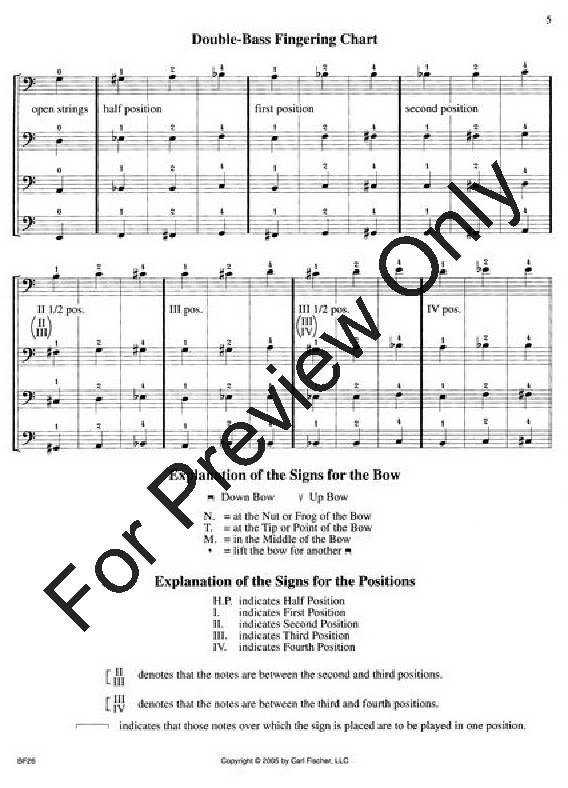
The open strings are included in the 1/2 position. I know my edition is old but AFAIK nothing has changed in this regard:

TalkBass has been independent since 1998. Add your voice.
Create a free account to reply to discussions, view embedded media, and browse with fewer display ads.
Join free Log in
Want zero display ads or expanded classifieds tools? Compare plans.
I don't consider the open string part of 1/2 position.
Thanks, the B line not being inside the open position color block explains it. But Semandl definitely included the open strings to be in Half Position.
-
The open strings are included in the 1/2 position. I know my edition is old but AFAIK nothing has changed in this regard:
View attachment 5266663
Again...I understand why you might conclude that but I don't think it's the intent. Take a look at page 15. Exercises in the I and II. Position. The first thing shown is the C Major scale. It marks I. Position for the first 6 notes. The notes are fingered 2, open, 1, 2, open, 1. Then you shift to II. Position and continue with 2 and 4. This implies the open strings are part of I. Position, but I don't think that is the intent.
View attachment 5266702
It's really a silly thing to argue about though, since I no longer thing in terms of Simandl positions.

to create a consistent system they (the open strings) have to go somewhere.
...
The open strings stand on their own, and or not part of any position.
Keep in mind you can grasp ... the open string from other positions
...
 ) so I'm out.
Since we can't talk to Simandl or Stuart Sankey, the only thing arguable is "intent". And there's no absolute proof available here. Still, I have to go back to that page 8 of New Method where "The Half Position" is introduced for the very first time. I shows open strings. Flip ahead to the introduction of "The First Position": No open strings, nor are open strings mentioned in any subsequent position introduction. Sure, open strings appear in exercises involving all the positions. And the position indications ("H.P.", "I", "II" etc) throughout the book are casual and rather erratic. I've found plenty of typos and flat-out errors in my copy.
-
Not necessarily logical unless "have to" had been explicitly stated in the method. Open strings could just as logically reside in H.P. by virtue of not logically belonging in any higher position, and open strings are never illustrated in those positions. Still, it's reasonable to consider open strings to be special and apart from H.P., and the notion doesn't trouble me overmuch.Logically, if the open strings belong to half position, then you would have to move your hand to half position to play an open string...