• TalkBass has been independent since 1998. Add your voice.
    Create a free account to reply to discussions, view embedded media, and browse with fewer display ads.
    Join freeLog in
    Want zero display ads or expanded classifieds tools? Compare plans.

How Do You Know When Your Truss Rod Is Not Working?

The title says it all: how do you know when your truss rod is not working? What is the usable range of adjustment (i.e. turns of the nut)?

I ask because I just changed strings on a new bass that I took delivery of in October. It came with really low action that I put up a little by loosening the truss rod. With the string change the action went a fair amount higher - not unplayable - but higher. I turned the truss rod about a 1/3 to 1/2 a turn (right - righty tighty) and let it settle for several days and I am not sure it did anything. Maybe a little. I gave it another 1/4 turn this evening and it still seems high.

There was no snapping sound, no difficult resistance. Nothing to note in the feel of the truss rod movement. I was always told to adjust in 1/8 or 1/4 turns and let it settle. I am thinking the total 3/4" turn should have shown some results. So when the rod is "adjusting", how much useable range should it have have?

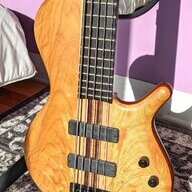
The bass is a new Sandberg VT5 with a roasted maple neck and pau ferro fingerboard.
 
Forgive me if I’m preaching to the choir here:

The truss rod adjusts relief, not action.

To see the difference your truss rod adjustments are making to the relief, press the E string down at the first fret and simultaneously at a fret where the neck meets the body and then check how much gap there is between the string and a fret mid way along the neck.

Then adjust the action by raising or lowering the saddles.
 
Last edited:
Forgive me if I’m preaching to the choir here:

The truss rod adjusts relief, not action.

To see the difference your truss rod adjustments are making to the relief, press the E string down at the first fret and simultaneously at a fret where the neck meets body and then check how much gap there is between the string and a fret mid way along the neck.

Then adjust the action by raising or lowering the saddles.

I did that for the B-string because I went from a tapered B to a non tapered B, but the other strings shouldn't have changed that much.
 
Manually flex the neck in the desired direction when tightening the TR nut / removing relief....slacken the strings if necessary. Never crank on the neck solely as damage may occur. The 1/8-1/4 turn is an old wives' tale. Tapered strings require the saddle to be raised a tad to compensate for the "step-down" effect but should have no profound influence on the relief unless the tension varies from its full-wrap counterpart.

Riis
 
As @Geepers said, use the truss rod to set relief, then the saddle screws to set the action. It doesn’t matter that the saddles were set correctly for the previous set of strings. If you’re installing a different set of strings you should do a full setup, beginning with setting the correct amount of relief. If you don’t know how to do a setup, there are plenty of videos on youtube that show you how to do it.

A couple of questions:
  • How is the neck relief right now? It should have a very tiny forward bow (see the aforementioned setup videos for details).
  • How much resistance do you feel when you turn the truss rod? Do you feel any at all? Do you have to use a lot of force? Do you feel more resistance as you tighten it?
  • Does your bass have a dual action truss rod (one that can bend the neck both forward and backward)? If so, and you feel almost no resistance when turning, then you could be in the ‘neutral’ zone, where it transitiones between pulling forward and backward.
Since it’s a new bass and, as I understand it, the tuss rod still turns normally, it seems very unlikely that it’s broken. And it’s very unlikely to break unless you use excessive force. But be careful, and if you’re not sure, take it to a professional.
 
Last edited:
  • Like
Reactions: Lenny JG
1. De-tune your strings.
2. Manually flex the neck to where you want it.
3. Gently snug up the truss rod nut.
4. Let go of the neck.
5. Tune your strings and see if it’s where you want it.
6. Repeat 1 thru 5 as needed.

Any other procedure is asking for disaster.
 
While you can set the action in a limited way using the truss rod, you really should not.
The truss rod is there to compensate the string tension.
You do want the neck as close to straight as it goes without frets buzzing. A little bow is necessary, though.
Once the neck is nearly straight with a slight bow to it (press the E/B string down in the first and last fret and check frets 7 to 9, there should be a tiny gap between the sting and the fret. Large gap= too much bow. No gap= too straight/back bow).
On a four string bass, the change should be immediately noticeable. Sure, the wood works and it takes a while to settle down completely, but those changes are tiny.

Set the string height and intonation at the bridge. The saddles have the height adjustment for a reason.
You generally can ride the thinner strings a bit lower than the fatter strings, but that is a matter of playing style and taste.
 
When I don’t know if a truss rod works fine or not, I remove the strings, loosen the truss rod nut until there is no resistance.

Then I verify the straightness of the neck with my neck ruler to see if it’s almost straight when there is no tension.

I then turn up the truss rod nut 1/4 turn at a time and take more readings with my ruler. At any time, the truss rod nut should be turned easily without forcing it.

1741959105420.jpeg
 
  • Like
Reactions: FronTowardEnemy
This is the wrong tool to measure relief. It doesn't matter what the profile of the neck is, you need to know the profile of the plane of the fret tops. The two planes are related but not necessarily the same. A regular straightedge across the top of the frets is best for that. If the fret tops are right it doesn't matter what the fretboard looks like. For example, if you levelled the frets while there was some relief in the neck, the fretboard may measure with the right amount of relief while there is no relief at all in the plane of the fret tops.
 
Read this and adjust accordingly:

 
You truss rod is not working if you tighten or loosen it and the neck relief doesn't change. It's as as simple as that.

You should never use the truss rod to adjust the action. NEVER!!! If anyone tells you otherwise they haven't got a clue what they're talking about. Seriously! The action is adjusted at the saddles and the nut, AFTER you have adjusted the neck relief.

Also, unless your bass is a pre mid-80s Rickenbacker or some poorly built quirky old, fragile vintage bass there really is no need to manually flex or clamp the neck when you adjust the truss rod. A functioning truss rod is perfectly able to to what it's supposed to do on it's own.

Unless the neck relief is WAY off it's usually not necessary to turn the truss rod more than around 1/4 turn, maybe close to 1/2 turn at most. In some cases you may need to turn it more than that, but in those cases it's a very good idea to let the neck settle overnight, and check the relief again after that, because more than 1/2 a turn is a LOT and the neck/wood may need some time for the adjustment to take full effect.
 
Last edited:
This is the wrong tool to measure relief. It doesn't matter what the profile of the neck is, you need to know the profile of the plane of the fret tops. The two planes are related but not necessarily the same. A regular straightedge across the top of the frets is best for that. If the fret tops are right it doesn't matter what the fretboard looks like. For example, if you levelled the frets while there was some relief in the neck, the fretboard may measure with the right amount of relief while there is no relief at all in the plane of the fret tops.
My tool does both. I can lay it on the fretboard to verify the wood and if I move it 1/4" on either side, it becomes a straight edge.
 
My tool does both. I can lay it on the fretboard to verify the wood and if I move it 1/4" on either side, it becomes a straight edge.
I realize that. I was just pointing out that many folk get the notched straightedge and use is to measure relief of the fretboard. That's not the relief that counts.
 
  • Like
Reactions: Gervais Cote
I don't understand why people spend money on expensive specialized tools just to measure the neck relief. It's really just a waste of money. The measured relief is quite frankly irrelevant. All basses are different and can handle different amounts of neck relief. There is no "one size fits all" when it comes to neck relief.

The correct amount of relief is ALWAYS THE STRAIGHTEST NECK YOU CAN GET AWAY WITH. This will depend on the bass/neck, the strings and your playing style. Adjusting the relief (or anything else on you bass for that matter) "by numbers" will always be a compromise that will most likely NOT be the ideal setup for YOUR bass, YOUR choice of strings and YOUR playing style.

Here's how you SHOULD adjust the neck relief:

1) Tighten the truss rod gradually until you start to get fret buzz in the lower frets.

2) Back off the truss rod slightly until the buzz disappears.

It really isn't any more complicated than that!

It certainly doesn't require a straight edge or feeler gauges or whatever. ANYONE with can do this. Just make sure you use the correct type/size wrench for the truss rod in question. Be particularly careful not to use the closest metric size wrench for an SAE/inches truss rod nut (or vice versa), because that will most likely damage the truss rod nut.