Enjoy the benefits of a premium membership!
Upgrade Account
-
TalkBass has been independent since 1998. Add your voice.
Create a free account to reply to discussions, view embedded media, and browse with fewer display ads.
Join free Log in
Want zero display ads or expanded classifieds tools? Compare plans.
You are using an out of date browser. It may not display this or other websites correctly.
You should upgrade or use an alternative browser.
You should upgrade or use an alternative browser.
How Do You Set EQ?
- Thread starter bmusic
- Start date
More options
Who Replied?

Not actively playing with others now, but I went wireless: I don't miss the cord! Might help to walk out into the audience area and listen out there if you can. Sounds different out there than right in front of the amp...
If I’m playing my combo I kind of bend over and turn the knobs and stuff.
Lots of great advice here. Personally I found that experimenting with a parametric EQ, and understanding some magic frequencies, was a huge help.
Chiefly...
1. There is a spot in the lower midrange where a lot of energy is generated by bass and other instruments. Roughly 330 Hz. If I recall correctly from an interview with Roger Sadowsky, the design of the Sadowsky preamp was created to boost lows and highs around that center spot where engineers were always notching out in the studios.
2. A high pass filter helps clean up unnecessary power-sucking mud frequencies that tax your amp. Most of the lows we want in a rock mix are actually higher than what the "low" knob is typically set to. 50 Hz might add lots of rumbly bottom end, but what we actually want for useful lows might actually be somewhere between 90 Hz - 220 Hz. More "upper bass" and "lower mid" than anything else.
3. There is a sweet spot in the mids where notes become clearer and much more audible in the mix without actually turning up your volume. Right in the 500 Hz region. I learned this trick from Uncle Will Lee.
4. A parametric EQ is HUGELY valuable for precision notching of nasty ganky frequencies and overall Tone Improvement. You could give me all the graphic EQ sliders in the world and I'd still want a parametric in there for pinpoint accuracy. There's a learning curve but it's well worth it.
Chiefly...
1. There is a spot in the lower midrange where a lot of energy is generated by bass and other instruments. Roughly 330 Hz. If I recall correctly from an interview with Roger Sadowsky, the design of the Sadowsky preamp was created to boost lows and highs around that center spot where engineers were always notching out in the studios.
2. A high pass filter helps clean up unnecessary power-sucking mud frequencies that tax your amp. Most of the lows we want in a rock mix are actually higher than what the "low" knob is typically set to. 50 Hz might add lots of rumbly bottom end, but what we actually want for useful lows might actually be somewhere between 90 Hz - 220 Hz. More "upper bass" and "lower mid" than anything else.
3. There is a sweet spot in the mids where notes become clearer and much more audible in the mix without actually turning up your volume. Right in the 500 Hz region. I learned this trick from Uncle Will Lee.
4. A parametric EQ is HUGELY valuable for precision notching of nasty ganky frequencies and overall Tone Improvement. You could give me all the graphic EQ sliders in the world and I'd still want a parametric in there for pinpoint accuracy. There's a learning curve but it's well worth it.

It can be challenging to get used to playing at loud volumes if you are using different gear each time. As some others have said most people try and get their alone tone to sound good with a loud band and it often won't, totally different tonal spectrum and you're occupying a lot of the same frequencies as the drums and other instruments. Eq can be your friend but start with small adjustments, bassists almost always pump the bass freq too much, you don't need alot to have a lot of balls in your sound, try keeping bass lower to start push the mids a hair and treble to taste, play some and adjust sparingly. It takes time to get used to hearing your sound this way if its a new thing so be patient and don't be afraid to try some stuff out. Also keep in mind that each amp make and model has their own baked in tone so setting knobs the same will get different results.
If you can swing it maybe pick up your own amp and get used to how it plays and feels for you, then you can take it along and make some tweaks depending on the room/cab, etc.
If you can swing it maybe pick up your own amp and get used to how it plays and feels for you, then you can take it along and make some tweaks depending on the room/cab, etc.

JeezyMcNuggles
Inactive
- Feb 23, 2018
- 14,723
- 20,970
- Disclosures
- I suck, but nobody really notices
If you need volume, set it flat.This is such a ridiculously broad and stupid question that I don't know how to search for existing threads. I know, in the end, it's going to boil down to "Just use yer ears, mate," but a little head start would help.
I don't play at drum volume a lot. Never have. Now I'm jamming covers with these guys, walking cold into practice rooms, plugging in and struggling to sound good. Struggling to be audible without being too loud.
The backline gear is not the issue. Last night it was a Darkglass Microtubes of some sort (into I-don't-know-what-cab); last time it was an Aguilar Tone Hammer. I'm driving a P with a Lindy through a MarkBass Compressore, into the head. I'm moving my fingers from the neck back to the bridge, trying to find a spot where the E string isn't invisible and the D string isn't massive.
The question, I think, is figuring out what room nodes (is that the term?) are doing to the tonal balance and using EQ to counter them. (In retrospect, I think last night I was primarily standing in a horrible place, next to a wall across the room from the cab.) And also, how to find a place to live alongside the two guitar players and keyboard player.
So yeah. How do you do that? You walk into a room, you're getting set up; where do you start with the EQ?
If you want more bass, scoop your mids and turn it up.
If you want to be brighter, drop your mids and bass and turn it up.
If you want fullness, boost lows only.


Close to flat. Occasional slight bump at 1k for presence, or small cuts at 125 or 250 in boomy, hollow rooms. I'm a bassist but I'm a sound tech too, and live by the old school theory that EQ's are for cutting, not excessive boosting. If you need crazy boosts or cuts, something else in your chain amiss. And...the dreaded "V" shape is the worst thing to do on your amp or your mains. Ughhhhh....
Last edited:


I've found that much of the time, when in doubt about the room, rolling off the lower frequency band on either the bass or the amp or both to reduce boom and mud works well. It provides better note definition, less low end clutter, and tends to meld with the kick.
Also, have a band mate stand out front and listen to the drum/bass blend during sound check to insure it sounds good out front. Remember, what you hear standing in front of your amp is not what is being heard in the audience. And too much of the time, especially in large rooms and concert halls, the bass ends up just being low end thunder without note definition.
Also, have a band mate stand out front and listen to the drum/bass blend during sound check to insure it sounds good out front. Remember, what you hear standing in front of your amp is not what is being heard in the audience. And too much of the time, especially in large rooms and concert halls, the bass ends up just being low end thunder without note definition.
Last edited:

Let's say it's a stage at a gig. I start with everything flat. Bass, amp, everything.
I then make sure there aren't too many lows or weird echoes or boominess due to the room or stage, so cut/boost highs/lows accordingly. HPF, this is your time to shine.
When the rest of the band comes in, I adjust my mids.
Then during the soundcheck itself I'll use my bass' onboard EQ to fine-tune stuff.
Viola, we've got our sound.
I then make sure there aren't too many lows or weird echoes or boominess due to the room or stage, so cut/boost highs/lows accordingly. HPF, this is your time to shine.
When the rest of the band comes in, I adjust my mids.
Then during the soundcheck itself I'll use my bass' onboard EQ to fine-tune stuff.
Viola, we've got our sound.


I almost always put my combo on a chair to get rid of the booming lows.
Also, don't be afraid to turn the pots really severely sometimes, even if you normally don't do it. There's a place I play regurarly, where I turn the bass almost all the way down and also the low mids get a rough down treatment. My sound then is not very nice, but I can hear what I play and the audience hears what can be recognised as bass guitar. The place has a vault over the little stage and I'm standing right in the middle, because there's no other place I could move to. So I know exactly what is wrong, but can't do anything with it anyway, except for severe treatment of my pots.
Also, don't be afraid to turn the pots really severely sometimes, even if you normally don't do it. There's a place I play regurarly, where I turn the bass almost all the way down and also the low mids get a rough down treatment. My sound then is not very nice, but I can hear what I play and the audience hears what can be recognised as bass guitar. The place has a vault over the little stage and I'm standing right in the middle, because there's no other place I could move to. So I know exactly what is wrong, but can't do anything with it anyway, except for severe treatment of my pots.
I don't play at drum volume a lot. . . . Struggling to be audible without being too loud. . . . You walk into a room, you're getting set up; where do you start with the EQ?
If you are "struggling to be audible", you either have to turn up, find a quieter drummer, push the low mids or use clear sounding cabs with a good dispersion. I also use hearing protection when required.
I start by being as loud as the other guys in the band, especially the drummer. Then, if the EQ is boost/cut, I set the EQ's to 12 o'clock, and set filters to off. If that's not 99% what I want, it's the wrong amp.
IMO I get 99% of what I need from Aguilar amps set like this. Then minor adjustments for the instrument and room get me the last 1%.
Sometimes the room/stage will defeat you, but as long as the bass sounds good in the audience I'll accept the stage sound, even if I can't get it to my liking.

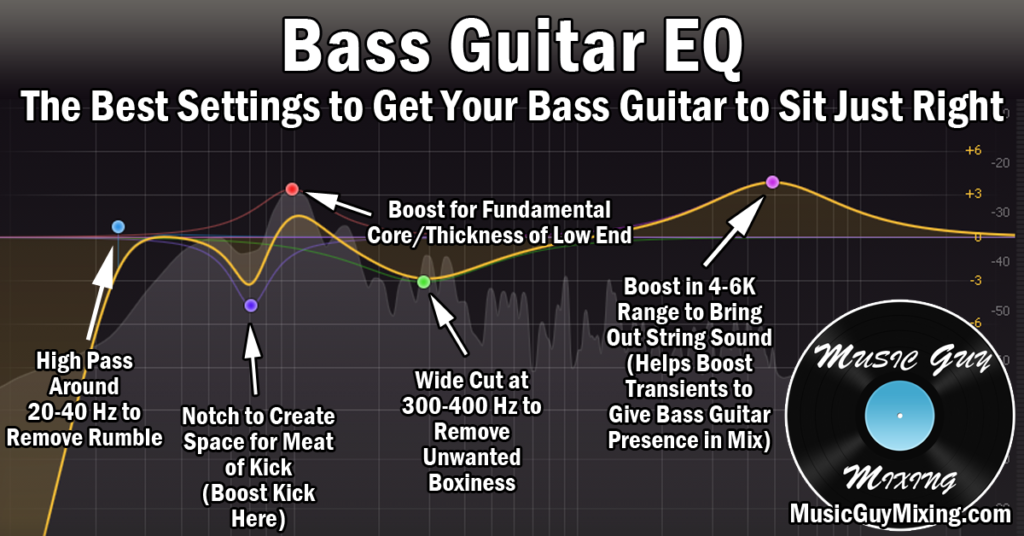
Good article here: Bass Guitar EQ Guide to Perfect it Every Time - Music Guy Mixing
It's more a mixing guide than a amp EQ guide but it's still usable I think
It's more a mixing guide than a amp EQ guide but it's still usable I think
This is of interest to me. Do you mind sharing how you do this? Is it a stand-alone unit you bring to gigs or software you run through a computer? Phone app maybe?I use an analyzer to find the flat settings of my amps, which I use as a starting point for upright bass. For electric, I'm always interested to try out the maker's voicing, so I set the knobs to noon, and really only mess with bass if the room is unfavorable, and treble if needed to mellow things out. The "backline" gigs I've played have always had PA support, so I adjust the stage amp for intelligible bass monitoring, i.e., not too much low end.