This is such a ridiculously broad and stupid question that I don't know how to search for existing threads. I know, in the end, it's going to boil down to "Just use yer ears, mate," but a little head start would help.
I don't play at drum volume a lot. Never have. Now I'm jamming covers with these guys, walking cold into practice rooms, plugging in and struggling to sound good. Struggling to be audible without being too loud.
The backline gear is not the issue. Last night it was a Darkglass Microtubes of some sort (into I-don't-know-what-cab); last time it was an Aguilar Tone Hammer. I'm driving a P with a Lindy through a MarkBass Compressore, into the head. I'm moving my fingers from the neck back to the bridge, trying to find a spot where the E string isn't invisible and the D string isn't massive.
The question, I think, is figuring out what room nodes (is that the term?) are doing to the tonal balance and using EQ to counter them. (In retrospect, I think last night I was primarily standing in a horrible place, next to a wall across the room from the cab.) And also, how to find a place to live alongside the two guitar players and keyboard player.
So yeah. How do you do that? You walk into a room, you're getting set up; where do you start with the EQ?
You got it. Use your ears and twiddle the knobs until it sounds good (as possible). The problem: It is difficult to know when good (as possible) has been achieved. Hint: Sometimes it's not very good.
What I do.
First thing is recognize that bedroom tone sounds great in the bedroom, but it typically gets lost and turns into an incoherent mess on stage.
I try to dial in a sound that I think will work. Once the band starts playing I frequently find it's necessary to turn the bass down a little more and turn the mids and treble up a little more.
IMHO the main problem is something called masking. If you have two sound sources producing the same frequency, you will only hear the louder sound source. So if guitar, bass, and keys are all putting out the same frequency, you will only here whichever is louder at your ear.
Keep in mind that the tone a bass produces is not just the fundamental. In fact, the bass guitar does not put out a particularly strong fundamental and most bass amps are not capable of flat response down to the fundamental of the E or B string. Most of what you hear is the 1st overtone.
If you are playing an open E (41hz), you hear mainly 81hz. Various overtones over 81hz are also present and give your notes clarity, focus, and a certain tonal quality and color. The next overtones are a 5th higher B (124hz), the second octave E (165hz), and a major third above the second octave G# (206hz). If some other sound sources is putting out significant sound at these frequencies it degrades how well you can hear your bass.
In addition to competing with the sound of other instruments, you are also competing with the indirect sound from your bass. In a live performance venue, the sound tends to bounce around for awhile, rather than dying out immediately. The sound goes out into the room and bounces off various surfaces before making its way back to your ears. It takes time for this to occur, so the indirect sound can arrive well after the direct sound. You may not even be playing the same note anymore. If the decay time in the room is too long, your own sound will mask itself to some degree.
In my experience, the more I turn up the lows, the more my own sound mask itself. So I find it necessary to find a balance between how strong the lows are and how much clarity and articulation I can hear. To me the clarity and articulation are way more important than fat lows.
Something I tend to do is elevate my cab and aim it at my head. Elevating the cab reduces the lows a bit and also puts a notch in the low mids. Aiming the cab at my ears ensures I hear the full bandwidth of my sound coming directly from my rig.
Why do I do this? Bass speakers are not constant directivity devices. Typically the lows will be omni-directional. As the frequency rises, the wavelength of the sound gets shorter. When the wavelength get sufficiently short in relation to the size of the drivers, the cab will begin to exert pattern control and force more of the sound out front.
As the frequency continues higher, the sound may focus into a fairly narrow beam. If your speaker is flat on the floor, the beam will shoot out below your ears...meaning you won't hear this frequency until it has bounced around for awhile.
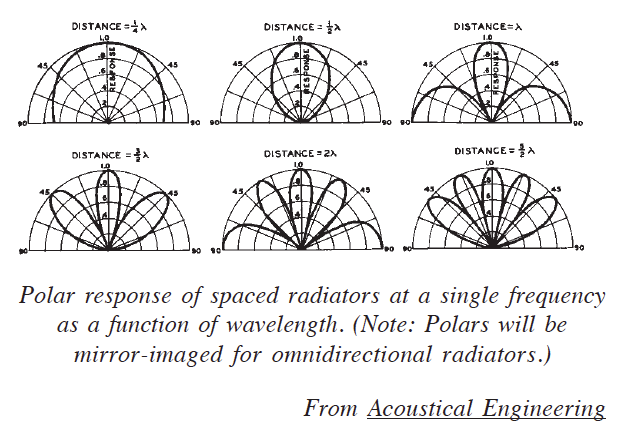
There may be another problem as well. If your cab has multiple drivers, the sound from the different drivers will interact and form into various lobes. This is due to destructive interference. At some angles the sound adds and at other angles the sound cancels. So you get a primary lobe that shoots out directly between the drivers, and you get secondary lobes that shoot out at various angles off-axis. The angle and number of secondary lobes is determined by wavelength and how it relates to spacing between the drivers.
Take a look at the following diagram: Distance is the center to center spacing between two drivers. The Greek letter Lambda is used to represent wavelength:
Here is the approximate dispersion pattern you get when driver spacing = 1 Lambda. This image assumes vertical alignment of the drivers.
Notice the ear is in the null between the lobes. So this guy will not hear this frequency very well. For a vertical 210 I believe this pattern occurs at approximately 1,130hz.
This is a higher frequency where driver spacing = 2 Lambda (2,260hz)
Notice one of the secondary lobes that is shooting up at an angle is pointing straight at the ear. So he will hear this frequency.
But if he moves here, his ear is in the null again.
Notice the primary lobe always shoots straight out (on axis). So if you make sure your ears are on axis to the primary lobe, you should hear the intended full-range response of the cab. You can do this by moving further from the cab, tilting the cab back to aim at your head, or elevating the cab to a suitable height.














 ,
,  ,
,  ,
,  , etc...not really kidding. depends on the room/environment.


