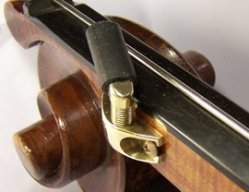
It's about time I gave back to the internet with a little how-to post of my own. The D string tuning key on my Kay finally snapped off. This is after years of abuse as I would lay the bass in my SUV with the peg head resting on the console. (From now on I'll stuff some padding in there to relieve the strain on that proud key.) I read this and other forums for repair advice and went with a DIY idea that someone posted. I wanted to get this done without having to remove the whole plate. Here is a little photo essay on how it went:

The "paddle" of the tuning key is held in the shaft by a rivet. The small part you see above was of course still stuck in the shaft, so step one is get that rivet out of there. I decided to cut one head off the rivet with my Dremel tool and a cutoff wheel. That was a bit too violent as I ended up shaving off a little of the shaft in the process. I recommend using a jeweler's saw instead. It will take longer, but the risk of catastrophe will be eliminated! Most likely the rivet will not just fall out or even be coaxed out with a hammer and punch. And you don't want to go banging away on your tuner. You'll probably bend the shaft. So step two is to get your Dremel or drill and start boring out that rivet. Be careful to drill straight down the axis of the rivet. Build up gradually with larger bits until the rivet loosens. I worked the rivet back and forth with a needle nose pliers as I went. Eventually it will come out. Then you can pull the remains of the paddle out of the slot.

The next step is to make a replacement paddle. I went to the hobby shop with the old paddle and found the $11 K&S .064 brass strip to be just slightly thicker than the original. The next gauge down was .032 and that was much too thin and would end up being too fragile. The .064 can be filed down to fit just fine. Next I traced the original paddle on a piece of paper. A little rubber cement is all you need to affix this template to the stock brass. Of course you could just trace right on the stock brass, but the ink may smear. Before cutting the shape I drilled the hole for the new fastener. Again, it's best to start with a tiny drill bit and work up to the final diameter. Then I used my old jeweler's saw from college and cut out the shape of the paddle. NOTE: I had an advantage here with my old metalwork kit from my college days including a supply of blades and lubricating wax. I also have a bench pin which makes cutting much easier. You can find these things on eBay. It does take some patience to cut metal this way. Don't put too much forward pressure on the blade and apply the wax occasionally to prevent snags. You will probably break two or three blades along the way. This is thick brass, but you'll get there. And remember the durability of this metal that resists you during this stage will serve you ever after. It should take about 30 minutes to finish the cut.

Now just file the edges of the new paddle until you are happy with the shape and feel. If you really want to go for beauty, you can sand and polish with your Dremel. I was short on time so I just smoothed the edges and filed the point down until it fit into the slot. Finally I found a suitable brass screw and nut with a spring lock washer and fastened the new paddle.

So there it is, working perfectly and even more durable than the original. If your D string tuning key is broken, give this repair a try. You won't have to remove your strings and spend $200 on a new set of tuners that might not even fit. Instead you'll spend $11 on a strip of brass and perhaps $25 on a saw, some blades, wax and a bench pin (I checked and you can buy the tools in one transaction). Finally if like me you lay your bass on it's back in your vehicle, I recommend rigging up some means of taking the weight off your D string tuning key! Best of luck.
The "paddle" of the tuning key is held in the shaft by a rivet. The small part you see above was of course still stuck in the shaft, so step one is get that rivet out of there. I decided to cut one head off the rivet with my Dremel tool and a cutoff wheel. That was a bit too violent as I ended up shaving off a little of the shaft in the process. I recommend using a jeweler's saw instead. It will take longer, but the risk of catastrophe will be eliminated! Most likely the rivet will not just fall out or even be coaxed out with a hammer and punch. And you don't want to go banging away on your tuner. You'll probably bend the shaft. So step two is to get your Dremel or drill and start boring out that rivet. Be careful to drill straight down the axis of the rivet. Build up gradually with larger bits until the rivet loosens. I worked the rivet back and forth with a needle nose pliers as I went. Eventually it will come out. Then you can pull the remains of the paddle out of the slot.
The next step is to make a replacement paddle. I went to the hobby shop with the old paddle and found the $11 K&S .064 brass strip to be just slightly thicker than the original. The next gauge down was .032 and that was much too thin and would end up being too fragile. The .064 can be filed down to fit just fine. Next I traced the original paddle on a piece of paper. A little rubber cement is all you need to affix this template to the stock brass. Of course you could just trace right on the stock brass, but the ink may smear. Before cutting the shape I drilled the hole for the new fastener. Again, it's best to start with a tiny drill bit and work up to the final diameter. Then I used my old jeweler's saw from college and cut out the shape of the paddle. NOTE: I had an advantage here with my old metalwork kit from my college days including a supply of blades and lubricating wax. I also have a bench pin which makes cutting much easier. You can find these things on eBay. It does take some patience to cut metal this way. Don't put too much forward pressure on the blade and apply the wax occasionally to prevent snags. You will probably break two or three blades along the way. This is thick brass, but you'll get there. And remember the durability of this metal that resists you during this stage will serve you ever after. It should take about 30 minutes to finish the cut.
Now just file the edges of the new paddle until you are happy with the shape and feel. If you really want to go for beauty, you can sand and polish with your Dremel. I was short on time so I just smoothed the edges and filed the point down until it fit into the slot. Finally I found a suitable brass screw and nut with a spring lock washer and fastened the new paddle.
So there it is, working perfectly and even more durable than the original. If your D string tuning key is broken, give this repair a try. You won't have to remove your strings and spend $200 on a new set of tuners that might not even fit. Instead you'll spend $11 on a strip of brass and perhaps $25 on a saw, some blades, wax and a bench pin (I checked and you can buy the tools in one transaction). Finally if like me you lay your bass on it's back in your vehicle, I recommend rigging up some means of taking the weight off your D string tuning key! Best of luck.