• TalkBass has been independent since 1998. Add your voice.
    Create a free account to reply to discussions, view embedded media, and browse with fewer display ads.
    Join freeLog in
    Want zero display ads or expanded classifieds tools? Compare plans.

How to get a neck that won't easily bow ?

I live in Montreal, Canada, so many drastic climate change. Very rough on the bass neck. Under those circumstances, which criterias will give me a nice piece of lutherie:
1. Multi-ply or one-piece neck ?
2. Buy one with canadian hard maple ? (In this case, avoid made in Indonesia bass ?)
3. Priorize necks with reinforced truss rod with carbon ?
 
Even in your conditions, your basses should not change that much. The first question I would ask is where do you store them? The major cause of change is humidity. Yes, temperature affects them, but not like humidity.
Never lean them against nor hang them on outside walls.
Keep them away from air ducts.
Try to keep the humidity in the room as stable and as near to 50% as possible.
When taking them out to gig, follow the last out/first in rule. That is, they should be the last thing you load into your vehicle and the first thing you take out. Don't put your instruments in the back of a truck or a trailer that isn't heated or cooled.
 
I live in Montreal, Canada, so many drastic climate change. Very rough on the bass neck. Under those circumstances, which criterias will give me a nice piece of lutherie:
1. Multi-ply or one-piece neck ?
2. Buy one with canadian hard maple ? (In this case, avoid made in Indonesia bass ?)
3. Priorize necks with reinforced truss rod with carbon ?

Multi-ply and reinforcing rods will make the neck less flexible.
As will a thicker neck profile and a modern single-cut design that leaves less neck unsupported by the body.
 
  • Like
Reactions: Gnal and skullbass
Even in your conditions, your basses should not change that much. The first question I would ask is where do you store them? The major cause of change is humidity. Yes, temperature affects them, but not like humidity.
Never lean them against nor hang them on outside walls.
Keep them away from air ducts.
Try to keep the humidity in the room as stable and as near to 50% as possible.
When taking them out to gig, follow the last out/first in rule. That is, they should be the last thing you load into your vehicle and the first thing you take out. Don't put your instruments in the back of a truck or a trailer that isn't heated or cooled.
This is freaking humid here in the summer, and very dry inside our houses in the winter. I can keep the humidity at 50% in the summer but it's hard to keep it over 35% in the winter.... But great tips nonetheless for hanging the bass !!!!
 
  • Like
Reactions: Gravedigger Dav
Not kidding here, if you want a truly "solid-state" neck, get one made from carbon-graphite, like a Steinberger, Moses, or Status. Any wood neck will move, which is why they need a trusssrod. My Steinberger neck is solid CF/Composite, and simply doesn't react in any measurable way to normal changes in temperature or humidity, and it will stay in tune for upwards of 6 months in the case. The only downside is that the relief is not adjustable, it's cast into the neck, but I've never had cause to want to adjust it. It just feels the same every time you pick it up, like the day I bought it in 1986. Some of the newer composite necks are hollow with a trussrod, so you can adjust relief. The Warmoth "Super Bass" necks are very good too, probably the best I've seen on a wood neck. They make them with CF or steel rods IIRC, and are very stable in my experience.
 
Bass necks can vary, some are just inherently stiffer than others due to the particular pieces of wood involved. One of my T40's back in the day would have never needed a whammy bar, as I could easily push on the back of the peghead and get a 1/2 step wobble in pitch !

WHATEVER you have, you want to stay ahead of adjustments, rather than playing catch-up. In other words, regardless of the season or prevailing kind of weather and temps and humidity where you are, you want to get it to your preferred setup and KEEP it there. You don't want to let it get way out of shape and then expect the truss rod alone to save your bacon.

This strategy will give you a lot more choices instead of having to buy via the criteria of one kind of neck construction or another. Learn to do your own setups, or certainly in Montreal there must be professional guitar techs who can maintain them for you. Then you just buy what appeals to you, do your steady maintenance, and you're good to go.
 
I'm not following....multi-ply single cut ?

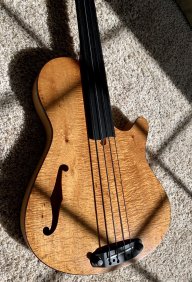
Like so, multi-ply neck and single cut body:

MarcoBass_SCProto_Back.jpg
 
  • Like
Reactions: skullbass
In general, multi-ply will be more stable. But I would say just to not get a cheap bass. I live in northern New England - lots on temperature and humidity change. I have had my two main basses (both with one piece maple necks) 34 and 15 years, and unless I change type of string, both of them go years without needing an adjustment.
 
Aluminum neck Kramer?

I live in the Great Lakes region. As a previous poster mentioned, the humidity is all over the place here. The hands-down most stable, consistent necks I’ve had here are Warwicks. I don’t know if it’s the weird woods they use or something else, but they NEVER seem to budge, no matter the temperature or humidity.