

Enjoy the benefits of a premium membership!
Upgrade Account
-
TalkBass has been independent since 1998. Add your voice.
Create a free account to reply to discussions, view embedded media, and browse with fewer display ads.
Join free Log in
Want zero display ads or expanded classifieds tools? Compare plans.
You are using an out of date browser. It may not display this or other websites correctly.
You should upgrade or use an alternative browser.
You should upgrade or use an alternative browser.
How to keep my Little Mark 250 head from moving?
- Thread starter bassdeal
- Start date
More options
Who Replied?
Get some rocks, just kidding.
Try a rubber mat. Something soft and pliable
might do it or rocks or a bungee.
Try a rubber mat. Something soft and pliable
might do it or rocks or a bungee.

Sorbathane "bumpers" work great. Just glue them on and forget about it. You can find them on Amazon, search "isolate it!"
https://www.guitarcenter.com/Isonod...pJyRKmWPEucPIsZKHeQIsoKuY3yv_cRwaAgdtEALw_wcB
https://www.guitarcenter.com/Isonod...pJyRKmWPEucPIsZKHeQIsoKuY3yv_cRwaAgdtEALw_wcB

I also keep a couple of rolls of that rubber mat material handy, it's the same stuff some people use to line the bottoms of kitchen cabinets. Works like a charm. Also lets you lean a cabinet without sliding on a smooth stage surface.

The head weight is small (5-7 lbs) so you cannot rely on gravity, friction and high hopes to hold it where you want it. Those mesh non-skid mats are great for many things but in rehearsal and performance they’re inadequate for keeping a head securely where it belongs. Bungees, straps, velcro, cups on the cab and the like will keep that several hundred dollar head out of the repair shop. (My Mrs. just suggested draping a piece of the non-skid mesh over the head then use a bungee or strap. That’ll stop the head slipping out from it.)
The input cable should be anchored to something substantial (cab handle or floor rack) very near where it plugs into the head. You should be able to pull on the cable without the head budging.
The input cable should be anchored to something substantial (cab handle or floor rack) very near where it plugs into the head. You should be able to pull on the cable without the head budging.

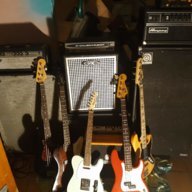


Don't put the amp on the cabinet. Sit it on something beside the cabinet, or a light weight folding table that bridges over the top of the cabinet without touching.
Invalid Link Removed
Invalid Link Removed


I had and amp that was vibrating off my cab... didn't want to do the drawer liner because I feel it's one more thing to keep set up, and keep track of.
I put these on my existing amp feet, and solved my problem. Got these at Lowes (or Home Depot). You can get 'em on Amazon too. They come in different sizes, so check that if you go this route.
Peel off sticker went right on the existing amp feet. No sticky mess or anything.

I put these on my existing amp feet, and solved my problem. Got these at Lowes (or Home Depot). You can get 'em on Amazon too. They come in different sizes, so check that if you go this route.
Peel off sticker went right on the existing amp feet. No sticky mess or anything.

Exactly what I hoped to see posted.

A piece of foam a little bigger than the amp to rest on will work. 1/4-1/2 thick works great.
I used to have a carvin cab thst wasn't braced well and would bounce a lightweight amp all over. The foam or bungee cord fixed that.
My ampeg and GK cabs are solid enough where little vibration is transferred to the cabinet, so the micro amps stay put.
I used to have a carvin cab thst wasn't braced well and would bounce a lightweight amp all over. The foam or bungee cord fixed that.
My ampeg and GK cabs are solid enough where little vibration is transferred to the cabinet, so the micro amps stay put.

I have a really light Eden TN226 head and it has two 1/8" rubber foam strips about 3/4" wide along the bottom all the way across the front and the back of the bottom. It weighs a little over 4-lbs and it stays put just fine. You might want to look for some adhesive-backed black foam and put a couple of strips on yours - may have to remove the feet from your amp if it has them, mine doesn't.I have a Markbass Little Mark 250 head which I have used several times for small shows (with a Yamaha 12" 2-way monitor but that is another story) and as a backup to my rack-mounted 1997 Ampeg B2R head. Well the Ampeg was having problems so I pressed into service the Little Mark for a smallish outdoors show (no PA support).
The Little Mark did a great job, excellent tone with my Fender 4x10 (2016) and plenty of volume. But during the sound-check tune, I noticed the Little Mark was hanging over the front of the cab. I pushed it back and kept playing. I noticed on the second song it was back hanging off the front of the cab. I pushed it back but this time watched it for a bit and noticed it was moving, shaking toward the front of the cab at a fairly rapid pace.
After the second song, the drummer gave me some tape (like electrical tape but not rubberized) to tape the Little Mark head to the cab. This worked but does not seem to be an elegant solution.
Being how popular the ultra-light heads are these days, others must have ran into this problem before but a search did not come up with any direct reference to this problem.
Does anyone have a reasonable suggestion to solving this issue?
Or get some of that grip liner that you see lining kitchen drawers and the drawers on rolling tool chests. Just get a roll in black and cut a piece of that to size. Most housewares, hardware, and auto-parts places have it. Looks like a bunch of small pieces of rubber connected together. Here's a link to the kind of stuff I'm talking about:
https://www.amazon.com/Global-Suppl...s&qid=1560832860&s=gateway&sr=8-2-spons&psc=1
As an Amazon Associate, TalkBass may receive commissions from qualifying purchases made via links on this site.

devnulljp
Supporting Member

The inertia and the frictional resistance are both directly proportional to the mass. This means the mass of the amp is independent of the tendency to wander, while the amp is still in contact.The head weight is small (5-7 lbs) so you cannot rely on gravity, friction and high hopes to hold it where you want it. Those mesh non-skid mats are great for many things but in rehearsal and performance they’re inadequate for keeping a head securely where it belongs. Bungees, straps, velcro, cups on the cab and the like will keep that several hundred dollar head out of the repair shop. (My Mrs. just suggested draping a piece of the non-skid mesh over the head then use a bungee or strap. That’ll stop the head slipping out from it.)
The input cable should be anchored to something substantial (cab handle or floor rack) very near where it plugs into the head. You should be able to pull on the cable without the head budging.
Without the sheet the little amp is light enough to bounce and lose all its friction with the top of the cab so inertia wins. With the sheet that is harder to do because 1 it cushions the amp from being bounced and 2 it has a much higher friction value.
A few others think / ''know'' it will work. I think it's worth a go. You may be right that this amp isn't heavy enough to stay on this cab but you can't be certain.

Vibration and bouncing (I’ve not played on many truly rigid stages) make short work of the niceties of coefficient of friction. N.B. I’m a retired engineer; this kind of thing came up in my line of work. I love and use the stuff but in this circumstance I have a lot less confidence in the reliability of the non-skid mat than you have.The inertia and the frictional resistance are both directly proportional to the mass. This means the mass of the amp is independent of the tendency to wander, while the amp is still in contact.
Without the sheet the little amp is light enough to bounce and lose all its friction with the top of the cab so inertia wins. With the sheet that is harder to do because 1 it cushions the amp from being bounced and 2 it has a much higher friction value.
The $ value of “worth a go” is nil vs. the cost of repairing or replacing a costly head.A few others think / ''know'' it will work. I think it's worth a go. You may be right that this amp isn't heavy enough to stay on this cab but you can't be certain.
Nobody’s got to follow my advice. It’s worth what they’re paying me for it. I favor securing the head to whatever it sits on in a way that will require an extraordinary happenstance to knock it off there. WRT amps and instruments I’m a belt-and-suspenders guy. Others can do with their gear as they see fit.

or ever again...Ha, That Markbass isn't going anywhere soon.


