• TalkBass has been independent since 1998. Add your voice.
    Create a free account to reply to discussions, view embedded media, and browse with fewer display ads.
    Join freeLog in
    Want zero display ads or expanded classifieds tools? Compare plans.

Double Bass How to make an extension?

I've been curious about this myself. Not because I feel in any way qualified to attempt to install one, but because I'm just interested the process. I understand that the expense is mainly because it is time consuming and a nightmare in terms of precision work with no margin of error, etc. but could someone please explain to me with some detail what makes these things so tricky?

also, shouldn't this be moved to setup/repair?
 
Chuck Traeger's book has instructions. I think what makes it tricky is simply that the extension is custom fitted to the bass.

Edit: Just to elaborate a bit, Traeger devotes 15 pages to the C extension -- possibly more than any other subject in the book.
 
i have a template and i am in the process of making one. I am an apprentice for a luthier already so i have the ability to do it, i just wanted to hear others ideas and the ways that they maybe did it to make sure im doing things right
 
hahahahahaha mattybass that just made my day xD that was funny.

im not going to a luthier, i am doing it myself. i just was looking for any sort of problems people ran into or anything so i could prepare myself

:eyebrow:Bass humor it's the lowest of the low....:hyper::help:
Well besides for the the Octobass.. :crying:

Hey hson, We'd love it, if you filled in your profile a little..;)
Just some basic info...

One thing I would say about extensions is they all seem to look a little different, in the way there put on, and there style..

It always makes me go "Ouch".. When I'm looking or playing at a bass that has an extension, what can I say I always feel bad for the neck when I see them getting screwed into.. :crying:

I'm sure maybe someone can offer some advice, but from what I've seen, looks like you have to treat each instrument a little different and figure out what is the best for your instrument..

Try and make sure you everything right before you pull out the black and decker.. :)
 
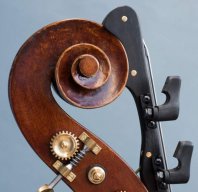
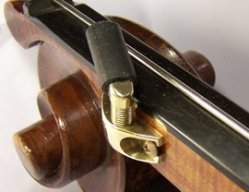
I haven't read the chapter in Traeger's book, but that sounds like a good place to start. Beyond that, I'd try to examine as many extensions as you can first-hand, and look at as many photos online as you can. Probably the biggest reason they are so difficult to build is that you don't have straight and square lines to measure against when dealing with the scroll and pegbox. Getting the string path just right, and extrapolating the fingerboard curve properly are two of the things which you just can't get out of a book. Another thing to consider is that there is a terrific amount of tension on the thing. You want the actual extension body to be strong enough to resist bending, but not end up looking like a section of baseball bat. Mounting it to the pegbox solidly but without seventeen screws is also something which perhaps requires a certain mechanical intuition. Add to that creating a well functioning closure device for the "E" or even chromatic closures, and you see why this subject falls into the realm of "very advanced luthiery". That said, there are many luthiers out there, and even some gifted hobbyists who have managed to make good extensions, so don't be discouraged. Just don't do your first one for a customer who needs his bass back in a week!
 
A properly functioning C extension is something that only a qualified doublebass luthier can install. It really is a big, hairy deal.

Steve is correct, it is a very tricky matter.

You should weigh in pros and cons.

However, if your instrument is not worth a lot of money and you are reasonably handy, it might be a risk worth taking, and you might learn something in the process. I would definitely take it to a luthier if your instrument has significant monetary or sentimental value, or obviously if you are not competent as far as woodworking goes.

Whatever you do, don't cut the scroll. If you don't cut the scroll you can reverse most of the work and the risks are not so great (you would have to get a new nut, refill and touch up whatever holes were drilled, which should not be too many)

 
Steve is correct, it is a very tricky matter.

You should weigh in pros and cons.

However, if your instrument is not worth a lot of money and you are reasonably handy, it might be a risk worth taking, and you might learn something in the process. I would definitely take it to a luthier if your instrument has significant monetary or sentimental value, or obviously if you are not competent as far as woodworking goes.

Whatever you do, don't cut the scroll. If you don't cut the scroll you can reverse most of the work and the risks are not so great (you would have to get a new nut, refill and touch up whatever holes were drilled, which should not be too many)

Also, working with wood can be very dangerous. Always wear a respirator and eye protection, and read all instructions thoroughly.
 

Latest posts