• TalkBass has been independent since 1998. Add your voice.
    Create a free account to reply to discussions, view embedded media, and browse with fewer display ads.
    Join freeLog in
    Want zero display ads or expanded classifieds tools? Compare plans.

How to make my gear sounds better?

There is no gear that will make it sound better, not one! The sound is in the hands. Like sound engineers are saying: Garbage in, garbage out.

And THAT is my advice to sound better: Go practice!!

As a sound engineer myself, I can tell you that "garbage in/garbage out" applies to both playing AND gear: I won't even record a guitarist at my studio with a poorly set up/intonated instrument with ancient strings, regardless of how well he can play, because it's never going to sound good.

Even Vic Wooten is going to sound bad on a bass with really dead strings and a signal chain that's clipping.
 
The problem is I'm not satisfied with the sound of my gear. Tried to figure it out but I don't know how to control it, just use knobs randomly.

Learn what the controls on your bass do first, address the rest of your signal chain second.

Victor Wooten has a very bright tone, but is using no effects in that video: you'll need fresh strings if you want to get anywhere close to that sound, and you'll probably need to boost the treble on your basses preamp as well :thumbsup:
 
Definitely change your right hand technique. Or you will hurt yourself.
Try the bass on the other knee. Try to have your wrist as natural as possible. Carpal tunnel syndrome bro


Left kneeing the bass is not a helpful suggestion. There's nothing wrong with how he's holding it other than needing to lift his right elbow a little.
 
  • Like
Reactions: MDBass
I think you should try some stainless steel strings. They'll brighten things up a bit. That being said, I think the tone in that Chili Peppers cover video is pretty good. I don't personally love bright twangy tone. Most of Victor's tone comes from him, sure, but I find that P/J basses provide a lot of that tone you're looking for.
 
  • Like
Reactions: lz4005
Hi @Vicolls and welcome on board!

I'm in the camp of don't buy anything and stick with your current gear which is pretty good. I'll suggest you as other have said to start understanding how your on board preamp work and how you can get different sounds slightly moving the right hand toward the neck and toward the bridge.

Regarding your onboard preamp just take it easy: start passive using only the balance knob to play with the neck pickup or the bridge one. You'll soon find the sound you are looking for.

By the way I liked the way your bass sounded.
 
Last edited:
Close your eyes when you fiddle with the knobs. Stop looking at your sound-listen to it. Don't open your eyes until it starts sounding better, or you fall on the floor, at which point, you'll be able to tell all of us TBers that you're floored by your sound ----see what I did there?
 
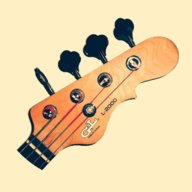
I own the 5 string version of your bass and there is no gain control. There is a blend control next to the volume control nearest to the strings. My B5 records well straight into Logic without effects but I like a funky, slightly grungy sound.
It's not a high end bass but a good reasonably priced bass and definitely good enough to gig with. Your sound isn't bad - a bit inconsistent and noticeably thicker and grittier than Victor's. Not a bad sound but it's all about what you are looking for.
If you're struggling to get the sound you want then I would recommend that you simplify your signal chain for the time being until you have better grasp of the bass and amp.
Start at the mid point (neither cut nor boost). I believe it's always best to use your eq to remove the frequencies you don't like before you try to add the ones you do. New strings and a softer touch will help you get closer but I'd point out that if everybody could easily sound like Victor then he wouldn't be so extraordinary.

Keep working on your technique and be aware that there are no short cuts.
 
Last edited:
  • Like
Reactions: Bassbeater
Left kneeing the bass is not a helpful suggestion. There's nothing wrong with how he's holding it other than needing to lift his right elbow a little.
Left kneeing the bass was a helpful suggestion for me. Playing in a sitting position like a classical guitarist. But what do I know. Look at Hadrian And Janek. They left knee it. Releases tension in you right arm. Sits natural.
 
Even Vic Wooten is going to sound bad on a bass with really dead strings and a signal chain that's clipping.
I disagree with this. Miles Davis on Ascenceur pour l'échafaud, Will Lee on a session with somebody else poor bass, and Victor Wooten at playing a great solo with only the wrong notes. They all sound great because they control what they are playing!
 
Last edited:
WOW, thank for so many advices <3

1. For sure I'm going to visit music store today for new stainless strings.
2. Truly I've started to hear how pickup knob affects the sound
3. Thanks for the "healthy issue". I'll try to keep my elbow up and in fact my wrist more straitgh.
4. Groove Master - can you tell me what's wrong with my technique in right hand? I want to correct that.

When I get new strings I'll record something "before" and "after" to make comparison :)
 
Yes the 'tone is in the fingers' - but learning your gear still matters.

one thing not yet mentioned: "bedroom tone" is rarely a good "band tone"
The tone you have dialed in to sound awesome alone at home is useless when playing in a band
the more instruments you play with, the more nuance a character will get swallowed up
the combined sound of every instrument will have a great impact
on what tone actually sounds good in the mix.

a common beginner mistake is to spend time crafting a great "bedroom tone"
but when they play with others they find much of it gets lost in the mix
and the foolishly simply try to turn up so they can hear their precious bedroom tone
rather than crafting a tone that has a good spot in the mix, and works for the ensemble

and that is the prime reason for spending time understanding what all your controls can do.
 
  • Like
Reactions: awakefie and Luigir
Tons of advice so far, i'm looking at 3 pages worth. Trying to remain relevant for you, having not read everything. Taking a quick break at work, so can't really indulge the history...

This might be a good way to go, given my disclaimers:
1. Find a tone that you admire.
2. Plug your bass DIRECTLY into your amp. No FX processor.
3. Set your bass and amp to flat (neutral) no tone boosted or cut.
4. Compare that tone to the one you admire and see what you can do with amp and bass knobs only to get as close as possible to that tone.
5. Realize that all you really need it the bass and amp, sell the FX processor.

Just kidding.... I'm sure you won't be there after following 1-4 above, but I'll bet you are closer than you thought you would be...

Honestly, far as the FX processor goes, the best way to learn how it can benefit you is to audition the different effects one at a time. Just like if they were individual pedals. It's tedious and not very exciting work but will help you in the long run.

Not sure what you are going for. Not sure what you have on your fx processor. If you have these, audition each of the following: chorus, flange, octave, delay, fuzz, overdrive. There are more to consider, but start there and see what you can learn about the nature of each.