Thank you this is very helpful.You are not dumb. You need a little more information and more experience.
You are lucky, a goliath I is a good sounding 410. It is really the cabinet that started the massive shift to 410 ported bass cabinets some time around 1980 or so. That design still works fine, but has been surpassed, IMHO.
Distortion comes from a lot of places, but the only kind that harms speakers is that caused by asking them to do what they cannot do. Sending a signal that asks them to move farther than they are designed to move will eventually burn them out or tear them up.
Heat build-up and mechanical over-excursion are both caused simply by playing (generally low frequencies) too loud.
Distortion from your pre-amp (gain), your amp (master volume), an effects pedal, etc. will NOT by themselves harm your speakers.
The problem is that all those other sources of distortion or extreme signal complexity will make it impossible to tell if your speakers are distorting.
Speakers complain before they fail. They make ugly sounds that mask the actual pitch. The intended waveform of your instrument is not correctly reproduced, and frequencies that don't belong to a given note obscure what should have been there. Sometimes it is a rattle, sometimes popping, sometimes clicking or even burps, fuzziness, or "farts."
My advice is as follows:
1) Get your goliath I fixed. It is a cool cabinet that is rare and worth keeping around in working condition.
2) Get a newer second cabinet that weighs less and can handle more power. Having the goliath as a back up or rehearsal cab would be good.
3) Experiment with your new amp head and cabinet. Get to know their limits.
4) Carefully supervise and use of your gear by others.
5) Wear hearing protection at all times in a loud music situation.

Enjoy the benefits of a premium membership!
Upgrade Account
-
TalkBass has been independent since 1998. Add your voice.
Create a free account to reply to discussions, view embedded media, and browse with fewer display ads.
Join free Log in
Want zero display ads or expanded classifieds tools? Compare plans.
You are using an out of date browser. It may not display this or other websites correctly.
You should upgrade or use an alternative browser.
You should upgrade or use an alternative browser.
How to (Not) blow out a Cabinet
- Thread starter A_maz
- Start date
More options
Who Replied?

I think you might find some of the information on this page to be helpful and interesting. Written by a verified cab expert. 
Barefaced Bass - Mythbusters #1 - amplifiers
Barefaced Bass - Mythbusters #1 - amplifiers
You can get preamp signal clipping from too much gain/active bass/eq settings. You can get power amp clipping by feeding it a hot signal and then maxing the amp’s output. This can happen well before that volume knob reaches 10!
if you set the gain to just not clip - that’s a fully hot input signal going in to the power section if the amp. At 3/4 way up, you were likely at max volume for your amp.
now factor in that your amp can put out a lot more power than your speakers can handle, and you’re set up to blow some speakers.
in the future, turn the bass control down as you turn the volume up, and try to have “more cab” than you need for volume. Ie - have your cab be over the wattage rating of the amp, and have enough speakers in the cab to send out some volume. (or have the cab have a loud db rating)
i gotta go eat dinner, but your head is more than your cab could handle, and the gig required more cab than what you brought.
btw - I’ve used a 700 watt head through a 200 watt cab at gigs. I set the volume at about 20% on the amp. You can always turn down your amp and use it with a cab not rated for high wattage but you really need to keep your amp’s volume down.
if you set the gain to just not clip - that’s a fully hot input signal going in to the power section if the amp. At 3/4 way up, you were likely at max volume for your amp.
now factor in that your amp can put out a lot more power than your speakers can handle, and you’re set up to blow some speakers.
in the future, turn the bass control down as you turn the volume up, and try to have “more cab” than you need for volume. Ie - have your cab be over the wattage rating of the amp, and have enough speakers in the cab to send out some volume. (or have the cab have a loud db rating)
i gotta go eat dinner, but your head is more than your cab could handle, and the gig required more cab than what you brought.
btw - I’ve used a 700 watt head through a 200 watt cab at gigs. I set the volume at about 20% on the amp. You can always turn down your amp and use it with a cab not rated for high wattage but you really need to keep your amp’s volume down.

Too bad about the cab. Vintage, cool, the 'granddad' of 410's. Those speakers are hard to come by. Not sure if anybody's reconing them. I'd suggest reducing Bass control and increasing Mid, on your amp. Those cabs by design make a lot of low but not so much mid, which can make it hard to hear especially if it's just laying on the floor. This makes it an easy mistake to over-power it with a powerful amp like that one.
Damn man I feel like I ruined some history. I knew when I got it that it was pretty vintage because I heard about it being the OG 410. Looks like I didn’t know how to take care of it properly. And for 200$ it was a steal.Too bad about the cab. Vintage, cool, the 'granddad' of 410's. Those speakers are hard to come by. Not sure if anybody's reconing them. I'd suggest reducing Bass control and increasing Mid, on your amp. Those cabs by design make a lot of low but not so much mid, which can make it hard to hear especially if it's just laying on the floor. This makes it an easy mistake to over-power it with a powerful amp like that one.

Lol thanks I definitely should’ve been on talkbass before it’s literally so helpful. Ok so I’m hearing I was a bad bass player and wasn’t listening as well as I should have been. So what are some tips just to make sure I’m putting a safe amount of power through the cab?
Also I just checked and the Eden-D410T has a frequency response of 80Hz to 14kHz and my Trickfish head has a bass frequency selector @ 40Hz or 80Hz. To avoid blowing it, should I not put the bass frequency selector at 40Hz and only use 80Hz?
The frequency selector switch on your head is for the bass knob. Boosting t 80 rather than 40 might help a little.... but not much.
You weren't a "bad bass player". I've blown a few speakers in my 30+ years of playing too. I've also learned a lot in my years here on this forum.
Don't overthink it. The short version is....
1) No, you can't turn your amp all the way up... even if the numbers say you can.
2) Listen closely to your speakers. If they start sounding a little distorted, they're struggling. Back down a little on bass frequencies, volume, or both.
3) A High Pass Filter can help. If your cab frequency range bottoms out at 48Hz, and you're sending it lower frequencies than that, it will struggle to keep up and might sound muddy. Those little boxes really can clean things up, AND help protect your speakers. I use the Broughton Always On. It's cheap and effective.
It seems to me that folks are over complicating the situation. If you want a clean sound, you turn the master volume all the way up and adjust the gain/preamp starting from 0, till you get the output volume you desire. If the cabinet starts to fart out, turn down the bass control/cut the eq at 35 hz until it cleans up. Most speakers can't reproduce frequencies below 40 or 50hz anyway, so it's just wasted power if you're trying to get those frequencies. The reason an old SVT 810 sounds so loud is that the cabinet isn't even trying to reproduce those super low fundamentals, but does a great job on the higher harmonics. @agedhorse , if I'm wrong, please advise. I am sure not an expert, but I think this is essentially correct.
Stuff happens. It's a thing. Hope it's worth fixing!Damn man I feel like I ruined some history. I knew when I got it that it was pretty vintage because I heard about it being the OG 410. Looks like I didn’t know how to take care of it properly. And for 200$ it was a steal.

Have I missed something? What are the symptoms that lead to the diagnosis that the cab is “blown”?
Could this be something as simple as an active bass overdriving the input?
Also, that cable connecting the speaker looks to me to be an instrument cable rather than a speaker cable. Best to get the correct cable.
Could this be something as simple as an active bass overdriving the input?
Also, that cable connecting the speaker looks to me to be an instrument cable rather than a speaker cable. Best to get the correct cable.
Damn man I feel like I ruined some history. I knew when I got it that it was pretty vintage because I heard about it being the OG 410. Looks like I didn’t know how to take care of it properly. And for 200$ it was a steal.
Wow - you got a great deal on that cab.
I also don't think you were a bad bass player here. Actually I'm grinning a little bit because it sounds to me like you were NOT being shy or tentative about lettin' it rip with that rig of yours. Hopefully today's amp technology can keep up with your ambitions, right?

I'm actually going to do a search later and see if there's some sort of club here for "Where were you when you smoked your first cab?" If anything, I'd say you've earned a little bada$$ bass cred.
Keep on rockin' and keep on reading (here and elsewhere). There are always new things to learn when it comes to gearing up to effectively push our sound.
I've never owned that particular cab you've got, but my first 4x10 cab was an SWR Workingman's 4x10 - more of a budget box compared with the Goliath line. Mine was rated 8 ohms and 400 watts RMS. I also have a more recent generation of the SWR Goliath Jr. 2x10 cab, which is rated 8 ohms and 350 watts RMS (I'd expect the 4x10 version of this cab to rate at 700 watts).
If that first generation of the Goliath 4x10's was indeed rated at 400 watts, you might want to scout for a later generation if you stick with that label. Aside from how you operate your head and any mechanical aspects of the drivers in different cabs, I'd bet that there are several different affordable 4x10's in the used market that are rated for more power if that's what you need.

Images attached.
You absolutely do have a Goliath I (The cloth grill variant. I have the same cab, but with steel grate and "designed by David Eden" on the back jackplate) and you are correct about the power handling: 400W.
Might also add that those cabs are 30 years old at this point, and most of them have not been treated nicely in their long lives. They sure do sound nice, though, don't they?
If that first generation of the Goliath 4x10's was indeed rated at 400 watts, you might want to scout for a later generation if you stick with that label.
The II (which is a truly incredible cabinet) and the III both handle 500 watts. Not a huge change.
I have one of each.The II (which is a truly incredible cabinet) and the III both handle 500 watts. Not a huge change.
My advice is as follows:
1) Get your goliath I fixed. It is a cool cabinet that is rare and worth keeping around in working condition.
2) Get a newer second cabinet that weighs less and can handle more power. Having the goliath as a back up or rehearsal cab would be good.
3) Experiment with your new amp head and cabinet. Get to know their limits.
4) Carefully supervise any use of your gear by others.
5) Wear hearing protection at all times in a loud music situation.
All great advice. #1 will be difficult but absolutely worth it; the drivers are not made anymore, nor (so I've heard) recone kits, so you're looking for someone who has gutted out a cab and that's a long-term hunt. If you have a working horn, keep that and the crossover no matter what, they're gold (and usually the first thing blown). I definitely recommend #2, as while my Goliath I is still my best sounding cab, it's a miserable haul and it sits at home most of the time. I was quite fortunate to find a Golight 4x10, which cops about 90% of the old SWR sound. A bit less low end, a LOT more power handling - 800W RMS. Only 56 pounds. Plenty of good 4x10 options out there.
As far as #4, I (in general) don't let people use my rig. However, if that sometimes becomes necessary, I have an HPF which I turn on before the new guy plugs into my rig, and basically drop anything under 80hz. I'm not getting my rig damaged.
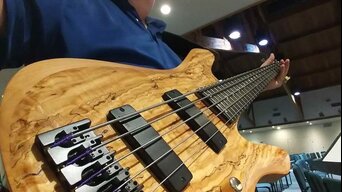
Surprisingly, people had told me to be careful not to blow out the 15" driver in my GK MBX115 cab. It was the tweeter that I blew out, but didn't notice it right away. Someone else with better hearing for highs pointed it to me after a gig.
Took the cab home and tested it, and sure enough the tweeter was making a crackling noise. Good thing, the tweeter is less than 10% the cost of the driver.
Even though my amp is 175W at 8Ω, and it's an 200W, 8Ω cab, I did it harm. So now I believe there is really no such thing as a worry free cab. Care and feeding is always warranted.
I have it switched off, and undecided whether to replace it or not. Doing so is easy-peasy as I just need to go to GK's web store and order a replacement for cheap. One thing I absolutely like about GK is their availability of parts. They do a better job than most.
Took the cab home and tested it, and sure enough the tweeter was making a crackling noise. Good thing, the tweeter is less than 10% the cost of the driver.
Even though my amp is 175W at 8Ω, and it's an 200W, 8Ω cab, I did it harm. So now I believe there is really no such thing as a worry free cab. Care and feeding is always warranted.
I have it switched off, and undecided whether to replace it or not. Doing so is easy-peasy as I just need to go to GK's web store and order a replacement for cheap. One thing I absolutely like about GK is their availability of parts. They do a better job than most.
Jim Carr
Dr. Jim
- Jan 21, 2006
- 16,223
- 7,614
- 76
- Disclosures
- fEARful Kool-Aid dispensing liberal academic card-carrying union member Musicians Local 72-147
All great advice. #1 will be difficult but absolutely worth it; the drivers are not made anymore, nor (so I've heard) recone kits, so you're looking for someone who has gutted out a cab and that's a long-term hunt. If you have a working horn, keep that and the crossover no matter what, they're gold (and usually the first thing blown). I definitely recommend #2, as while my Goliath I is still my best sounding cab, it's a miserable haul and it sits at home most of the time. I was quite fortunate to find a Golight 4x10, which cops about 90% of the old SWR sound. A bit less low end, a LOT more power handling - 800W RMS. Only 56 pounds. Plenty of good 4x10 options out there.
As far as #4, I don't let people use my rig. However, if that sometimes becomes necessary, I have an HPF which I turn on before the new guy plugs into my rig, and basically drop anything under 80hz. I'm not getting my rig damaged.
I agree the OP will have difficulty replacing a damaged driver, as re-cone kits and PAS 10" 8 ohm replacement drivers seem to have all vanished into the mists of time. There are reasonable substitute drivers. Surely someone on talkbass has managed this substitution. My search has not yielded much, other than advice to talk to Sweetwater.com or partsexpress.com, I think I'd add Leland Crookes at Speakerhardware.com to that list, too. I'd even be tempted to contact Eminence. They usually have experience with theses kinds of questions.
Yet, I think I'd first want to verify the cabinet has a damaged 10" driver—which, while likely is not the only cause of distorted output.
I once thought I toasted a speaker in my '83 goliath ll, but it was just that a wire had become disconnected from the series/parallel wiring harness—making one driver silent and one of the others distorted. Also, the Forster horn has a "dome light" fuse in the goliath ll, likely the same in the goliath l. Any one know?
@A_maz — can you tell us exactly what symptoms your detecting from your goliath l?
As far as #4, I (in general) don't let people use my rig. However, if that sometimes becomes necessary, I have an HPF which I turn on before the new guy plugs into my rig, and basically drop anything under 80hz. I'm not getting my rig damaged.
A HPF, at least, will pretty much remove one worry: blowing up your speakers from over-extending the Xmax (mechanical speaker movement) due to frequencies produced by your amp that the speakers cannot reproduce or reproduce efficiently.Even though my amp is 175W at 8Ω, and it's an 200W, 8Ω cab, I did it harm. So now I believe there is really no such thing as a worry free cab. Care and feeding is always warranted.
Last edited:
Jim Carr
Dr. Jim
- Jan 21, 2006
- 16,223
- 7,614
- 76
- Disclosures
- fEARful Kool-Aid dispensing liberal academic card-carrying union member Musicians Local 72-147
A HPF, at least, will pretty much remove one worry: blowing up your speakers from over-extending the Xmax (mechanical speaker movement) duo to frequencies produced by your amp that the speakers cannot reproduce or reproduce efficiently.
While over-excursion is bad and should b avoided, and a HPF is a good idea as it keeps infra-sonics away from your pre-amp, amp and speakers, a HPF will not remove a huge power transient sent to your speakers. That sort of (loud) transient, with low frequencies to be sure, is what typically damages cones, surrounds, etc.
On the other hand, voice-coils overheat and burnout, and that is due to just too much power for too long.
The latter may or may not be accompanied a lot of audible distortion, though that is usually the case in my experience. Perhaps we will hear from @agedhorse — surely he knows how speakers get damaged, and also how to diagnose such damage.
Jim Carr
Dr. Jim
- Jan 21, 2006
- 16,223
- 7,614
- 76
- Disclosures
- fEARful Kool-Aid dispensing liberal academic card-carrying union member Musicians Local 72-147
Damn man I feel like I ruined some history. I knew when I got it that it was pretty vintage because I heard about it being the OG 410. Looks like I didn’t know how to take care of it properly. And for 200$ it was a steal.
Don't worry. Yes $200 was a good price, though I got a goliath II 410 about 20 years ago for $220, because the horn was blown. It turned out it was not the horn, just the light bulb fuse mounted on the inside of the back panel that was blown. Replacement was $2.80, less than 3 bucks.
Yours is an old cabinet. Eventually all speakers wear out due to deterioration of the cone materials, surrounds, adhesives, coil wire shorts or breaks, etc. The driver can be replaced with a similar 10" bass driver. Indeed you may even find an old identical one on eBay. I think they are PAS drivers. We need pics.
Another approach is to buy an old used 8 ohm 210 SWR goliath (I or II) Jr. They are plentiful. Use one driver as a replacement, and keep the other as a spare.
Replace both the drivers in the old SWR goliath jr. 210 with something similar when your wallet will let you. Then you will have a 210 to sell or use as a small rig.
Last edited:
Also, the Forster horn has a "dome light" fuse in the goliath ll, likely the same in the goliath l. Any one know?
Same part: replacement bulb No. 211-2.
I think they are PAS drivers.
They aren't. That was the Goliath II. The I uses some (very old, no longer made) Eden driver.


