When I turn on my amp and start playing, the amp is incredibly quiet no matter what the gain and volume settings are, and it sounds like it's buzzing, but more so on the low end. I play higher up on my bass(on my G string for example) it sounds somewhat alright(still very quiet) with maybe a little bit of buzzing if I pluck the string hard, but then I go down an octave and it's very buzzy. And when I put my ear to the cab and listen to each of the speakers it sounds like it's coming out of the upper left to me.@A_maz — Let's debug your goliath l. I mean figure out if, in fact, a driver is toasted, and if so, which one.
Then we can brain storm the next step that suits your needs.
Question: When you play through it, exactly what happens?

Enjoy the benefits of a premium membership!
Upgrade Account
-
TalkBass has been independent since 1998. Add your voice.
Create a free account to reply to discussions, view embedded media, and browse with fewer display ads.
Join free Log in
Want zero display ads or expanded classifieds tools? Compare plans.
You are using an out of date browser. It may not display this or other websites correctly.
You should upgrade or use an alternative browser.
You should upgrade or use an alternative browser.
How to (Not) blow out a Cabinet
- Thread starter A_maz
- Start date
More options
Who Replied?
Jim Carr
Dr. Jim
- Jan 21, 2006
- 16,223
- 7,614
- 76
- Disclosures
- fEARful Kool-Aid dispensing liberal academic card-carrying union member Musicians Local 72-147
You may have a wiring issue. In any case, it is time to get the grill cloth off, and take some pictures.
After that, the next step if to pull a driver or two and see if there are any loose wires.
Somewhere on talkbass I once posted the wiring diagram for a goliath ll, it's probably the same [edit: could not find that post, but I found another reasonable diagram, see below.]
I'll try to track it down today or tomorrow. Others will likely help out.
After that, the next step if to pull a driver or two and see if there are any loose wires.
Somewhere on talkbass I once posted the wiring diagram for a goliath ll, it's probably the same [edit: could not find that post, but I found another reasonable diagram, see below.]
I'll try to track it down today or tomorrow. Others will likely help out.
Last edited:

Given you've had problems with your bass and it's a new head, the problem may actually be with one of them instead of the cab. Can you try a different cab? If you don't have another could you take your bass and amp to a music store to try a different cab? Or maybe a friend has one?
I still say tighten every screw on that cabinet. Commonly the spkrs, horn, grill cover are the usual suspects for getting loose. I wound up putting felt under the grill in strategic areas to stop noise and prevent the cones from hitting the grill where it was slightly deformed.
Be like a detective, sop troubleshooting.
Be like a detective, sop troubleshooting.
The problem is worse than that now. He says it barely works at all now (see his above post) . That's why I'm thinking it's maybe not the cab at all. But he hasn't tried a different cab yet so who knows.I still say tighten every screw on that cabinet. Commonly the spkrs, horn, grill cover are the usual suspects for getting loose. I wound up putting felt under the grill in strategic areas to stop noise and prevent the cones from hitting the grill where it was slightly deformed.
Be like a detective, sop troubleshooting.
Jim Carr
Dr. Jim
- Jan 21, 2006
- 16,223
- 7,614
- 76
- Disclosures
- fEARful Kool-Aid dispensing liberal academic card-carrying union member Musicians Local 72-147
@A_maz Please read this very brief thread and see if it fits your situation.
Speaker "farting" Oh heck, here is the relevant post:
I believe the goliath l is wired like this. N.b., each speaker is in series with a mate, and those pairs are in parallel. The little blobs, or dots show who is connected to whom. Something is likely loose.
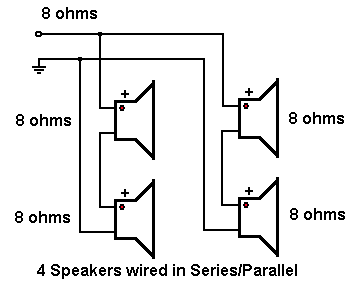
Speaker "farting" Oh heck, here is the relevant post:
I agree that over-driving a speaker is the typical source of the distorted tone called "farting," but a speaker can accurately reproduce a distorted tone originating from one (or more) sources besides the speaker itself. These include the instrument electronics, onboard preamps, effects, main pre, and power amp.
Furthermore, I recall once when a speaker in my goliath II 410 stopped working and all the others started farting at low volume. I was pretty sure I had fried the drivers, but it was a loose speaker wire in the cabinet, and much easier to fix than diagnose.
I believe the goliath l is wired like this. N.b., each speaker is in series with a mate, and those pairs are in parallel. The little blobs, or dots show who is connected to whom. Something is likely loose.
Last edited:
Jim Carr
Dr. Jim
- Jan 21, 2006
- 16,223
- 7,614
- 76
- Disclosures
- fEARful Kool-Aid dispensing liberal academic card-carrying union member Musicians Local 72-147
I have read that getting that grill cloth off tricky. It is likely held on with velcro. You can gently pry it off with a butter knife, but stay clear of the drivers! My goliath ll had a metal grill, which is a bit easier to deal with.
Having the cabinet on it's back is probably a good idea.
Once the grill is off, VERY CAREFULLY, unscrew the driver that seems the most afflicted (upper left?) and lift it away from the baffle hole. Gently lift it out by the edges. Leave it connected, and set it on the baffle somewhere nearby.
Don't drop any screws—put them in a cup, and don't pierce the speaker surrounds, dust cap or cone with a screwdriver tip. Yes, it happens a lot, though somehow I've avoided it so far.
In fact, at this point, don't touch the speakers that you are not working on AT ALL.
Shine a light inside and look for a loose wire. Take lots of pics of what you see and post them.
Study the wiring diagram I posted above and try to relate them to what you see. It is possible your cabinet has a different wiring scheme, but I doubt it.
N.b., you have a horn in the circuit, so there will be more wires running around than you might expect.
Having the cabinet on it's back is probably a good idea.
Once the grill is off, VERY CAREFULLY, unscrew the driver that seems the most afflicted (upper left?) and lift it away from the baffle hole. Gently lift it out by the edges. Leave it connected, and set it on the baffle somewhere nearby.
Don't drop any screws—put them in a cup, and don't pierce the speaker surrounds, dust cap or cone with a screwdriver tip. Yes, it happens a lot, though somehow I've avoided it so far.
In fact, at this point, don't touch the speakers that you are not working on AT ALL.
Shine a light inside and look for a loose wire. Take lots of pics of what you see and post them.
Study the wiring diagram I posted above and try to relate them to what you see. It is possible your cabinet has a different wiring scheme, but I doubt it.
N.b., you have a horn in the circuit, so there will be more wires running around than you might expect.
Last edited:
Jim Carr
Dr. Jim
- Jan 21, 2006
- 16,223
- 7,614
- 76
- Disclosures
- fEARful Kool-Aid dispensing liberal academic card-carrying union member Musicians Local 72-147
I still say tighten every screw on that cabinet. Commonly the spkrs, horn, grill cover are the usual suspects for getting loose...
In this case, I don't believe it is a loose fitting, though it might be a loose wire. It very much fits the symptoms I had about 11 years ago with my goliath ll. It was a detached wire. I was certain I had toasted a driver, but fortunately had not.
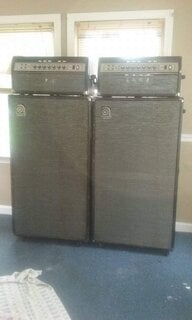
ALSO: just learned that clipping/distortion is caused by an overdriven amp, and NOT the cabinet being pushed too hard. Or at least that's my dumb understanding of it. Please clarify if I'm wrong.
And just to let you know, I also backlined the rig for a house show where two other bands used my bass rig so it could have just been overworked in one night. And this guy with a passive bass cranked the volume knob but I thought it was ok because (as I'm learning on this thread) I'm dumb.
Yes, an amp clips, not a speaker, that's when an amp is played too loud, means the audio sine wave's top and bottoms are clipped off as seen on an oscilloscope, some bass players like this if it's a tube amp and most guitarists like it (Marshall for example) but is not good from a solid state head usually.
clipping:
Last edited:
This is wrong. A cabinet that is pushed too hard can absolutely "fart-out".
However, contrary to popular belief, a speaker being driven past its limits may not always give audible clues that are easy to hear. I know this from personal experience.
"Farting out" is not clipping, only an amp can "clip" he's correct.
It seems to me that folks are over complicating the situation. If you want a clean sound, you turn the master volume all the way up and adjust the gain/preamp starting from 0, till you get the output volume you desire. If the cabinet starts to fart out, turn down the bass control/cut the eq at 35 hz until it cleans up. Most speakers can't reproduce frequencies below 40 or 50hz anyway, so it's just wasted power if you're trying to get those frequencies. The reason an old SVT 810 sounds so loud is that the cabinet isn't even trying to reproduce those super low fundamentals, but does a great job on the higher harmonics. @agedhorse , if I'm wrong, please advise. I am sure not an expert, but I think this is essentially correct.
SVT cabs will go down to 40 Hz but at a reduced level, they're pretty flat from 50 up. When retubing mine I've played around with a signal generator while plugged into the cab.


"Farting out" is not clipping, only an amp can "clip" he's correct.
Read his post again, he said clipping/distortion. Speakers can distort.
Read his post again, he said clipping/distortion. Speakers can distort.
Yes, clipping is a form of distortion, speakers do not clip, they can distort though.
Clipping
Audio
Description
Clipping is a form of waveform distortion that occurs when an amplifier is overdriven and attempts to deliver an output voltage or current beyond its maximum capability. Driving an amplifier into clipping may cause it to output power in excess of its power rating.
Yes, clipping is a form of distortion, speakers do not clip, they can distort though.
You could copy and paste a hundred definitions of clipping and it wouldn't change the fact that the OP literally said distortion.

You could copy and paste a hundred definitions of clipping and it wouldn't change the fact that the OP literally said distortion.
I'm not going to waste my time arguing with you, see ya.
if you have a multimeter-
How to test for damaged drivers:
open the cab and check for loose wires starting at the input jack.
if it's a multispeaker cab, separate the speaker leads (usually by pulling off the quick connect terminals at the backs of the speakers) take the meter (set to ohms) and test the resistance of the speaker. polarity of the leads is irrelevant.
the resistance should read something close to the speakers nominal impedance (4,8,16 ohms etc).
if it reads much higher the speaker has shorted open, if it reads close to 0- shorted closed.
gently press on the speaker cone and listen for scraping/scratchy sounds or odd feeling in the springy feeling of the suspension. the voice coil could be deformed
sealed enclosures are much more resistant to over excursion than ported as there is no boost beyond the resonant frequency.
Long (possibly in minutes depending on how much power is being dumped in) periods of playing at high power will cause the voice coil to overheat.
nearly all the electrical energy your amp puts out turns into waste heat at the voice coil.
efficient speakers/cabs are a great way to boost volume, plus you deal with less power compression (as the VC heats up it becomes more inefficient.)
How to test for damaged drivers:
open the cab and check for loose wires starting at the input jack.
if it's a multispeaker cab, separate the speaker leads (usually by pulling off the quick connect terminals at the backs of the speakers) take the meter (set to ohms) and test the resistance of the speaker. polarity of the leads is irrelevant.
the resistance should read something close to the speakers nominal impedance (4,8,16 ohms etc).
if it reads much higher the speaker has shorted open, if it reads close to 0- shorted closed.
gently press on the speaker cone and listen for scraping/scratchy sounds or odd feeling in the springy feeling of the suspension. the voice coil could be deformed
sealed enclosures are much more resistant to over excursion than ported as there is no boost beyond the resonant frequency.
Long (possibly in minutes depending on how much power is being dumped in) periods of playing at high power will cause the voice coil to overheat.
nearly all the electrical energy your amp puts out turns into waste heat at the voice coil.
efficient speakers/cabs are a great way to boost volume, plus you deal with less power compression (as the VC heats up it becomes more inefficient.)
I'm not going to waste my time arguing with you, see ya.
Second-weirdest argument I've ever had on TB.
Second-weirdest argument I've ever had on TB.
I don't think Talkbass is a good place to argue, who wants to read two bozos arguing?

The thing is, peeps use a lot of terms incorrectly, and yet, it's pretty easy to understand what they intend. And when it's not, it's a simple thing to clarify. Or dust up an argument, if you prefer.
Jim Carr
Dr. Jim
- Jan 21, 2006
- 16,223
- 7,614
- 76
- Disclosures
- fEARful Kool-Aid dispensing liberal academic card-carrying union member Musicians Local 72-147


