• TalkBass has been independent since 1998. Add your voice.
    Create a free account to reply to discussions, view embedded media, and browse with fewer display ads.
    Join freeLog in
    Want zero display ads or expanded classifieds tools? Compare plans.
How to play like Phil Lesh?

Apologies if you're here because you expected to find the answer, but I'm afraid I only have the question
I knew that before I ever hit the button! :)
I also knew that I would find some very smart people who have invested their time and talent into understanding the band and its bassist. He is the single most important influence I've known as a bassist, and his sweetness and sense of humor have always attracted me to him, personally...more like a crazy old uncle than a polished, professional musician of the highest standard. He, and his playing, have sustained me for almost 4 decades, and STILL, every time I listen to an old favorite...I listened to Skullfrack just this past weekend!...I find something new and interesting to contemplate. I've long since stopped trying to imitate him. I have never aspired to be a Phil Clone. He is the cornerstone of my musical education...the pilot of the ship...The Ice Cream Kid...
 
  • Like
Reactions: Miles_ONeal
One thing he does (did?) is control the duration of every (EVERY) note he plays; he rarely plays legato. This is an enormous factor in his rhythmic approach.
Something he got into towards the end of the dreadful great was playing the root on the one throughout the vocal. Kind of a schematic of the chords and tempo.
One thing he left off doing (I guess) is playing chords that would cause the rest of the band to disappear for a few seconds.
I studied him for a couple decades.
 
Interesting thread......it will take me some time to read through it all:)

I'm a Phil fan and have done my share of Dead covers over the years. Honestly, study all you want, Phil is an improve. It's pretty much stream of consciousness. The best way to pick up his style is to listen to a TON of Dead. The more the better.

When we used to do Dead covers, I would definitely pay homage to his style, but most of the time I made it my own........not too much though, because it won't sound like a Dead song anymore lol.

Without Phil, the Dead sound NOTHING like they do. Probably the biggest lacking feature of most Dead cover bands is a bassist that can't fill the role.
 
Hail Phil. I've been listening to the Dead for years now at the advice of friends but I mostly rejected them. I just wasn't there yet. Suddenly, I find myself glued to them. I was just on a Beatles kick. Learned (then soon forgot) a lot of the songs from '63-'65. Now its a Dead kick. Listening to his lines on the first Album, I feel like you can actually realize that he is on his way. Then by Europe '72 he is way there already. Really a great ride and I'm loving it. Lets keep the Phil Lesh thread keep going.
 
Hail Phil. I've been listening to the Dead for years now at the advice of friends but I mostly rejected them. I just wasn't there yet. Suddenly, I find myself glued to them. I was just on a Beatles kick. Learned (then soon forgot) a lot of the songs from '63-'65. Now its a Dead kick. Listening to his lines on the first Album, I feel like you can actually realize that he is on his way. Then by Europe '72 he is way there already. Really a great ride and I'm loving it. Lets keep the Phil Lesh thread keep going.
Cool. You really want to focus on live stuff, though. (Europe '72 is live, but you want to listen to full sets instead of collected bits and pieces.) There are tons of good-quality vids on YouTube: I'm happy to recommend some particular ones if you like. In general, I especially recommend anything between 1973-4 and 1977-8.
 
  • Like
Reactions: Youngspanion
Cool. You really want to focus on live stuff, though. (Europe '72 is live, but you want to listen to full sets instead of collected bits and pieces.) There are tons of good-quality vids on YouTube: I'm happy to recommend some particular ones if you like. In general, I especially recommend anything between 1973-4 and 1977-8.

Oh nonsense, nothing interesting or important happened after 1972!

Just kidding, but it's definitely important to include the 1968-72 material, especially with respect to his tone. In some ways, 1971 was a high-water mark of his tone (EB-3), but there were many high water marks along the way, even up to today. By 1977, his playing started to become much more conventional and less adventurous, but that was true of the whole band. There's also a lot to be learned from the studio albums, often in unexpected places (check out how he plays on China Doll from Mars Hotel. Definitely not typical ballad playing).
 
Honestly, study all you want, Phil is an improve. It's pretty much stream of consciousness. The best way to pick up his style is to listen to a TON of Dead. The more the better.
Once again, the notion that improvisation is not a product of study but just happens rears its head. Phil is improvising, but his improvisations are themselves a product of study of classical music, from Bach to Brahms to Berio, jazz, tidbits from other areas, and intense practice for years with his bandmates. No one just makes that stuff up off the top of their heads, it comes from years of hard study and intention. Even Weir was studying string quartets in the late 60s and early 70s to learn voice leading and had been working on McCoy Tyner's techniques all along. Garcia's influences are obvious.

We all stand on the shoulders of those who came before.
 
I have spent the better part of the last 37 years intently listening to the three main voices of Grateful Dead musicianship - the lead (Jerry), low frequency lead (Phil) and rhythm voice (Bob).

To my ears it's simply three simultaneous lead voices occupying different parts of the sonic spectrum.

I also have spent a lot of time pondering how Garcia's lines leaned against Lesh's, in comparison to how Jerry aligned with the the in-the-pocket grooves of John Kahn - a much more traditional approach to bass then anything Phil has ever played.

In so many intellectual ways as a bass player, I am repelled by Lesh's anti-pocket, use of pick, zero funk, hardly every on the downbeat or dwelling on the root notes approach to this music, but my emotional reaction to his insistence on inferring, instead of actually playing the beat has always been a trippy and satisfying experience.

One other truly rewarding aspect of his approach is the thick lushness of his tone when employing (primarily for me) his Modulus basses. When he was using the Mod, to me it had the most satisfying aurally engaging deepness. For a while in the post-Jerry era he switched to a couple of different Ritter basses and literally, based upon fan request, reverted back to Modulus to enhance his capacity to unleash "Bombs."

Of course in the earliest days he used Fender P's and then Guild Starfires, eventually with pick-ups modified by Rick Turner and Ron Wickersham of Alembic. From there it was Music Man 4's up until about '79 when he got an Irwin - which gave way to a few Ken Smith's and then a long run of Moduli....

As for how to play in that style - it takes a ton of listening and the idea of "inferring," instead of emphatically playing on the beat.

My initial gut reaction to the question was - it's actually easier to play like Phil then to repetitively mine the groove in the style of the average, everyday bass player. But having thought and now typed this, it only comes to me easily because of the ridiculous amount of GD and post GD shows I've seen and continue to see, the huge number of hours over decades spent listenting to it and understanding that this music is basically the soundtrack to my life and is part of my musical consciousness.

This is not helpful to anyone striving to learn Lesh's approach.

So hit the archive and fill your ears, head, gut and mostly your heart with GD music and eventually you will get there!
 
Last edited:
Of course in the earliest days he used Fender P's and then Guild Starfires, eventually with pick-ups modified by Rick Turner and Ron Wickersham of Alembic. From there it was Music Man 4's up until about '79 when he got an Irwin - which gave way to a few Ken Smith's and then a long run of Moduli....

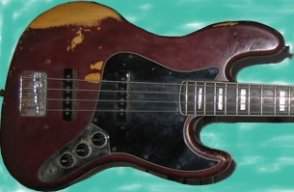
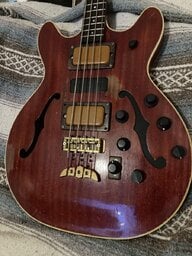
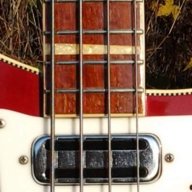
Actually, it wasn't quite like that in the early days. At first he had an EB-0, that was replaced with a Jazz by 1966. In '67 he picked up a Starfire, that was modified with extra magnets and preamps built onto the bottom of pickups (spider sex style). Then, he turned it over to Alembic for the big modification and played an EB-3 that was modified with BiSonic pickups and an extra tailpiece from 1970 to 1971. In '71 he got the Starfire back with the full on mods (which I have played. It was awesome, but surprisingly not all that different from my Starfire.
Big Brown-1.jpg
) and played that through '74 (and off and on through 1979), when he got the Alembic Osage Orange bass, as seen in the GD movie. It was switched out with the Guild through '79 or '80, when he played a '62 Jazz for a bit (terrible tone) and then a G&L (slightly better) and then a Doug Irwin bass (also terrible- it's the bass on Dead Set and Reckoning). Finally, ca. 1983 or maybe late '82, he jumped into Modulus world.

My favorite tones are the EB-3, Starfire, Alembic, and Moduli. Sort of in that order. The Ritter and Ken Smiths didn't do much for me. These days I've gone back to my short scale roots and there's a lot of Phil's 60s and 70s tones that are due to that.

As far as Phil's lack of conventionality, I think two points are worth keeping in mind: 1) with all the other bass players in the world who play conventionally, life's not too short for a Phil Lesh. The world is a richer place for him. 2) If you step out of the rock world and are as steeped in classical music (especially modern classical), jazz, and electronic music as I am, it's quite refreshing to hear the bass as a legitimate voice with equal weight to the other voices (as you point out). Listen to Steve Swallow for an equally melodic and creative voice in the jazz world, or Scott LaFaro. It's worth spending time with the Bach Cello Suites (a lifelong companion) and delving into other classical composers for examples of how to organize counterpoint and beyond. It seems that most complaints about his refusal to stick in the groove and play roots are from people who come from a rock/R&B/funk background. Nothing wrong with that, I played mostly funk for 25 years, but again, life's not too short.

(Meanwhile, my 5 year old has discovered my Bootsy collection and has been playing them nonstop for days! As he said on Sunday, "When the band brings it, ya gotta dance!")
 
The reason why you can't find anyone who has pinned down Phil's style is the fact that his playing really varies. What he is most known for basswise is his melodic style. He'll play melodies throughout a song, sometimes playing off of the vocal, sometimes Jerry, sometimes off of the keys, sometimes out there all by himself. I've played many Dead covers over the years and the one thing that I've learned is that if you play the song the way Phil played it, you better have a drummer that knows what the song is supposed to sound like already, because they're getting no clues from you. The drummer cannot follow you if you're copping Lesh licks. If you want to learn how to play like Phil; study your theory, chord, scales and whatnot; smoke lotsa really good weed; and play with a bunch of incredibly talented hippies for about 40 years. That should get you there.

Edit: I would like to add that I in no way condone the use of illegal drugs, playing with hippies, or studying whatnot.

I think this is spot on. When I play with a drummer that knows the Grateful Dead I can actually begin to play Dead songs like Phil does - otherwise I need to play the roots and make the whole experience much more simple.

It's tough to play like Phil - I find I end up using some Phil licks whenever I can. I play with a pick less and less though so it's becoming less authentic.
 
  • Like
Reactions: 47th Street
Actually, it wasn't quite like that in the early days. At first he had an EB-0, that was replaced with a Jazz by 1966. In '67 he picked up a Starfire, that was modified with extra magnets and preamps built onto the bottom of pickups (spider sex style). Then, he turned it over to Alembic for the big modification and played an EB-3 that was modified with BiSonic pickups and an extra tailpiece from 1970 to 1971. In '71 he got the Starfire back with the full on mods (which I have played. It was awesome, but surprisingly not all that different from my Starfire.View attachment 1181375 ) and played that through '74 (and off and on through 1979), when he got the Alembic Osage Orange bass, as seen in the GD movie. It was switched out with the Guild through '79 or '80, when he played a '62 Jazz for a bit (terrible tone) and then a G&L (slightly better) and then a Doug Irwin bass (also terrible- it's the bass on Dead Set and Reckoning). Finally, ca. 1983 or maybe late '82, he jumped into Modulus world.

My favorite tones are the EB-3, Starfire, Alembic, and Moduli. Sort of in that order. The Ritter and Ken Smiths didn't do much for me. These days I've gone back to my short scale roots and there's a lot of Phil's 60s and 70s tones that are due to that.

As far as Phil's lack of conventionality, I think two points are worth keeping in mind: 1) with all the other bass players in the world who play conventionally, life's not too short for a Phil Lesh. The world is a richer place for him. 2) If you step out of the rock world and are as steeped in classical music (especially modern classical), jazz, and electronic music as I am, it's quite refreshing to hear the bass as a legitimate voice with equal weight to the other voices (as you point out). Listen to Steve Swallow for an equally melodic and creative voice in the jazz world, or Scott LaFaro. It's worth spending time with the Bach Cello Suites (a lifelong companion) and delving into other classical composers for examples of how to organize counterpoint and beyond. It seems that most complaints about his refusal to stick in the groove and play roots are from people who come from a rock/R&B/funk background. Nothing wrong with that, I played mostly funk for 25 years, but again, life's not too short.

(Meanwhile, my 5 year old has discovered my Bootsy collection and has been playing them nonstop for days! As he said on Sunday, "When the band brings it, ya gotta dance!")

So cool!
 
  • Like
Reactions: 47th Street
I think this is spot on. When I play with a drummer that knows the Grateful Dead I can actually begin to play Dead songs like Phil does - otherwise I need to play the roots and make the whole experience much more simple.

It's tough to play like Phil - I find I end up using some Phil licks whenever I can. I play with a pick less and less though so it's becoming less authentic.

So true. If the drummer doesn't have that drive and swing (and especially doesn't just follow the lead guitar player's dynamics, but provides a constant energy and flow), then you're stuck being John Kahn. Also, having the rhythm guitar parts being right helps a lot. Either way, the band needs to internalize the structure of Trane's band with McCoy Tyner and Elvin Jones before anything real can happen.

Phil did play with his fingers some between 1970 and 1972. Check out this video for a few cuts of finger playing. I'm really curious to know what he did to get that tone, though. When I play my Starfire with my fingers it looses that clarity that he has. Must be a filter setting, but he did the same thing with his EB-3 (Wharf Rat and Bertha from the Skull and Roses album are great examples).


  • Like
Reactions: 47th Street
I have an intuition (not based in any particular facts I can cite) that he turns the amp way up and plays very lightly. Can anyone confirm or refute this?

I think Phil's style is unique, I've never heard anyone else do anything approaching it. Every time I listen to him, I get a big grin of wondrous amazement, it's always a delight....