I've been intensely enjoying the new May 1977 box set that the GD put out about a month ago, and it's a really beautiful example of where the band was at that point in time. It's a perfect example of how refined they were while being able to keep things loose. I'm a big (yuuuuge) fan of The Dead and Phil, but I think the "classical training" influence is pretty overblown. I can hear more of those concepts in the band as a whole (such as splitting the band in half during a St. Stephen jam or having a few key centers happening at once) rather than Phil's personal playing.
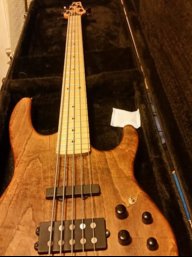
The elements that stick out to me with Phil's playing is that he really "gets after it" all the time. Different eras have different sounds, but his playing style is still very much himself. For being into a lot of atonal music, he's largely a tonal player, and doesn't use much chromaticism that is outside of the key of a given song. Even with the range his lines cover, I don't hear him as a particularly melodic player-- Jerry was melodic, imo. Phil is what I would call a "groove buster," and if he was in any other band than the Grateful Dead his style is a big middle finger to the music. With the Dead, it's an integral part of the sound, and I think it's what keeps them from ever really sounding thick or heavy. Phil's rhythmic sensibilities are what really set him apart to my ears. It's sort of how piano players try to sound like Thelonious Monk by playing a bunch of cluttered notes, but they completely forget that Monk swung really hard. Phil's often playing an independent line from the band in most instances. Listen to the intro to "Help on the Way" when the band plays the rhythmic figure and Phil is doing something totally different (but it works great). Some bassists are masters at telegraphing a song, and you know exactly where it's going. Phil's not that guy, and he doesn't have to be. If you were sitting in with the band, he's not going to give you any kind of indication as to where the music is going. I'd describe his style as "playing around the song" rather than "laying it out." Phil basically let's everyone else establish the song while he plows through it, and that's a huge part of the Dead sound. There's also the fact that everyone in the band plays in such a way that they're not socially stepping on each other. For the number of musicians playing at the same time, the band's sound is pretty "open."
One thing I've really picked up on while listening to the May '77 shows is that you really have to listen to the instrumental sections in a more linear way rather than vertically. I think we're conditioned as listeners to hear music from a vertical perspective. We hear things in 4 or 8 bar phrases, we want to hear harmonies that all line up together at the same point in time, etc. The Dead's approach is more horizontal and I think this is why they are perceived to be noodling. If you zero in on an individual player at a given moment, you can hear a lot of direction and intention in what they are doing. There's a particularly great example of the band doing a sort of "Time no one" thing that Miles Davis' second quintet did so well. The band gradually peels away from the phrase structure one by one, and everyone has their own concept of where their own downbeat is. The beat stays the same, but they're all phrasing independently of each other. Sam Rivers and Dave Holland have explored this style of writing and improvising as well, and it would not surprise me if the GD were hip to what Sam was doing.
The elements that stick out to me with Phil's playing is that he really "gets after it" all the time. Different eras have different sounds, but his playing style is still very much himself. For being into a lot of atonal music, he's largely a tonal player, and doesn't use much chromaticism that is outside of the key of a given song. Even with the range his lines cover, I don't hear him as a particularly melodic player-- Jerry was melodic, imo. Phil is what I would call a "groove buster," and if he was in any other band than the Grateful Dead his style is a big middle finger to the music. With the Dead, it's an integral part of the sound, and I think it's what keeps them from ever really sounding thick or heavy. Phil's rhythmic sensibilities are what really set him apart to my ears. It's sort of how piano players try to sound like Thelonious Monk by playing a bunch of cluttered notes, but they completely forget that Monk swung really hard. Phil's often playing an independent line from the band in most instances. Listen to the intro to "Help on the Way" when the band plays the rhythmic figure and Phil is doing something totally different (but it works great). Some bassists are masters at telegraphing a song, and you know exactly where it's going. Phil's not that guy, and he doesn't have to be. If you were sitting in with the band, he's not going to give you any kind of indication as to where the music is going. I'd describe his style as "playing around the song" rather than "laying it out." Phil basically let's everyone else establish the song while he plows through it, and that's a huge part of the Dead sound. There's also the fact that everyone in the band plays in such a way that they're not socially stepping on each other. For the number of musicians playing at the same time, the band's sound is pretty "open."
One thing I've really picked up on while listening to the May '77 shows is that you really have to listen to the instrumental sections in a more linear way rather than vertically. I think we're conditioned as listeners to hear music from a vertical perspective. We hear things in 4 or 8 bar phrases, we want to hear harmonies that all line up together at the same point in time, etc. The Dead's approach is more horizontal and I think this is why they are perceived to be noodling. If you zero in on an individual player at a given moment, you can hear a lot of direction and intention in what they are doing. There's a particularly great example of the band doing a sort of "Time no one" thing that Miles Davis' second quintet did so well. The band gradually peels away from the phrase structure one by one, and everyone has their own concept of where their own downbeat is. The beat stays the same, but they're all phrasing independently of each other. Sam Rivers and Dave Holland have explored this style of writing and improvising as well, and it would not surprise me if the GD were hip to what Sam was doing.