
Enjoy the benefits of a premium membership!
Upgrade Account
-
TalkBass has been independent since 1998. Add your voice.
Create a free account to reply to discussions, view embedded media, and browse with fewer display ads.
Join free Log in
Want zero display ads or expanded classifieds tools? Compare plans.
You are using an out of date browser. It may not display this or other websites correctly.
You should upgrade or use an alternative browser.
You should upgrade or use an alternative browser.
How to use the tone knob
- Thread starter Derp
- Start date
More options
Who Replied?

If you're strung with flats or dead rounds I've found this can often be the case. Beyond that, you might want to try a higher value capacitor or replace the pot with a logarithmic taper rather than linear (I'm assuming there's a linear in there)

I don't feel a difference, but I do hear a difference. I agree if your strings are somewhat dead you won't hear as much difference from the tone knob.
The tone knob (together with a capacitor) is a low pass filter, meaning that it cuts high frequencies. If you turn your tone knob down, you'll hear the high frequencies disappear, and the low frequencies will be all that remain. This can create a sound that is more mellow, but can also become muddy. If you turn your tone knob up, the high frequencies will be restored, and your attack will be more crisp, and your tone will be brighter.
Capacitor values affect the amount of treble that is cut. An article on capacitors: http://www.seymourduncan.com/tonefiend/guitar/customize-your-caps/
As for log versus linear, you should have (and probably do have) a logarithmic taper potentiometer (pot) in your instrument, as log pots are typically used in audio application. That just reflects the way our ear works. However, the type of taper should not affect the actual tone of the instrument. You want log, though.
Capacitor values affect the amount of treble that is cut. An article on capacitors: http://www.seymourduncan.com/tonefiend/guitar/customize-your-caps/
As for log versus linear, you should have (and probably do have) a logarithmic taper potentiometer (pot) in your instrument, as log pots are typically used in audio application. That just reflects the way our ear works. However, the type of taper should not affect the actual tone of the instrument. You want log, though.
It can be scary, but there are few things wired up more simply than a P-bass, and opening it up to change out the pots it a great way to get your feet wet learning how to wire. I didn't have the slightest idea what I was doing (seriously, no electronics experience whatsoever, and no helpful mentor except the internet) when I tried to tackle swapping out he pickups and preamp in my brubaker, and it took me a month, but I got there.
Give it a go, you'll happy you learned how to do it.
Give it a go, you'll happy you learned how to do it.
The tone knob (together with a capacitor) is a low pass filter, meaning that it cuts high frequencies. If you turn your tone knob down, you'll hear the high frequencies disappear, and the low frequencies will be all that remain. This can create a sound that is more mellow, but can also become muddy. If you turn your tone knob up, the high frequencies will be restored, and your attack will be more crisp, and your tone will be brighter.
Capacitor values affect the amount of treble that is cut. An article on capacitors: http://www.seymourduncan.com/tonefiend/guitar/customize-your-caps/
As for log versus linear, you should have (and probably do have) a logarithmic taper potentiometer (pot) in your instrument, as log pots are typically used in audio application. That just reflects the way our ear works. However, the type of taper should not affect the actual tone of the instrument. You want log, though.
It's a brand new 2013 affinity

you should definitely be able to detect a difference in sound between the extreme positions of the tone knob.
But it may not be as much as you expect, as the tone knob is a very simple filter, as mentioned.
don't expect the variety of tone you hear in recordings -there's alot from variety in basses and gear involved.
You will get more noticable tone tweaks in the amplifier, in general.
It's very unlikely that a brand new 2013 affinity needs repair or replacement parts.
before you got take the trouble of hacking your bass apart, be aware of how the rest of your signal chain is behaving.
is your cable good? what are the amplifier settings? any pedals involved? (you are plugging in aren't you? )
room shape and size is also a factor, perhaps try a headphone out if your amp has it.
But it may not be as much as you expect, as the tone knob is a very simple filter, as mentioned.
don't expect the variety of tone you hear in recordings -there's alot from variety in basses and gear involved.
You will get more noticable tone tweaks in the amplifier, in general.
It's very unlikely that a brand new 2013 affinity needs repair or replacement parts.
before you got take the trouble of hacking your bass apart, be aware of how the rest of your signal chain is behaving.
is your cable good? what are the amplifier settings? any pedals involved? (you are plugging in aren't you? )
room shape and size is also a factor, perhaps try a headphone out if your amp has it.

I usually use my tone knob to reduce the buzz and hum coming from my amps. Turning it down 50% usually eliminates the majority of the unwanted noise.
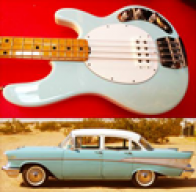
It's a brand new 2013 affinity
What kind of amp are you going through? Your amp probably has some eq knobs as well, and that can definitely have overriding effects with whatever you're putting into it. Try setting your amp's eq flat and then mess with your tone knob on the bass.
What kind of amp are you going through? Your amp probably has some eq knobs as well, and that can definitely have overriding effects with whatever you're putting into it. Try setting your amp's eq flat and then mess with your tone knob on the bass.
My amp is the crappiest thing you can think of. It's a headphone amp. Great thing to have, but of course you can't expect any serious sound. But I still expected a "significant" difference between the tone pot all the way down and all the way up.
My amp is the crappiest thing you can think of. It's a headphone amp. Great thing to have, but of course you can't expect any serious sound. But I still expected a "significant" difference between the tone pot all the way down and all the way up.
The one thing I noticed when I bought a quality amp/cab combo was that suddenly the tone knobs on my basses actually worked.

The knobs on your bass are likely working fine, but your head-phone amp + head phones are covering it all up with their own contributions to the sound you hear.
On a passive bass, just run the tone knob full up, to get the whole sound.
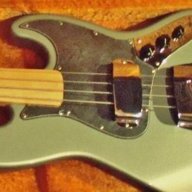
A tone knob does very little to my ear. Little good, that is. As mentioned, it either cuts or allows highs, is all, which I suppose is a change in the frequencies you are producing, but it doesn't really shape overall tone that much.
A good amp should have Lows, Low Mids, High Mids, and Highs, which will do more to change your overall tone than the simple cutting of highs on your basic bass tone knob. I generally run the tone on my basses full up and use other means to shape my tone. Another way to affect tone on the bass itself is to experiment with pickup blending. Depending on how the pickups are wired (assuming you have 2 or more pickups), you can try different blends. This does more than just raise/lower the output from each pickup. For example, on a Jazz, start with both PUs full on, then back off the bridge pickup about 25%. You can hear a distinct tonal change to a mid-heavy sound.
A good amp should have Lows, Low Mids, High Mids, and Highs, which will do more to change your overall tone than the simple cutting of highs on your basic bass tone knob. I generally run the tone on my basses full up and use other means to shape my tone. Another way to affect tone on the bass itself is to experiment with pickup blending. Depending on how the pickups are wired (assuming you have 2 or more pickups), you can try different blends. This does more than just raise/lower the output from each pickup. For example, on a Jazz, start with both PUs full on, then back off the bridge pickup about 25%. You can hear a distinct tonal change to a mid-heavy sound.
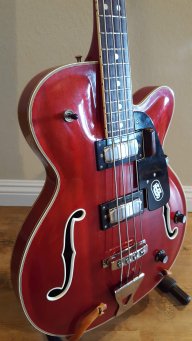
I usually use my tone knob to reduce the buzz and hum coming from my amps. Turning it down 50% usually eliminates the majority of the unwanted noise.
If the tone knob on the bass reduces hum and buzz, then its coming from the bass, not the amp. I say shielding problem.
I usually use my tone knob to reduce the buzz and hum coming from my amps. Turning it down 50% usually eliminates the majority of the unwanted noise.
tbplayer59 has a good point. Though IME, this unmusical buzz and noise is usually the result of running single coil pickups at anything other than equal volume. That to me is a big fail on the Fender Jazz bass (and copies). As soon as one pickup is favoured over another, there is the buzz/hum/noise. For certain styles of music, the noise is accepted, but for me, I just don't like it. I generally use the Jazz bass with the two pickups at equal setting and the tone knob full up, and deal with baseline sound shaping via knobs at the amp. If the room situation is great magnetic-field wise, I might be able to favour a p/u in an acceptable to me way. The rest, fingers.
If the tone knob on the bass reduces hum and buzz, then its coming from the bass, not the amp. I say shielding problem.
Those Affinity P basses all do it. More of a grounding issue I suspect since making contact with the controls or the strings completely gets rid of it.
Try using that headphone amp to "Smiley face" the EQ a bit, that is, boost the Bass and the Treble, and either flatten or cut the mids altogether. While I wouldn't normally do this on a real amplifier, it will probably help you with the tone knob. If you're starting by cutting everything but the bass, you're basically doing the same thing the tone knob does, but on the amp.


