
• TalkBass has been independent since 1998. Add your voice.
    Create a free account to reply to discussions, view embedded media, and browse with fewer display ads.
    Join freeLog in
    Want zero display ads or expanded classifieds tools? Compare plans.

How To Write Chord Progressions With NEGATIVE HARMONY [Simple Explanation]

I was able to find a simple "Intro into Negative Harmony" on the web.


Download the PDF with annotations (ENG) : https://www.mediafire.com/?sr2bvoon9b...

Let's read.

Neg1.PNG


In short.
The most important thing in that "negative harmony" concept is the SPINE of tonality - the Tonic and the 5th.
Which means, we go up the scale (C major) = positive harmony = from the Tonic and
go back from the 5th/dominant (!!! not from the 8th) degree of the scale by using a reverse interval structure of the scale - T-T-ST-T-T-T-ST - in our case - a C major scale.

Now, let's learn that term "GENERATOR".
(From the same Intro)
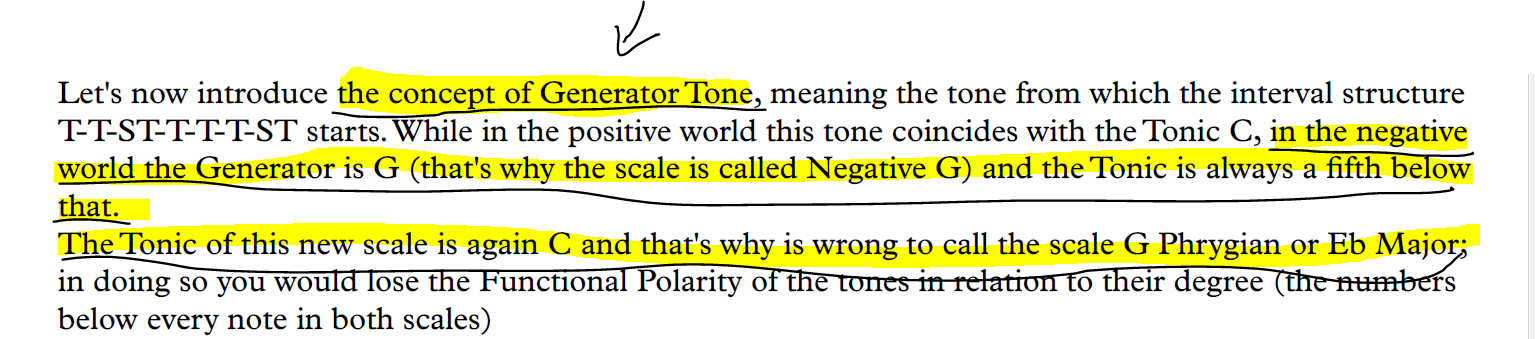
neg2.PNG

Here is the same Marco Fiorini with another lesson on negative harmony.
Download the PDF with annotations: https://www.mediafire.com/?qntuqa7ifa...

neg3.PNG


Some interesting substitution.

neg4.PNG
 
Last edited:
Let's continue with our "Intro into Negative Harmony".
As we've learned from some comments earlier, in order to go back - to "negativize" a scale - we need to start with the 5th degree of the scale, not with the last 8th (1st)!

It's due to the vision of the negative harmony concept.
That's why we have that "strange" displacement feeling.
And that's why G triad does not become G minor triad, or F triad does not convert into F minor, etc...

Here is a harmonized C major scale.
From C to ("shining") C going up - the positive/normal way, but we go backwards from the 5th degree!
I looks confusing because the C major triad in its negative form becomes C minor, but...

We descend in thirds from the 5th degree of the scale, and call it "negative" I triad.

The formula for any major triad is
Root position + 4 half steps + 3 half steps (or 7 half steps above root).
Now, let's reverse/go backwards from the 5th degree of the scale by using the same but "reversed"/"negative" major triad formula.
In C major.
We start with the note G - 4 half steps - it's Eb - 3 half steps = C.


neg-harmony.PNG


P.S. There are two "outlandish" terms to learn.

"Telluric Adaptation consists in reading chords from the bottom up, as we are already used to do in the
positive world",
and
"Absolute Conception, on the other hand, we read the chords starting from the Generator tone, so
from top to bottom."
 
Now that we know "a lot" about the basics of "negative harmony", let's ask and answer a few questions about negative chords.

N.B. Remember it's all about the "SPINE of tonality" - the Tonic and the 5th.
We go backwards from the 5th degree.

I would like to know what is the negative chord of Imaj7 or (as in our example), Cmaj7 - C E G B.
C + 4 half steps to E + 3 half steps to G + 4 half steps (h.st.) to B as
Root + 4 h.st. + 3 h.st. + 4 h.st.

We start counting intervals backward from the 5th degree.

G - (minus) 4 half steps to Eb - 3 h.st. to C - 4 h.st. to Ab.

Now we have a negative - Cmaj7 as Ab - C - Eb - G. looks like a simple Abmaj7 chord, but...

What note is our GENERATOR - the note that we started/"generated" that negative chord?
It's G, the 5th degree of the C major scale.
If we know the Generator, than, the root of the newly formed "negative" chord is a fifth below its Generator = C; therefore, the "proper" notation of that (so called) Abmaj7 chord is Cmin(b6), with the Root note - C.

Let's get a more complex question.

What would be the negative chord of bII - a major triad starting (root) with b2?
If we have the C major tonality, then bII would be Db (major).
Where do we start counting backwards in order to obtain that "negative bII chord?
We know that b2 is a half step up from the "positive"/normal Tonic, and (when we include that "negative displacement" = Count backwards from the 5th degree), then,
we would need to apply that "half step" difference - b2 - to the 5th degree.
The result would be the 5th degree - (minus) a half step to b5 (or #4).
In C major we would have G - (minus) a half step = Gb or F#.
And that note - Gb/F# - becomes our Generator.
F# - (minus) 4 half steps to D - (minus) 3 h.st. to B.
Now we have the following "negative" chord notes - F# - D - B or B - D - F#.
If we know our Generator - yes, it's F#, then the root of that "negative chord" is a fifth below the Generator - B.
It means, a negative chord of bII is vii
or in our case,
In C major, the negative chord of Db is Bmin.
 
In "positive" Harmony, the Db major triad is Db major triad, but in the realm of "negative harmony", we have some differences.

Negative Harmony works in relation to a tonal center or key; therefore,
the "negative mirror" of the Db major triad in the key of C = B min (from the comment above), but in the key of Db major, the negative mirror of Db is Dbmin.
We start counting backwards from the 5th degree - Ab.

Db.PNG