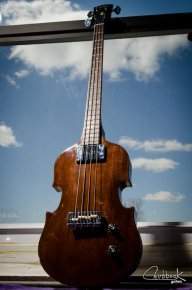
In my experience, it's the nitro lacquer that darkens over time from UV exposure, not the wood. I do a lot of restorations on 1960's Ampegs, and when I scrape off the old nitro lacquer, the bare 45 year old maple is about the same color as fresh maple. Now, it's true that if you left unfinished maple out in the sun, it will darken (and crack, and rot!). But the finish protects the wood from the sun.
The only places where the wood gets darkened is where the finish is cracked or chipped. When I scrape off a lacquer finish that has a bunch of age crack lines, there's a "suntan" of dark lines in the maple matching the pattern of the cracks. The lines are some combination of UV darkening and soaking in of grease and grime.
From what I've seen so far, modern polyester and polyurethane finishes don't significantly darken with age. Maybe they will have darkened some in 50 years, but I doubt it. Basses that I painted 15 years ago with polyurethane haven't shown any signs of darkening. The amber on the backs of the necks is a tint that I added when I sprayed it.
So, instruments finished in poly probably won't darken with age, but instruments finished in nitro lacquer almost certainly will. The modern water-based polyurethane-acrylics that many of us smaller luthiers are using these days also appear to be very stable and not likely to darken.
The important thing is the the integrity of the finish. If you chip it, seal it back up. Try not to expose it too much to direct sunlight. The modern finishes are much more resistant to sunlight, but too much heat can still cause them to buckle, shrink, and crack.