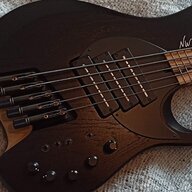
Yes, a custom that is totally different, neck throught, tight string spacing, soapbar pup.If it's clipping in Cubase, you can apply the HPF there.
Do you have another 5 string that does not do this
Same string brand, super balanced

TalkBass has been independent since 1998. Add your voice.
Create a free account to reply to discussions, view embedded media, and browse with fewer display ads.
Join free Log in
Want zero display ads or expanded classifieds tools? Compare plans.
Yes, a custom that is totally different, neck throught, tight string spacing, soapbar pup.If it's clipping in Cubase, you can apply the HPF there.
Do you have another 5 string that does not do this
Remove the B string...it's not necessary and it's only getting in your way. Problem solved.Hi!
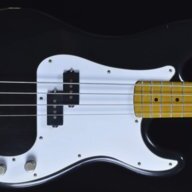
I have a 5 string P Bass with a Low B that overpowers the other 4.
Lowering the pickup doesnt work because it make the E string, and A quieter too.
Unbalance persist.
Rising the action of B string would be a solution, but currently the B string saddle is at the same high as E string, so the action is noticiable higher than the rest of the strings. Still so unbalanced.
Tried different gauges. Heavier still moves a lot and create a greater signal. Lighter = more floppy but still enough to create greater peaks than the rest.
Trying to find a solution that doesnt include buying 1 millon strings in order to get one with a less magnetic signal to get balance
any ideas?
It is more than annoying specially when recording it keeps clipping, with the rest of the strings with a quieter signal input.
thanx!
That's good news. That means you can fix it with eq'ing, pickups etc. That's why I play an instrument I'm considering buying, strictly acoustically for quite a bit before I plug it in.No, acoustically sounds like normal
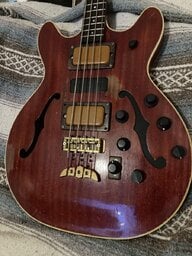
Try a tort pickguard, seems to the the cure-all! (Come on, a little humor on a Friday)
That, and of course, fire the drummer.Try a tort pickguard, seems to the the cure-all! (Come on, a little humor on a Friday)



Lower that side of the pickup.
Compressor.
HPF.
Lighter B gauge.
Any would help with part of the problem which is that the mass of a B is higher.


Just a nitpick (of no consequence at all): 24 bits are the bit depth of the resulting *file*, but basically no converters go beyond 20/21 bits. The lower three bits are noise. Still, 20 bits mean a potential SNR of 120dB. You can record peaking at -18dBFS (and you shouldn't, -18dBFS should be the integrated reading, seen through a VU meter or an RMS meter, not the peak value) and still have 100dB SNR. (A bass guitar is going to be much noisier anyway).you mentioned, you're recording. you should have one in your DAW. and a frequency analyzer that will help you understanding, is it like louder in all frequencies or has the sub-sonic boom (a rather common case).
lower the gain until you won't clip the input, at 24 bits you have not to worry if your signal is strong enough after this.
Maybe the not original pu isNope. The original pup is a fender style and the custom a got have no exposed poles

An idea : could this unbalance be unavoidable to a certain degree with 5 string (passive) P (non-reverse pickup) basses, which would partly explain why they are so uncommon?
There was a thread a few weeks ago, about how to get a great sounding B string. Two of the common answers that I remember of are "having a bridge pickup" and "going active". Not saying that these are mandatory, but it makes sense that missing those two ingredients makes things a bit harder.Not a trivial point at all. I find the low B indistinct and boomy on any P 5er, no exception (while retaining nothing of the P growl really). Just not to the (apparently unplayable) extent the OP is describing.