
Enjoy the benefits of a premium membership!
Upgrade Account
-
TalkBass has been independent since 1998. Add your voice.
Create a free account to reply to discussions, view embedded media, and browse with fewer display ads.
Join free Log in
Want zero display ads or expanded classifieds tools? Compare plans.
You are using an out of date browser. It may not display this or other websites correctly.
You should upgrade or use an alternative browser.
You should upgrade or use an alternative browser.
How's your reading?
- Thread starter BassyBill
- Start date
More options
Who Replied?
- Apr 1, 2000
- 17,398
- 9,828
- Disclosures
- Endorsing Artist: Roscoe Guitars, DR Strings, Aguilar Amplification
Which is why he said it was impossible, Bruce.
Exactly.

The point is that Jaco wasn't sight reading, when he played his version(s) of Donna Lee!
Well, thanks for clearing that one up.

Bruce, joking aside... maybe you just missed post #6 in this thread?
The provenance of that recording is NOT the point at all. It was just used as an example (by Febs, and by me) of something that would be pretty much impossible to read and play on sight, at tempo - in other words, to establish some sort of upper, unnattainable limit on this particular skill. If it had originally been generated by some sort of random MIDI sequencer, the example would still be valid.
And if we'd picked something that was actually played on sight, it wouldn't be a valid example of something that was.. er... impossible to play on sight.
What I'm saying is that it is a bad example; firstly, as it is a piece that was improvised and that anyway - it's not that complex as an idea - it's a fairly typical 32-bar Jazz standard.
Have a look at some classical scores like the Rite of Spring or any Messiaen if you want to see stuff that it is hard to read - not a repeating 32-bar chord sequence...
It's not changing time every bar for example :
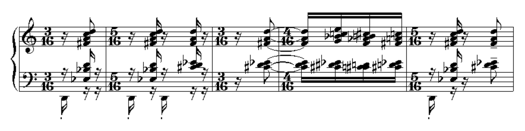
Have a look at some classical scores like the Rite of Spring or any Messiaen if you want to see stuff that it is hard to read - not a repeating 32-bar chord sequence...
It's not changing time every bar for example :
- Apr 1, 2000
- 17,398
- 9,828
- Disclosures
- Endorsing Artist: Roscoe Guitars, DR Strings, Aguilar Amplification
What I'm saying is that it is a bad example; firstly, as it is a piece that was improvised and that anyway - it's not that complex as an idea - it's a fairly typical 32-bar Jazz standard.
So you could sight read a transcription at tempo?
But that's not what Jaco was doing!
He was improvising - he was not sight-reading!
And what I can or can't do, is not relevant to whether it's a good example!
He was improvising - he was not sight-reading!
And what I can or can't do, is not relevant to whether it's a good example!
- Apr 1, 2000
- 17,398
- 9,828
- Disclosures
- Endorsing Artist: Roscoe Guitars, DR Strings, Aguilar Amplification
Jesus Bruce, you've totally missed the point. Totally and completely.
I'm pretty sure everyone else got it though.
I'm pretty sure everyone else got it though.
Well you keep saying the same thing - which is just a put-down of me - but adds nothing to the discussion, whatsoever!
At least I have tried to provide relevant examples - whereas you are just being negative about my suggestions with no alternatives of your own - passive/aggressive?
At least I have tried to provide relevant examples - whereas you are just being negative about my suggestions with no alternatives of your own - passive/aggressive?
- Apr 1, 2000
- 17,398
- 9,828
- Disclosures
- Endorsing Artist: Roscoe Guitars, DR Strings, Aguilar Amplification
The example that Febs provided was perfect, and you chose to pick it apart. Talk about adding nothing to the conversation....
How can it be perfect as an example of difficult sight-reading - when it is not a written piece - makes no sense... ?
?
Besides - there can't be one perfect example - there are centuries of written music out there which does fit the bill - to just limit yourself to one piece sounds like a severe lack of imagination on everybody's part, to me...?
I would suggest people look at Ligeti,Messiaen,Stockhausen,Xenakis,Henze as well as Stravinsky (who was a favourite of Jaco ) for written scores with considerable degrees of difficulty. Or the virtuoso concertos from the Romantic period..? Rachmainov's piano concertos are reckoned to be amongst the most challenging ever written?
?Besides - there can't be one perfect example - there are centuries of written music out there which does fit the bill - to just limit yourself to one piece sounds like a severe lack of imagination on everybody's part, to me...?
I would suggest people look at Ligeti,Messiaen,Stockhausen,Xenakis,Henze as well as Stravinsky (who was a favourite of Jaco
) for written scores with considerable degrees of difficulty. Or the virtuoso concertos from the Romantic period..? Rachmainov's piano concertos are reckoned to be amongst the most challenging ever written?
The example that Febs provided was perfect
... and yet somehow I'm now sorry that I picked that example.

Open your minds - embrace all that difficult music out there - don't limit yourself to plank-spankers!!
I guess this has been beaten to death, but I thought the Donna Lee thing was a perfect example.
Remember, 'Donna Lee' is a jazz standard (if I remember correctly, it's basically a new head put over the changes to 'Back Home in Indiana' by Charley Parker back in the day).
If you have a Real Book, there will be a written out head for Donna Lee just like any other jazz standard (bop or otherwise). Whether Jaco 'read the head' when he played it (I'm sure he didn't) is a moot point.
The reason it is a good example IMO is that it was one of the first examples that I know of, of a bass player playing the head of a fast, bop tune. So, to me, that would be a good example of probably the most difficult level of sight reading that would typically be asked of an electric bassist (I don't have the skill to even play it cleanly with lots of practice, much less sight read that head!).
Remember, 'Donna Lee' is a jazz standard (if I remember correctly, it's basically a new head put over the changes to 'Back Home in Indiana' by Charley Parker back in the day).
If you have a Real Book, there will be a written out head for Donna Lee just like any other jazz standard (bop or otherwise). Whether Jaco 'read the head' when he played it (I'm sure he didn't) is a moot point.
The reason it is a good example IMO is that it was one of the first examples that I know of, of a bass player playing the head of a fast, bop tune. So, to me, that would be a good example of probably the most difficult level of sight reading that would typically be asked of an electric bassist (I don't have the skill to even play it cleanly with lots of practice, much less sight read that head!).

Link Removed
Okay, let me clarify my previous response given this example. I was able to sight read this just now.
So, maybe I rate a B or A if the song is this simple.
The above example, Alabama Lady, I would not be able to sight read perfectly the first time. I could get it after a few tries. What level would I be considered?
I guess this has been beaten to death, but I thought the Donna Lee thing was a perfect example.
I probably agree with you on the first part...but I still disagree on the second!!
Remember, 'Donna Lee' is a jazz standard (if I remember correctly, it's basically a new head put over the changes to 'Back Home in Indiana' by Charley Parker back in the day).
Yep - that's why I said the changes are not that hard.
The reason it is a good example IMO is that it was one of the first examples that I know of, of a bass player playing the head of a fast, bop tune. So, to me, that would be a good example of probably the most difficult level of sight reading that would typically be asked of an electric bassist (I don't have the skill to even play it cleanly with lots of practice, much less sight read that head!).
Well - I have been given a lead sheet of Donna Lee a few times - but as bass player I have never been expected to play the head - this was done by the horn players and is part of the reason why I said I felt guilty - as the guys I tend to play with, will eat this kind of head up, no problem - in fact fast bop is the kind of thing they (sax players) tend to love playing and complain when we're not!
But - generally in performances I have seen or given, recordings I have listened to etc etc - Donna Lee is not a standard where the bass players is expected to play the head - that's why I say it is not a good example..?
There have been many other tunes where everybody played the head in unison and I generally think that there are some Jazz standards where it is expected that the bass player will play the head.
One that I can remember off the top of my head is "Cheesecake" by Dexter Gordon - OK people will say you can play that tune any way you want - but I wouldn't be surprised if somebody said - "let's play the head all together with the stops" and there are many Jazz tunes like that!
But Donna Lee isn't one of them!!
I probably agree with you on the first part...but I still disagree on the second!!
Yep - that's why I said the changes are not that hard.
Well - I have been given a lead sheet of Donna Lee a few times - but as bass player I have never been expected to play the head - this was done by the horn players and is part of the reason why I said I felt guilty - as the guys I tend to play with, will eat this kind of head up, no problem - in fact fast bop is the kind of thing they (sax players) tend to love playing and complain when we're not!
But - generally in performances I have seen or given, recordings I have listened to etc etc - Donna Lee is not a standard where the bass players is expected to play the head - that's why I say it is not a good example..?
There have been many other tunes where everybody played the head in unison and I generally think that there are some Jazz standards where it is expected that the bass player will play the head.
One that I can remember off the top of my head is "Cheesecake" by Dexter Gordon - OK people will say you can play that tune any way you want - but I wouldn't be surprised if somebody said - "let's play the head all together with the stops" and there are many Jazz tunes like that!
But Donna Lee isn't one of them!!
+1 to all of the above. My point (and I think the point of the person who put that out as an example) is that it would be a good example of a VERY high level of site reading, at the top end of what a bass player would ever need to do.
I think the point Bassybill or whoever was making is, if you can site read a chart like that, you get an A
Well I suppose what I'm saying is that amongst the hundreds and hundreds of written charts I have been given at the last minute - Donna Lee was by no means the most scary - in fact it would be a medium-ranking Jazz tune and caused no problems!
The scariest chart I was given - although to be fair, I wasn't expected to play it - it was just for a class - was the complete written bass line for "Do I Do" by Stevie Wonder - the extended 10 minute version!
But as I said before - what I do or don't do, is not really relevant!!
The scariest chart I was given - although to be fair, I wasn't expected to play it - it was just for a class - was the complete written bass line for "Do I Do" by Stevie Wonder - the extended 10 minute version!
But as I said before - what I do or don't do, is not really relevant!!
Well I suppose what I'm saying is that amongst the hundreds and hundreds of written charts I have been given at the last minute - Donna Lee was by no means the most scary - in fact it would be a medium-ranking Jazz tune and caused no problems!
The scariest chart I was given - although to be fair, I wasn't expected to play it - it was just for a class - was the complete written bass line for "Do I Do" by Stevie Wonder - the extended 10 minute version!
But as I said before - what I do or don't do, is not really relevant!!
sigh... I think you continue to miss the point. We aren't talking about reading changes, but rather reading lines. Of course, the changes to 'Back Home in Indiana' aren't particularly unusual or 'hard' if you are reading a chord chart!
It's just an example of a very difficult head that HAS been performed many times on bass by many players, and again, is a good example to me of assessing how well you can read lines, in the spirit of the thread. If you can site read the HEAD to Donna Lee in the bass clef accurately, my guess is, you could read anything. That's the only point the OP was making, and it makes total, complete sense to me. It's a very difficult head that is, due to Jaco, in the 'bass vocabulary', even though most can't play it, much less read it (and, to your point, thank god it isn't considered a requirement for a bass player on a jazz gig)!
Whether you regularly or ever have to play or read that particular head is a totally different discussion.
Can we get off the Donna Lee thing, please? The point is being missing completely. I think this post has the potential of being a really constructive discussion on improving your reading proficiency, but you're going to wear out everyone's patience by harping on one tune.


