• TalkBass has been independent since 1998. Add your voice.
    Create a free account to reply to discussions, view embedded media, and browse with fewer display ads.
    Join freeLog in
    Want zero display ads or expanded classifieds tools? Compare plans.

HPF fix everything?

I also suspect that the reason some people get MORE lows using a hpf is that they're using a hpf with a pronounced resonant peak near the cut off point. This can sound awesome and is a great mixing trick but adding a resontant peak somewhere below 100Hz on stage is a dangerous game if the high passed signal goes out to FOH. You will have absolutely ZERO idea how that added peak will sound out of the PA.

But if it works for you, great! Personally I don't see the point. I'm getting great sounds without hpf on stage and see no reason to add potential problems to my signal chain.
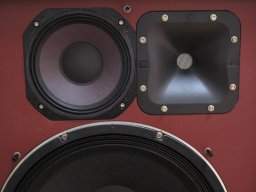
 
One reason to use an HPF is to address the phenomenon of driver unloading. Below a certain frequency (often above the fundamental of your lowest string), the cabinet is unable to control the excursion of the cone. This frequency range provides little musical benefit, and the sound energy in it is sometimes perceived as muddiness. To the speaker driver and at higher volumes, the energy and motion can be mechanically and thermally stressful. The HPF reduces this energy and allows you a limited ability to equalize and boost the bass without hurting the driver. Some drivers will let you know they're being overdriven ("farting out"), and other drivers will let you know by sudden silence.

So, the use of an HPF can allow you to better equalize your tone in a useful frequency range. It's generally more beneficial the more volume you try squeeze out out of a cabinet. It also provide some protection to your speaker drivers.

Bass reflex - Wikipedia

[sfx]:micro-thumpinator

[Invalid or Expired Link Removed]
 
Last edited:
No, not applicable to "any effect" because most effects aren't anywhere near as intrusive as a hpf.

Really? Distortion is not intrusive? Bass synth is not intrusive? Fuzz is not intrusive? Octaver is not intrusive? Hmmmm...

An engineer can work with properly set effects but he can't bring back anything you've filtered out using a hpf.

An engineer can work with PROPERLY SET HPF too... If I set my HPF at 40Hz for my 4stringer, there's no downside...

Problems with room acoustics should be handled with surgical, narrow band notch filters.

Why? Notch filter is one tool which can be used. HPF is another. There are problems which notch filter is not capable dealing with...

A hpf is a great mixing tool but using it on-stage is often creating more problems than it solves IMO.

How would you know? You said you don't use one...?

There's a reason why classic bass amps aren't equipped with hpf.

Some are, some aren't. And some work as if equipped with HPF because of the technology used...as already pointed out by others.

It would have been every engineers nightmare if all SVTs suddenly had built in high pass filters.

My sound tech actually likes that I am using HPF.

The tone controls on most bass amps are usually very wide bell filters and shelf filters for broad shaping of the sound. They are FAR less intrusive than a hpf.

If I want to boost bass, I don't usually want to boost frequencies below 40-50 Hz. Without HPF, I would have to using the shelf filters on my amps...

But yeah, I still think they should be used sparingly and preferrably not touched after the sound check if the amp is miked.

Agreed.

Unless you're a soloist bass is all about "sitting in the mix" rather than having a great sound soloed.

My HPF helps me to sit well in the mix.

By all means, if a hpf works for you, great!

It does.

But I would be wary, or at least check with the engineer that he's ok with it.

I always do. And I usually send to FOH my signal affected by HPF only if the HPF setting is not extreme.
 
Last edited:
And a hpf isn't exactly cheap either. Some of the most popular ones cost almost as much as a decent amp head! Insanely overpriced for what you get IMO.

Really? The most popular seem to be FDeck and Broughton. Their basic models cost 50 USD (FDeck) and 70 USD (Broughton). Which "decent amp head" can you buy for this kind of money (brand new)?
 
I don't get this kind of threads...where people not using certain devices try to discourage people who find them helpful from using them.

I, personally, don't use phaser pedal, for instance. Do I feel temped to create a thread abou it? Nope.
 
Last edited:
  • Like
Reactions: Rilence
A person on stage can't hear how a hpf will affect the sound in the audience. A musician on stage should never use a hpf on anything that goes out to FOH. That includes your amp, if it's miked. And if it's not miked, do you really bring your $xxxx rig just to use it as a stage monitor even when it sounds THAT poor without applying a hpf??? My advice: Get a different amp that sounds decent on stage! And maybe you don't really need an SVT with a 810 for that small club gig? When it comes to stage sound in smaller venues less really is more (provided that the entire band follows up of course).

Yes, a musician shouldn't use a hpf on anything that goes out to FOH. But, it's very useful to run a hpf just on stage and send a full bandwidth signal to FOH. Okay, if the sole signal being sent to FOH is from a mic'd cab then this all goes out of the window, but if you're using the amp's DI, you still get the character of the amp's preamp at full range, but have the option to add a hpf further down the signal path to clean up the stage 'boom'. If you really want a mic's cab tone in the FOH you can mix one in on a second channel. It won't matter if it's got the low frequencies chopped off as the DI is handling these frequencies.

Units like the Line 6 helix have opened up a wealth of possibilities. I have mine setup with an amp model (no cab model - I prefer a lpf - even without a cab model, you still hear the signature sound of the different amps) and a global eq which includes a hpf/lpf that only affects my on stage frfr speaker. The XLR out is unaffected so I'm sending a full range amp tone to the FOH.

Compared to my old rig, my onstage sound is much tighter and less boomy, but FOH get all the bottom end goodness.
 
  • Like
Reactions: BLDavis
Yes, a musician shouldn't use a hpf on anything that goes out to FOH.

Why?

It's an overgeneralization, IMO.

If I set my HPF at 30Hz there is no reason not to send it to FOH.

For the frequency range 30-80Hz: it depends. Some players (especially DB players) prefer to emphasize first harmonic. In order to do that, they set HPF at 80Hz (four strings) or 60 Hz (five strings). If it's part of "their" sound, why wouldn't they send it to FOH?

Just for the record: yes, I agree that if HPF is set high by the bass player (let's say above 80Hz), it's usually not a good idea to force it on FOH.

As for other musicians (guitar and keyboard players): in my opinion, they should be given simple HPF pedal for free as part of their (mandatory) musical education! :)
 
Last edited:
  • Like
Reactions: mcnach and petrus61
Bottom line, it boils down to the same phrase almost all of us were told as we were growing up: "Try it - you might like it." And if you end up not liking it, get rid of it. Nothing is going to explode of you don't use an HPF or any other effect, and FOH isn't going to sit there pulling out their hair if you do use it (or any other effect).

Too often, the pendulum of what is called 'advice' around here swings way too far... half the crowd saying that there's this one thing will solve all of the problems you can imagine - from thin tone to male pattern baldness - and the other saying that the world will basically burst into flames if you hit the stomp switch. Neither is correct and there is always someone who can prove it.

Just play the bass. Try things. Keep what you like and toss the rest - this advice included.
 
Good point about everyone not affording several amps but I did recommend going SMALLER. Which usually means cheaper. And a hpf isn't exactly cheap either. Some of the most popular ones cost almost as much as a decent amp head! Insanely overpriced for what you get IMO.
You are wrong about the cost. I have never seen a dedicated HPF pedal that cost more than $200 Canadian dollars, new or used.
 
  • Like
Reactions: Zbysek
Yes, a musician shouldn't use a hpf on anything that goes out to FOH. But, it's very useful to run a hpf just on stage and send a full bandwidth signal to FOH. Okay, if the sole signal being sent to FOH is from a mic'd cab then this all goes out of the window, but if you're using the amp's DI, you still get the character of the amp's preamp at full range, but have the option to add a hpf further down the signal path to clean up the stage 'boom'. If you really want a mic's cab tone in the FOH you can mix one in on a second channel. It won't matter if it's got the low frequencies chopped off as the DI is handling these frequencies.

Units like the Line 6 helix have opened up a wealth of possibilities. I have mine setup with an amp model (no cab model - I prefer a lpf - even without a cab model, you still hear the signature sound of the different amps) and a global eq which includes a hpf/lpf that only affects my on stage frfr speaker. The XLR out is unaffected so I'm sending a full range amp tone to the FOH.

Compared to my old rig, my onstage sound is much tighter and less boomy, but FOH get all the bottom end goodness.

I get what your saying @ga_edwards, but in my case, I send my whole signal chain to FOH with hpf set 50-80. I do everything I can to thwart over eager sound tech overlords and their evil horde of sub-woofer-demons.
Sometimes I get a win.
Last Fridays gig was one of the first in a long time that we got a tech who "gets it". I showed him my board before sound check and described our song list and my tone preferences. He took me serious and let me control compression and hpf on stage. We both got compliments from audience members about the sound. For the whole three hour show, you couldn't have knocked the stupid grin off my face with a sledgehammer.
I would give that guy half my pay and all my comp beers if I could get him to work for us full time.
B.
 
  • Like
Reactions: Zbysek
Why? It's an overgeneralization, IMO.

I get what your saying, but in my case, I send my whole signal chain to FOH with hpf set 50-80. I do everything I can to thwart over eager sound tech overlords and their evil horde of sub-woofer-demons.

Yes, I was overgeneralizing for effect and to paraphrase the quote I was responding to - my bad. I should have said it's not always advisable to hpf to FOH unless you know what you're doing. It was in response to a comment advising against hpf pretty much completely. (Although I do agree with their sentiment regarding bring the appropriate amp to the gig).

Any sound engineer worth their salt who is responsive to your experienced requests should be able to provide a carefully adjusted hpf to sound great through FOH, leaving the player to set their own for the stage.

However, in less experienced hands, a hpf set to sound great on stage may not necessarily translate to FOH - hence my comment advising to leave full range. But yes, I agree, this is then open to abuse by subwoofer fancying sound engineers.
 

Attachments

  • image.png
    image.png
    83 bytes · Views: 29
  • image.png
    image.png
    83 bytes · Views: 37
  • image.png
    image.png
    83 bytes · Views: 29
  • Like
Reactions: Zbysek and BLDavis
Kick drum. I'm afraid you've completely lost me. Kick drum? I thought my post was about NOT swamping the 'entire low end' from a bass guitar viewpoint. I'm missing where drums come into this . . . . obviously me and the kick drum occupy some of the same sonic real estate, but I've no control over that, nor however (and if) the kick is being handled FOH. I was only positing my take on 'knowing when to say when' as far as my tone goes.
Sorry, I just like to take every opportunity to express my feelings about the kick drum overpowering the bass at every concert I've been at lately - no disrespect to your post. If anything, I completely agree with you!
 

Latest posts