I have owned many Fender basses, from custom shop to mij. I am particularly sensitive to setup and prefer a nearly flat neck. Several just could not achieve this and I compromised by using strings with less tension, DR sunbeam 100s seem ideal for this. Occasionally I will find a neck that is absolutely stable, my roasted neck custom shop 64 jazz being one, a Sadowsky another. The neck on my genuine 63 jazz feels great but I know the relief will not go to heavier tension strings. I even once had Fender tell me to allow two years for an MIA neck to settle before they would replace it. The two most practical lessons I have learned over the years have been to clamp or hold the neck into a slight backbow before tightening the truss rod and the benefit of adding a couple of washers if the truss rod seems maxed out.

Enjoy the benefits of a premium membership!
Upgrade Account
-
TalkBass has been independent since 1998. Add your voice.
Create a free account to reply to discussions, view embedded media, and browse with fewer display ads.
Join free Log in
Want zero display ads or expanded classifieds tools? Compare plans.
You are using an out of date browser. It may not display this or other websites correctly.
You should upgrade or use an alternative browser.
You should upgrade or use an alternative browser.
I broke a Fender neck by taking the strings off
- Thread starter BBassBassington
- Start date
More options
Who Replied?

Turnaround
Commercial User
Yes. Remember, the truss rod is there to counter the tension of the strings. No strings, no truss rod tension.Are new necks from Fender or Warmoth left loose until you install the neck and tighten the rod yourself?
Those are two things I will have to try in the future!I have owned many Fender basses, from custom shop to mij. I am particularly sensitive to setup and prefer a nearly flat neck. Several just could not achieve this and I compromised by using strings with less tension, DR sunbeam 100s seem ideal for this. Occasionally I will find a neck that is absolutely stable, my roasted neck custom shop 64 jazz being one, a Sadowsky another. The neck on my genuine 63 jazz feels great but I know the relief will not go to heavier tension strings. I even once had Fender tell me to allow two years for an MIA neck to settle before they would replace it. The two most practical lessons I have learned over the years have been to clamp or hold the neck into a slight backbow before tightening the truss rod and the benefit of adding a couple of washers if the truss rod seems maxed out.
Fender even sell bags of the right size washers for this purpose. I think the issue probably arises from people tightening the truss rod nut without assisting the neck by holding it in a backboard, eventually this compresses the wood and the truss rod is maxxed out i.e. it runs out of thread. I added four washers once but it did save the bass. An up/ downside of this is that it is invisible: upside if you are selling although I always disclose, downside when buying if it is only a temporary fix although ime it seems to last. Some necks just seem to be more stable than others, I suppose because each piece of wood is unique.Those are two things I will have to try in the future!
Anything to add life to a bass is a good thing IMO. Maybe not from a buying perspective but I'm not the biggest on buying used. I'm also done with selling stuff because it's a massive PITA, ends up taking up way more time than you'd expect, and in the end it's all for pennies on the dollar.Fender even sell bags of the right size washers for this purpose. I think the issue probably arises from people tightening the truss rod nut without assisting the neck by holding it in a backboard, eventually this compresses the wood and the truss rod is maxxed out i.e. it runs out of thread. I added four washers once but it did save the bass. An up/ downside of this is that it is invisible: upside if you are selling although I always disclose, downside when buying if it is only a temporary fix although ime it seems to last. Some necks just seem to be more stable than others, I suppose because each piece of wood is unique.
The joys of finally being employed is I can now just work more to make money. Much more straight forward.
My necks adjust at the heel. How can I put them in a backbow if they're not screwed to the bass?Fender even sell bags of the right size washers for this purpose. I think the issue probably arises from people tightening the truss rod nut without assisting the neck by holding it in a backboard, eventually this compresses the wood and the truss rod is maxxed out i.e. it runs out of thread. I added four washers once but it did save the bass. An up/ downside of this is that it is invisible: upside if you are selling although I always disclose, downside when buying if it is only a temporary fix although ime it seems to last. Some necks just seem to be more stable than others, I suppose because each piece of wood is unique.

My necks adjust at the heel. How can I put them in a backbow if they're not screwed to the bass?
Try this video, Dan does similar on a heel adjustable bass. I did this to my MIM 50s Lacquer Classic a few weeks ago, had way too much relief and truss rod was near the end of adjustment. Seems to have fixed it good and proper. Also did it to a Squier Bass VI that a tech told me wasn't worth repairing due to too much foward bow. This technique sorted out the Bass VI as well.
Gotta love Uncle Dan

This is the Bass VI on the rack ...
Last edited:
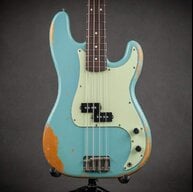
Sory to hear about this. Hope you get it resolved. BTW: That color is beautiful!
Most of my basses adjust at the heel. I simply use a clamp as in the video above. Simple,easy and effective.My necks adjust at the heel. How can I put them in a backbow if they're not screwed to the bass?

Absolutely right.Taking off the strings didn't cause this issue. It never would. I have a MIM Statocaster and have changed the strings several times without issue. I also have a MIM Player Jazz and have taken the strings off a couple of times to address some sharp fret edges. Again, no issues.

1) There is no way this neck was damaged simply by removing the strings
2) A chat with the luthier would be interesting. He/she should know exactly what is going on with this neck. If not, then you are not talking to what I would call a "luthier."
3) A lot of damage can be done to various instruments by an individual who is learning how to set the instrument up. Bodies damaged by neck plates because the screws were installed too tightly. Bent neck plates in fact. Broken necks because someone tightened the truss rod too tight. My best guess is that this is what happened.
This problem was not caused by the OP, and it is very unlikely this is a manufacturing error. Something else happened.
2) A chat with the luthier would be interesting. He/she should know exactly what is going on with this neck. If not, then you are not talking to what I would call a "luthier."
3) A lot of damage can be done to various instruments by an individual who is learning how to set the instrument up. Bodies damaged by neck plates because the screws were installed too tightly. Bent neck plates in fact. Broken necks because someone tightened the truss rod too tight. My best guess is that this is what happened.
This problem was not caused by the OP, and it is very unlikely this is a manufacturing error. Something else happened.
Thanks!Sory to hear about this. Hope you get it resolved. BTW: That color is beautiful!
I am a bit suspicious about not getting an email today with the luthiers diagnosis.
I also don't particularly want to pester the buyer because it'd be ideal for me if they just ghosted me. We'll see where things go from here.
Also I appreciate the faith many of you have in my ability to not break a bass! ... Or I guess conversely your faith in Fender to make a bass that can survive me. But for those who don't think I broke it, thanks!
I'm still going to step up my setup game in the future! I love the idea of helping the truss rod get into place.
I also don't particularly want to pester the buyer because it'd be ideal for me if they just ghosted me. We'll see where things go from here.
Also I appreciate the faith many of you have in my ability to not break a bass! ... Or I guess conversely your faith in Fender to make a bass that can survive me. But for those who don't think I broke it, thanks!
I'm still going to step up my setup game in the future! I love the idea of helping the truss rod get into place.
Try this video, Dan does similar on a heel adjustable bass. I did this to my MIM 50s Lacquer Classic a few weeks ago, had way too much relief and truss rod was near the end of adjustment. Seems to have fixed it good and proper. Also did it to a Squier Bass VI that a tech told me wasn't worth repairing due to too much foward bow. This technique sorted out the Bass VI as well.
Gotta love Uncle Dan
This is the Bass VI on the rack ...
View attachment 4629239
Thanks but I was referring to the recommendation to backbow the neck by hand when tightening the truss rod to help it. Can't do it if the neck is not screwed into the body and I don't have a jig like Dan Erlewine. It would be impractical to use anyway. I only loosen the bolts and tilt the neck upwards, I never take it off completely. So far I haven't had any trouble nor have I run out of adjustment.
You only need a G clamp and a couple of pieces of wood to achieve a slight backbow. Nothing technical or expensive at all. Like you I just slacken the screws and tilt the neck up a bit. I have always used this clamp method when adjusting my Fenders. It works and is simple, easy and effective. You certainly do not need a jig to achieve the same result.Thanks but I was referring to the recommendation to backbow the neck by hand when tightening the truss rod to help it. Can't do it if the neck is not screwed into the body and I don't have a jig like Dan Erlewine. It would be impractical to use anyway. I only loosen the bolts and tilt the neck upwards, I never take it off completely. So far I haven't had any trouble nor have I run out of adjustment.
Still no message. I'm busy tomorrow now either way so hommie won't be coming by tomorrow either way. I'm gonna say that even though this is increasing the sketchiness it's so far moving things the direction I want to go. 
Question:
If I broke the anchor point on the truss rod I wouldn't have been able to loosen the nut completely right? Instead of the nut coming out (I backed it out until I visibly saw it, it move) if I broke the anchor point it would have stayed in place but the nut would have moved?
If I broke the anchor point on the truss rod I wouldn't have been able to loosen the nut completely right? Instead of the nut coming out (I backed it out until I visibly saw it, it move) if I broke the anchor point it would have stayed in place but the nut would have moved?
Or could the nut have stuck onto the rod and twisted it out of the anchor? Pictures online show them looking like the truss rod is just screwed into them? (I think I need to watch some videos on truss rod construction and installation. My memory and google searches aren't doing it for me.)


Okay, yeah I didn't break it.
Those truss rods get welded in, and with the curve and pressure from the wood there's no way I could put anywhere near enough torque to break a weld. Heck I can't break any welds! Not with my noodle arms.
From my Google searching the nut would only spin freely if the rod snapped right at the rod, or the threads were somehow completely destroyed. Or they just used too small of an allen wrench. I also use one of the Fender truss rod adjustment tools. There's no way a truss would snap before that would even bend.
That neck never made a noise when adjusting, let alone the loud kind of crack one would expect from a rod snapping. That neck never gave me an issue in adjustments.
I don't remember who said it or on what page but the suggestion that the seller had a fitment issue seems most correct. It's entirely possible that as soon as he realized I was going to look for proof of his claims he decided to ghost me.
This now became a much more interesting story!
Unless I just delete my seller account and hope he doesn't just show up to my house or give my address to the internet to come attack me or something. lol
Those truss rods get welded in, and with the curve and pressure from the wood there's no way I could put anywhere near enough torque to break a weld. Heck I can't break any welds! Not with my noodle arms.
From my Google searching the nut would only spin freely if the rod snapped right at the rod, or the threads were somehow completely destroyed. Or they just used too small of an allen wrench. I also use one of the Fender truss rod adjustment tools. There's no way a truss would snap before that would even bend.
That neck never made a noise when adjusting, let alone the loud kind of crack one would expect from a rod snapping. That neck never gave me an issue in adjustments.
I don't remember who said it or on what page but the suggestion that the seller had a fitment issue seems most correct. It's entirely possible that as soon as he realized I was going to look for proof of his claims he decided to ghost me.
This now became a much more interesting story!
Unless I just delete my seller account and hope he doesn't just show up to my house or give my address to the internet to come attack me or something. lol


