

Enjoy the benefits of a premium membership!
Upgrade Account
-
TalkBass has been independent since 1998. Add your voice.
Create a free account to reply to discussions, view embedded media, and browse with fewer display ads.
Join free Log in
Want zero display ads or expanded classifieds tools? Compare plans.
You are using an out of date browser. It may not display this or other websites correctly.
You should upgrade or use an alternative browser.
You should upgrade or use an alternative browser.
More options
Who Replied?

I’m off to Walmart right n....I know a lot of people put foam under the strings but I've never been able to get that quite right no matter how many times I tried. So I went looking for a device to do this and I found the Fump dampener, but the reviews weren't the greatest. I don't need to go into that in detail...the reviews are online for anyone who wishes to see them.
Anyway, I started thinking that there had to be a better way to do this and inspiration struck me in the kitchen of all places! I was putting a clip on a bag of almonds when it hit me that the clip, lined with foam, might just be what I was looking for! So I gave it a shot and this is what I came up with. I have to trim the foam down a little because it really deadens the strings as is, but I knew that would be the case. Let me know what you think.
First I "gutted" the red clip, as you can seen in comparison to the green one:
View attachment 2984667
Next I cut the foam to length:
View attachment 2984668
Glued the foam into place:
View attachment 2984670
At the top of the clip I had to add a small plastic piece from the trimmings since the foam distorted the clip and wouldn't allow it to stay closed:
View attachment 2984674
Close up:
View attachment 2984675
And the final product, crude as it may appear, installed:
View attachment 2984676
So there's your Pampered Chef string dampener...not counting time for the glue and JB Weld to dry, it took all of about 30 minutes to make. They sell these types of clips at Walmart in bags for like $3. If anyone else gives it a shot I'd love to hear how it works for you!
But yeah. Great idea you have there. Always love a JB Weld project.


I’m off to Walmart right n....
But yeah. Great idea you have there. Always love a JB Weld project.
I’ve done a lot of “experimenting” with foam under the strings. In that arrangement they are against the body pushing up.
Then I half-ass rigged something to have the foam on top pushing down.
For some reason and in my case at least, I thought that worked better... sounded better....more thumpy.
Then I remember that some folks used to put the foam under a bridge ashtray.
Hmmm, again, foam pushing down.
To me, it seems that foam mutes better if there is some pressure against the strings rather than two pieces of foam just pressing against each other.
It might need a bit if leverage, or it could be that the width of the foam on the Walmart Special isn’t wide enough.
Maybe two clips side by side, or a wider type of clip will work to dampen the strings more.
I also noticed that if you have too much space between the mute and the bridge that it mutes too much.
Just thought I throw out some of my observations FWIW in case it might help inspire more experimentation.
I think you’re on the right track though.
Then I half-ass rigged something to have the foam on top pushing down.
For some reason and in my case at least, I thought that worked better... sounded better....more thumpy.
Then I remember that some folks used to put the foam under a bridge ashtray.
Hmmm, again, foam pushing down.
To me, it seems that foam mutes better if there is some pressure against the strings rather than two pieces of foam just pressing against each other.
It might need a bit if leverage, or it could be that the width of the foam on the Walmart Special isn’t wide enough.
Maybe two clips side by side, or a wider type of clip will work to dampen the strings more.
I also noticed that if you have too much space between the mute and the bridge that it mutes too much.
Just thought I throw out some of my observations FWIW in case it might help inspire more experimentation.
I think you’re on the right track though.
Good points! I was trying to improve upon the Fump but I've given up. Someone else can take this and run with it!I’ve done a lot of “experimenting” with foam under the strings. In that arrangement they are against the body pushing up.
Then I half-ass rigged something to have the foam on top pushing down.
For some reason and in my case at least, I thought that worked better... sounded better....more thumpy.
Then I remember that some folks used to put the foam under a bridge ashtray.
Hmmm, again, foam pushing down.
To me, it seems that foam mutes better if there is some pressure against the strings rather than two pieces of foam just pressing against each other.
It might need a bit if leverage, or it could be that the width of the foam on the Walmart Special isn’t wide enough.
Maybe two clips side by side, or a wider type of clip will work to dampen the strings more.
I also noticed that if you have too much space between the mute and the bridge that it mutes too much.
Just thought I throw out some of my observations FWIW in case it might help inspire more experimentation.
I think you’re on the right track though.

Your using cheap low cost open cell foam, not very dense, wonder how your project will work with open cell urethane foams, they have great compression, and fast rebound, and made in many durometer's plus you can get it with acrylic adhesive backing , FYI I die cut foam for a living - gaskets and such.
here is a source : McMaster-Carr
thinking soft grade x 1/4" thick would work
here is a source : McMaster-Carr
thinking soft grade x 1/4" thick would work
Last edited:
Good suggestion! Can you direct me to where I can find open cell urethane foam? I'd like to have a look!Your using cheap low cost open cell foam, not very dense, wonder how your project will work with open cell urethane foams, they have great compression, and fast rebound, and made in many durometer's plus you can get it with acrylic adhesive backing , FYI I die cut foam for a living - gaskest and such.
Good suggestion! Can you direct me to where I can find open cell urethane foam? I'd like to have a look!
here is a source : McMaster-Carr
thinking soft grade x 1/4" thick would work
Thinking about your project while have a rum and coke, gets my OCD going, if your thinking of say'n making these and sell them on Reverb, a flash of thought hit me what if you were able to use either alum, or abs plastic say 3" long x 3/8" x 090" thick with the foam sandwiched and at each end threaded flat head bolt 10/32 - set with counter sunk hole with a bit J&B weld epoxy to set the bolts then use with thumb screws to adjust tensions on either end, like the E cord might need more tension vs: the G cord needing less, just the rum and coke talking.
Plastic Parts, or may think Aluminum less likely to flex as much as Plastic and charge more
McMaster-Carr
McMaster-Carr
Plastic Parts, or may think Aluminum less likely to flex as much as Plastic and charge more
McMaster-Carr
McMaster-Carr
Last edited:
Heh! I like how you think but honestly I'm not capable of creating a finished product that would be worth selling!Thinking about your project while have a rum and coke, gets my OCD going, if your thinking of say'n making these and sell them on Reverb, a flash of thought hit me what if you were able to use either alum, or abs plastic say 3" long x 3/8" with the foam sandwiched and at each end threaded flat head bolt 10/32 with thumb screws to adjust tension on each end E cord might need more tension vs the G cord, just the rum and coke talking.
Plastic Parts, or may think Aluminum and charge more
McMaster-Carr
McMaster-Carr
From foam standpoint what do you think of this in the 1/4" thickness? McMaster-Carr
Well the fun part is always going to be trial and error , that foam has a different type of texture sort of slick on top meaning it should seal around the strings, start with soft and try ex soft , if they dont work hit med hardness, thats why I figured the med would be a good start off point .
Only problem with that is this experimentation isn't cheap! Some of those foams are pricey! Could you possibly show me which one you're referring to specifically? I'm not opposed to buying it & trying but I'd like to start with your specific recommendation. Thanks!Well the fun part is always going to be trial and error , that foam has a different type of texture sort of slick on top meaning it should seal around the strings, start with soft and try ex soft , if they dont work hit med hardness, thats why I figured the med would be a good start off point .
I really like this idea.Thinking about your project while have a rum and coke, gets my OCD going, if your thinking of say'n making these and sell them on Reverb, a flash of thought hit me what if you were able to use either alum, or abs plastic say 3" long x 3/8" x 090" thick with the foam sandwiched and at each end threaded flat head bolt 10/32 - set with counter sunk hole with a bit J&B weld epoxy to set the bolts then use with thumb screws to adjust tensions on either end, like the E cord might need more tension vs: the G cord needing less, just the rum and coke talking.
Plastic Parts, or may think Aluminum less likely to flex as much as Plastic and charge more
McMaster-Carr
McMaster-Carr
I am actually planning to do something similar to this on my Jag refinish-rebuild.
The biggest problem with stuffing foam under the strings or in an ashtray seems to be to get the right amount of pressure on the strings. And one type of foam will need different pressure than another. Being able to adjust the pressure really makes a lot of sense.
One thing that I did try was to cut slots in the foam that gets placed under the strings. The slots are so the string can ride down in the foam. This means you have foam underneath and also around the strings. The slots are cut to allow for some control of the upward foam pressure. Obviously, this is a one trick pony relying on trial and error.
The foam on top that is adjustable seems to me to be the way to go.
BTW... I think J-B Weld is “da bomb” for most applications that require a hard glue solution and you have a reasonable amount of surface area to work with. It is my “Go-To” in those situations and will work well for the adjusts-foam modification.
If you need to have a bit of flexibility, in other words a strong joint but that won’t pop apart if it is dropped or stressed, then I like Shafting epoxy. This is the stuff used to glue golf club heads to the shaft. I’ve built a lot of golf clubs and have never had an epoxy joint fail. When you consider the stresses place on a golf club at impact, that’s some amazing glue. A properly struck iron shot actually hits the ground right after it strikes the ball.
You can buy this from Golfsmith. (No affiliation) I’m sure the same thing is used for other applications and sold under a different name, but this us how I know it.
We now return you to our regularly scheduled thread.
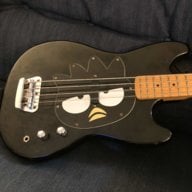
You made something to make your strings wet? That's kinda wei-Ohhhhhh, I see, you made a damper - not a dampener. To damp = to quell vibration; to dampen = to make a little bit wet.
Sorry, haven't had my coffee yet today - A recent video kinda got on my nerves about this same word problem (It appears to be rampant).
Sorry, haven't had my coffee yet today - A recent video kinda got on my nerves about this same word problem (It appears to be rampant).
You made something to make your strings wet? That's kinda wei-Ohhhhhh, I see, you made a damper - not a dampener. To damp = to quell vibration; to dampen = to make a little bit wet.
Sorry, haven't had my coffee yet today - A recent video kinda got on my nerves about this same word problem (It appears to be rampant).
Might be the OP just missed what his autocorrect did to him, and failed to proof read.
Could be he saw it and believed the software was correct.
Yes he should check his work. We all should. But it happens all the time.
I started a thread once that was devoted to autocorrect errors that still worked in a sentence.
This would be a good one for that.

Of course if one swipes a used sponge from the kitchen for this project they might also be dampening their strings.
Stop on by. The coffee’s on.

Might be the OP just missed what his autocorrect did to him, and failed to proof read.
Could be he saw it and believed the software was correct.
Yes he should check his work. We all should. But it happens all the time.
I started a thread once that was devoted to autocorrect errors that still worked in a sentence.
This would be a good one for that.
Of course if one swipes a used sponge from the kitchen for this project they might also be dampening their strings.
Stop on by. The coffee’s on.
I just assumed OP wasn't at fault per se, but rather fell victim to the sheer popularity of the wrong word usage (like everybody calling those little-brimmed douche hats 'fedoras' when they're not).
Let's see, I'll need some coffee even to make it all the way to where you are to GET some coffee =0)
I screwed upI just assumed OP wasn't at fault per se, but rather fell victim to the sheer popularity of the wrong word usage (like everybody calling those little-brimmed douche hats 'fedoras' when they're not).
Let's see, I'll need some coffee even to make it all the way to where you are to GET some coffee =0)

Dude. The Bassic Gear Review guys did the exact same thing with a blurb about Fretwraps. It's a super common thing - I've seen people say it on Star Trek ("inertial dampers" has become "inertial dampeners" on that and other scifi shows several times). Sorry to call you out, it's a really common thing apparently, which is why I intimated it's not your fault. =0)I screwed up
In my experimenting I also found that the distance from the bridge and the width of the foam or felt affects the degree of damping for each string.I really like this idea.
I am actually planning to do something similar to this on my Jag refinish-rebuild.
The biggest problem with stuffing foam under the strings or in an ashtray seems to be to get the right amount of pressure on the strings. And one type of foam will need different pressure than another. Being able to adjust the pressure really makes a lot of sense.
One thing that I did try was to cut slots in the foam that gets placed under the strings. The slots are so the string can ride down in the foam. This means you have foam underneath and also around the strings. The slots are cut to allow for some control of the upward foam pressure. Obviously, this is a one trick pony relying on trial and error.
The foam on top that is adjustable seems to me to be the way to go.
BTW... I think J-B Weld is “da bomb” for most applications that require a hard glue solution and you have a reasonable amount of surface area to work with. It is my “Go-To” in those situations and will work well for the adjusts-foam modification.
If you need to have a bit of flexibility, in other words a strong joint but that won’t pop apart if it is dropped or stressed, then I like Shafting epoxy. This is the stuff used to glue golf club heads to the shaft. I’ve built a lot of golf clubs and have never had an epoxy joint fail. When you consider the stresses place on a golf club at impact, that’s some amazing glue. A properly struck iron shot actually hits the ground right after it strikes the ball.
You can buy this from Golfsmith. (No affiliation) I’m sure the same thing is used for other applications and sold under a different name, but this us how I know it.
We now return you to our regularly scheduled thread.


