• TalkBass has been independent since 1998. Add your voice.
    Create a free account to reply to discussions, view embedded media, and browse with fewer display ads.
    Join freeLog in
    Want zero display ads or expanded classifieds tools? Compare plans.

I may need help understanding my Bass Big Muff.

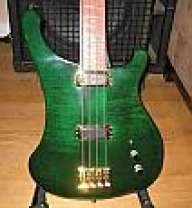
The other day I was at my local shop buying my long saved-for, much sweated-over dream bass (fireglo Rick), and on a whim I got them to throw in a Bass Big Muff for very little extra scratch. I'm new to fuzz, and I'm not sure what I was expecting, but I haven't figured out how to get a usable sound yet.

I was hoping for, i dunno, some kind of grindy biting fuzz... but i haven't been able to get much more than a kind of oversaturated swampy fart sound. So perhaps this is the wrong pedal for me, or, and this a distinct possibility, perhaps i have no idea how to use it.

Yes, yes, i did a search already, thanks. But here's what I'm wondering... is there any way to use this pedal and maintain some semblance of attack? I'm a pick guy, playing rounds on a Rick (and others basses but that's the main one now). Every time i click it on, no matter what tone or sustain setting i lose at least 90% of the attack. Might as well be using an ebow. Is there a trick to getting the knobs to work together? It seems like the tone knob at its higher settings cuts a significant amount of bass, which seems counterproductive. And i kept noticing weird volume drops... particularly in bass boost mode. Am i overloading the pedal somehow with too much input? And one last question... to use the dry setting, do you have to use both outputs? I switched over to DRY and couldn't get the knobs to make any change to the tone.

Any and all help is appreciated, please forgive my ignorance, i'm more familiar with overdrive and chorus/flange/delay stuff. If anyone could help explain how the controls interact i'll forever be in your debt. (previous searches revealed some sample settings which i plan to try, but i'd like to better understand it as a whole). Thank ya kindly.
 
And, the dry out is just that, no effect. The knobs won't do a thing.

Yeah, that's what it seemed like. So... how do you use it in DRY mode? The instruction manual is decidedly vague. Can you only use dry mode if you're using both outputs? And if so... how does that work? My ashdown head only has one input, as do most bass amps.

I have a feeling being able to blend the clean and fuzz signals would work best (ala Sparkle Drive), but if it requires two outputs i can't see any use for it in a live setting.
 
Yeah, that's what it seemed like. So... how do you use it in DRY mode? The instruction manual is decidedly vague. Can you only use dry mode if you're using both outputs? And if so... how does that work? My ashdown head only has one input, as do most bass amps.

I have a feeling being able to blend the clean and fuzz signals would work best (ala Sparkle Drive), but if it requires two outputs i can't see any use for it in a live setting.

I've never used that pedal, but I'm pretty sure you're right about the dual outputs. It (that feature
) is designed to use with a two channel amp, a two amp setup or a stereo track while recording. Or any other application where you would send out two signals to two destinations.

However, the BBM has a blend feature, right? When the switch is in "mix" mode, or whatever it is, the tone control acts as a blend. Use the regular (not the dry) output.

Maybe you have an older Muff that doesn't have blend capabilities. I don't know for sure.
 
mine is brand new, and had just arrived that day from EHX so i assume it's as new as they get. looks just like this:


bass-big-muff-pi.jpg


From the instructions:

In Dry mode, the bottom position, the original dry signal from your instrument is mixed with the output of the distortion circuit. The level of the Dry signal is constant and will not change as you turn the Volume knob up or down. This allows you to set the level of the distortion effect against your dry signal.
-----
Effect Out Jack - is the main output of the Bass Big Muff Pi. Connect it to the input of your amp or another effects pedal.
-----
Direct Out Jack - is connected directly to the Input jack to allow access to your original bass signal. You can connect this jack to an amplifier or different effects chain.


So does this mean, when in DRY mode, you use the volume knob to turn up the level of the fuzz? That would make sense...
 
Dry out is no effect, as in, the effect will not be sent to that output at all.

The dry blend has NOTHING to do with that output. It simply blends a set amount of your dry uneffected signal with the muff tone.

That means that increasing the volume might let you essentially select how dominant the fuzz tone is over the dry tone, but I know that the dry blend is a preset. Obviously if you have two signals going to two different amps, no matter how loud one is, if you turn the other one up enough then you you can achieve the same effect as turning the other one down, so in my head turning up the muffs volume should give you some relative level control of the blend.
 
Success! i dug around and found a few TB users' sample settings... gave one a whirl and I've got some usable sounds... all using Dry mode. Thanks for the help guys, i didn't quite understand how everything worked at first. Now i've found a solid starting point I'm gonna tweak for a bit, but i'm on to some pretty good tones so far.
 
I HATE the fact that they called it 'dry' mode and added a 'dry output' yet the two have no relationship. Talk about non-initiative.

non-intuitive, even! or just plain stupid. The Dry output is onlu useful if you're bi-amping. The Dry MODE is really a BLEND mode. Turn it up past 2 o'clock in dry mode and you'll have trouble finding a useable output level, but don't worry, you're unlikely to want to use that range in dry mode.

Normal mode fairly closely resembles the lower gain green russian muff. Bass boost takes you closer to some of the "tuned" muff clones that are popular on bass.

The BBM tone knob is powerful. It DOES cut bass when above 12 o'clock - this allows you to to emulate vintage recorded bass fuzz sounds (which often used bass sucking guitar fuzz pedals). Below 12 cuts the high end. The tonal range is thus REALLY wide for a single knob - but it can be a little fussy to use because of this.

Me likey bass big muff.
 
non-intuitive, even! or just plain stupid. The Dry output is onlu useful if you're bi-amping. The Dry MODE is really a BLEND mode. Turn it up past 2 o'clock in dry mode and you'll have trouble finding a useable output level, but don't worry, you're unlikely to want to use that range in dry mode.
I have seen this pedal on display like 20 times and I never would have guessed that it actually did have a blend. It doesn't say blend anywhere. I assumed that dry was the same as 'no boost.' Maybe I could have even saved money instead of buying a high-end 'tuned' muff just for that reason.

Though there is no question about it, everything I've played/heard running off the muff circuit seems to suffer a loss of attack, which is one of the key properties of the muffish sound.