• TalkBass has been independent since 1998. Add your voice.
    Create a free account to reply to discussions, view embedded media, and browse with fewer display ads.
    Join freeLog in
    Want zero display ads or expanded classifieds tools? Compare plans.

I NEED more punch/sustain!

My Carvin and Ernie Ball basses sustain clearly for a looong time. The Squier affinity jazz vi just sold sustains for the more typical length of a standard jazz bass... more attack, more audible decrescendo after.

Really? My Carvin does have tons of sustain, it has a big ole bridge on it. My Stingray however has the worst sustain in my entire herd bar none. I do attribute this to the bridge more than anything.


I absolutely refuse to believe anyone who says their bridge saddles worked their way completely out of whack on ANY bridge during the course of one show.

Well you can believe what you want but I have had a saddle work itself all the way down during a show. It wasn't all of them and they weren't going off the bridge but the saddle did get ****ed during the single 45 minute set. I highly doubt I am the only one who has had this happen.

It was a Fender Standard P-Bass stock bridge(Mexican) the G string saddle screw closest to the ground had stripped or something so it would work itself down toward the plate. It was remedied the next day when I went to the store at which I bought it and we just swapped the single adjustment screw and it worked for years after just fine.


And yeah, back to the OP, sorry I missed somewhere you were using a 110 C, that was definitely the problem. I wouldn't use anything thinner than a .120 personally.
 
don't understand all the hate'n in here on the BAII

i absolutely love 'em

every bass that i buy that has one, first thing i pull it, put on a bent plate, & flip it here at TB pretty quickly ( it just anchors the ball ends of your strings yall, ain't no voodoo magic goins on )

makes me a very happy bass player :bassist::bassist::bassist:
 
Really? My Carvin does have tons of sustain, it has a big ole bridge on it. My Stingray however has the worst sustain in my entire herd bar none. I do attribute this to the bridge more than anything. .

My SR5 has more natural sustain than any bass I currently or previously owned. AFAIK, Ernie Ball/Musicman has been using the exact same bridge on their basses for years. I've never seen one swapped out. I think people like to believe that bridges really impact sustain because its an easy, tangible part that you can point to and easily change on most instruments.

The truth is the natural materials that are used to build the bass, ie the actual specific pieces of wood (not necessarily the type of wood) and how they are put together will have the most impact on the natural sustain (as in unplugged) than anything else. Where the wood is from, how it lived its life being part of the tree, when and how it was harvested, milled, dried and all the other things that happen before it becomes a bass neck or body vary tremendously.

Not saying your Carvin doesn't sustain more than the Stingray. Just saying it has little to do with the bridge in either case.
 
After 3 pages i couldn't read any more. Punch and sustain?
Adjust your action, raise the string height a bit. Viola.

Viola?
3ury5yqa.jpg
 
Your old bridge wasn't made of tin, first of all. There are 1,000 threads about this subject. Personally, I doubt that you are experienced enough to discern real subtleties and the difference is in your head.

as far as i'm aware...it's a turn of phrase to denote a flimsy, cheap bridge. an old bent tin bridge like they used to fashion for home-made instruments, from food cans.

whether i can discern subtleties in tone is another matter, but i can detect condescending overtones. see what i did there? :D
 
My SR5 has more natural sustain than any bass I currently or previously owned. AFAIK, Ernie Ball/Musicman has been using the exact same bridge on their basses for years. I've never seen one swapped out. I think people like to believe that bridges really impact sustain because its an easy, tangible part that you can point to and easily change on most instruments.

The truth is the natural materials that are used to build the bass, ie the actual specific pieces of wood (not necessarily the type of wood) and how they are put together will have the most impact on the natural sustain (as in unplugged) than anything else. Where the wood is from, how it lived its life being part of the tree, when and how it was harvested, milled, dried and all the other things that happen before it becomes a bass neck or body vary tremendously.

Not saying your Carvin doesn't sustain more than the Stingray. Just saying it has little to do with the bridge in either case.

I am not even thinking about opening that can of worms... I will just say I disagree with you on the effects of wood on an electric instrument.
 
I am not even thinking about opening that can of worms... I will just say I disagree with you on the effects of wood on an electric instrument.

Sry to start that but as a player, hobbyist builder and recording engineer i'd say it's all about wood! :) The other components count too of course, but wood is the most important. :)

So if one would like get certain sounds out of his/her bass, start from picking the right wood combo!
 
I am not even thinking about opening that can of worms... I will just say I disagree with you on the effects of wood on an electric instrument.

And I wasn't trying to either. That argument is usually about how wood impacts tone. I would agree that most of those differences are negligible and quickly disappear once you plug into an amp.

The discussion here has been specifically about sustain and which factors have the most impact. There's no question that wood and instrument construction have the largest impact on an instruments natural sustain. Adding a higher mass bridge to an instrument that doesn't have much natural sustain won't improve the sustain of that instrument.

There has also been parallel arguments here as to why sustain matters much when you're a bass player but I won't (re)open that can of worms :D
 
Punch and sustain are kinda opposite. Punch is a very strong peak sound that decays quickly. Sustain is a consistent level.

Those two contradictory goals can probably be most easily achieved using compression where you can control the attack and release thresholds.

Punch is an electrical phenomenon, while sustain that doesn't come from a pedal or amp is a mechanical characteristic. The physical impulse from a string can only do so much, but the electrical signal can be very strong while the bass sustains well. It's possible to have both punch and sustain, but not when using most compressors.
 
A plucked string anchored between a nut and a bridge
or a fret and a bridge, should vibrate smoothly and slowly
decay, amplified or not.

If it doesn't, the string is probably dead (loosened wrap
from fret wear or dirt and corrosion) It's that simple.

I have never lacked sustain on any bass I've ever had
and those ranged in price from cheap beaters less than $100
all the way up to my $3,000 Sadowsky. They all sustain
perfectly.

I keep my strings clean and wiped after gig or practice.

When my strings finally do die, I CHANGE em!
If one dies, I change the whole set.
It's a rare occasion because I change strings about once
a year on average, and I rotate 10 basses so they don't
get a lot of wear.

I know, I know, lots prefer dead strings for their thump.
That's fine, but those folks are not looking for sustain.

My basses sustain for an eternity if I want them to.
I can sound like the bass pedals on a church pipe organ
if I want to - lonnnnnnnnng sustaining notes. No compression,
no special bridges or nuts, no pedals.

Get new strings - and they can be flats or rounds -
(I like D'addario Chromes myself)
and a good setup, and you shouldn't have to rebuild your
bass with so called "miracle cures".

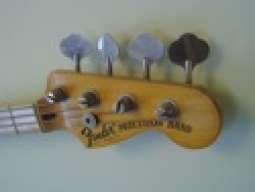
I have also found that spiral winding your strings on the
tuning posts so that they're right down to the bottom of the
post when the string is tuned helps. Don't cut your strings so
short when you're first installing them. Don't overlap the
windings either. You want hard contact with the post
all the way down to the base of the post.

Try it, you'll like it :hyper:

:cool:
 
So I have two fender jazz basses, one of which is a 1999 fender deluxe active jazz and the other is an early 90s jazz standard. I love the way these both sound but they just don't sustain like I want them to. I'm already going to switch out the stock bridges for badass IIs but I was wondering if there's anything mor I could do to make these things tone monsters?

I saw that you switched to heavier strings and got the results you were looking for. Part of the reason this happens is due to the fact that heavy materials and objects tend to vibrate more slowly because it takes more time to start and stop. The resonance frequency of a string has to do with its mass and the tension on it. If you have a lower mass string, e.g., a smaller diameter string, and de-tune it, it will eventually just flap around with no punch, sustain or tonal quality. With a heavier string, the tension needed to tune it to pitch is lower, partially because of the heavier core.

I have two basses- one is an Ibanez fretless and the other is an old SD Curlee. The SD Curlee came to me with a BadAss II, but is the wrong bridge for that bass because it's made for wider string spacing. The sustain has always been good, but that's more likely due to the neck going almost all the way through the body to the end. I recently put a new neck on it (the original had serious problems) and tried it without plugging into my amp- still had great sustain. I didn't use the old round wound strings from before and these are GHZ Pressurewound, from .045" - .105". I decided that the .105" is heavier than I want, so I bought a .100" to finish the setup and it sustains for days on all of the strings. Another thing I changed is the bridge- I went with a HipShot A-Type, made of brass. I only have two screws holding it in place because I'm still tweaking things and now that I have found that the intonation can't be set AND rout the strings through the original holes in the body, I'll have to move it. Regardless, the bridge isn't the "end all and be all" some make it to be, although I will say that a bridge made from a more dense material is better (more inert) than something less dense, but even that doesn't matter if the less dense material is anchored well. One of the other factors, as someone else mentioned, comes from raising the action at the bridge. More downward force means more energy is transferred to the body and it works this way on acoustic OR electric instruments.
 
A plucked string anchored between a nut and a bridge
or a fret and a bridge, should vibrate smoothly and slowly
decay, amplified or not.

If it doesn't, the string is probably dead (loosened wrap
from fret wear or dirt and corrosion) It's that simple.

I have never lacked sustain on any bass I've ever had
and those ranged in price from cheap beaters less than $100
all the way up to my $3,000 Sadowsky. They all sustain
perfectly.

I keep my strings clean and wiped after gig or practice.

When my strings finally do die, I CHANGE em!
If one dies, I change the whole set.
It's a rare occasion because I change strings about once
a year on average, and I rotate 10 basses so they don't
get a lot of wear.

I know, I know, lots prefer dead strings for their thump.
That's fine, but those folks are not looking for sustain.

My basses sustain for an eternity if I want them to.
I can sound like the bass pedals on a church pipe organ
if I want to - lonnnnnnnnng sustaining notes. No compression,
no special bridges or nuts, no pedals.

Get new strings - and they can be flats or rounds -
(I like D'addario Chromes myself)
and a good setup, and you shouldn't have to rebuild your
bass with so called "miracle cures".

I have also found that spiral winding your strings on the
tuning posts so that they're right down to the bottom of the
post when the string is tuned helps. Don't cut your strings so
short when you're first installing them. Don't overlap the
windings either. You want hard contact with the post
all the way down to the base of the post.

Try it, you'll like it :hyper:

:cool:

I thought a bunch of gunge adds mass to the strings. :hiding:

When I worked at a music store in the mid-late '70s, I was taught to pull the string taut and cut it two tuning posts beyond the one it where it will be inserted, then wind it evenly as the tuner is rotated. On the non-vintage style tuners with the little hole in the capstan, lighter gauge (un-wound) strings pass through the hole, are pulled back from the rear to the front to be passed under, lifted and bent over the string where it passed through the hole to form a sideways V before tightening. This makes it pull against the string enough to keep it from ever slipping, but not enough to do any damage. Once I started doing it this way, I haven't had a string slip in over 40 years on any plain string.
 
as far as i'm aware...it's a turn of phrase to denote a flimsy, cheap bridge. an old bent tin bridge like they used to fashion for home-made instruments, from food cans.

whether i can discern subtleties in tone is another matter, but i can detect condescending overtones. see what i did there? :D

I do have a tendency to get condescending about bridge snobbery. That will all change as soon as someone posts a video of themself bending a "flimsy" steel plate with their hands.