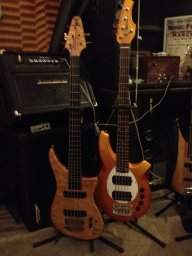
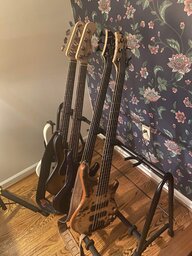
Can't we all just get along with our 4, 5 and 6 string brothers?? Hate on the 7 and 8 string players, but get along with the 4, 5 and 6'ers 


TalkBass has been independent since 1998. Add your voice.
Create a free account to reply to discussions, view embedded media, and browse with fewer display ads.
Join free Log in
Want zero display ads or expanded classifieds tools? Compare plans.


That's exactly what I don't like about a 4 string. Whenever I play one I have trouble keeping my thumb on the back of the neck and curling my fingers to hit the notes.I like the narrower neck of the 4 string...
I can only go by my experience- and I have never played a Dingwall. The sustain onmy Lull PJ5 24 snd my Lull P5 is tremendousHaving owned several 5's including a Stingray, Mike Lull PJ5, Nordy VJ5, I can honestly say that in my experience I disagree. The only B string that I have heard that Was any good was on a Dingwall, and my tiny brain couldn't cope with the fanned frets....
I recently got a peavey foundation 5er and am working it into my playing. It's a lot different than the 2 short scale jaguars (which have a really narrow neck) I have but it's getting easier to switch between the different basses. I do like the 5 string for its extra range thoughThat's exactly what I don't like about a 4 string. Whenever I play one I have trouble keeping my thumb on the back of the neck and curling my fingers to hit the notes.
I have a 4 string neck on my favorite 5'er. The pic as my avitar. It is a Modulus Bassstar. 1-7/8" nut with a 2-1/2" heal. Standard Fender heal 4 string width. Gives a feel of a 4 banger but has 5 strings. I also have converted a couple of 1-3/4" nut and 2-1/2" heal 4 bangers to 5'ers. I love them. Great even tight feel. Easy on my hands after a 3-1/2 hour show and a blast to play!!That's exactly what I don't like about a 4 string. Whenever I play one I have trouble keeping my thumb on the back of the neck and curling my fingers to hit the notes.
a 4 string could sound different from a five string when one takes a home position on the 5 string further up the neck that provides more useful range of notes without having to move from that home position. The 4 has fewer choices that have to be played lower on the neck.
(unless you're very young Bill Wyman who seemed to play up the neck on his 4 all the time -- what keys where they playing those songs in?)
so playing further up the neck could account for the sound of a 5 being different from a 4.
I started playing 5 with the home position frets 5-8 and feel most at home there, but have been making an effort to work more in the 2 - 5 fret range, but even there I use the B string for E and F, where 4 string players don't have a lot of choice.
I play mostly standards in flat ('horn') keys and really don't do a lot in typical 'guitar' sharp keys and I would probably be playing more in the 2-5 fret range in those keys, so I suspect a 4 is most at home with open strings and low home position in those 'guitar' keys.