• TalkBass has been independent since 1998. Add your voice.
    Create a free account to reply to discussions, view embedded media, and browse with fewer display ads.
    Join freeLog in
    Want zero display ads or expanded classifieds tools? Compare plans.

I Think I Lost My Way

As long as you're seeking career advice, let me give you some that is unrelated to music but will prove immensely helpful; learn to write better.

Often the first impression we get about someone comes from how they write. Your writing is in need of improvement, especially in regards to grammar, sentence construction and content presentation.

There are so many resources that can help (books, writing forums, Youtube lessons, even studying how others write on a forum like this) that if you applied yourself for a few months you'd be writing at a much better level. You can't say that about playing an instrument.

Good luck!
My writing does need help, I typically don’t de well with Essays or writing which was another reason I went the course of majoring in music
 
To the OP, first, what you're feeling is real. I have two degrees in music education (percussion was my primary), got hired as a band director for two years, and now I don't work in the field at all. A lot of the comments that've been made thus far are very true:
  • Music is a hard industry to make it in - there are a lot of factors outside of your personal ability that need to be in place to be successful. Some of which are influenced by how strong of a player you are.
  • There is something to be said about buckling down and practicing even when you don't 'feel' the way you want to feel about it. When it comes to discipline, our feelings are our enemy because they're not reliable, and often not really based on truth. As it's said in the leadership world, 'actions lead, feelings follow.'
  • Sometimes a change of pace, scenery, or even a break is absolutely necessary. One of the disservices modern secondary music education does is teach that you need to be in a practice room 24/7.
All of that being said, I've got two things to contribute.

First, one of the healthiest and most important things to do when you're in the place you're in, is to have some dedicated time to yourself just to think. Our world is a noisy place, and it's never lacking for advice, input, or commentary. You need to clear some mental space to really think (and if you're a man of faith, pray) about what thoughts are true and which ones are based in untruth. Clarity is king!

Second, be wary of the fact that when you pose a question on a forum like this one, with thousands of members, who all come from various backgrounds and experiences, you're probably taking in more data than what is helpful. Not to takeaway from what anyone has posted, but you probably asked the question hoping for a water fountain response, and are now getting the Niagara falls experience! (I'm aware that I'm a stream in that as well!) Just my .02.
 
Hey Jalen,
Your honesty with yourself and willingness to share your thoughts with a bunch of strangers on the internet is impressive. It is a good sign for you! With regard to ADHD...it takes several forms, and is more or less severe with each person properly diagnosed with it.
How many musicians/artists have some form of ADHD? I'd say a higher percentage. But secret benefits of the "disorder" is 1.) ability to see things in a different, perhaps creative way (compared to other people).
And 2.) an ability to focus hard (sometimes) on things that really interest you: one's attention "deficit" shuts out distractions (sometimes) and allows one to get down to business.
The best thing I've learned since my diagnosis (at age 33) is to learn and love structure. Set times of the day to get tasks done and also set times of the day to do whatever; just make sure you get the important stuff done first!
 
  • Like
Reactions: LBS-bass
I can't offer advice on a career path, but I can talk a little about playing. I often think of myself as a wannabe who sucks at this instrument. But looking back over the years, I stick with it because there have been times when I connected. Some times it's a real song and sometimes it was just me noodling, but things clicked. I'm sure you know what I mean.

Recently I was given some good advice regarding my mechanical technique:
"Play it like you wrote it."
This goes back to what I said about connecting with the instrument. Not all bass lines are easy to play, but they were easy for the person who did. Make your lines easy, whatever that means for you. Sometimes when I'm composing, I find that the tone and sound will inspire the notes. I dial in the feeling, and the song almost writes itself.
 
I’m good at history but that’s about it.
@Jalen Fuller This is far, FAR more valuable than you might think.

I'll also add agreement with those who are saying that trying a new instrument probably won't make a difference, except maybe at the hobbyist level.

Music school is about commitment, going all-in on whatever direction you're choosing. I can say this because I have a son in music college, sounds like you guys are same age and stage.

If you need to re-boot your direction, that's cool, people are doing this every single day. I wish I were young enough, and free enough of responsibilities to others, to do my own re-boot.

Good luck, we're with you.
 
  • Like
Reactions: Jalen Fuller
Recently I’ve been to push myself out as this intermediate bassist when in reality I’m just a wannabe with a lack of rhythm. I might of had more rhythm in my high school band while playing with a pick but once I got out I started to lose it. What’s worst is as a result after going through a long phase of getting a new bass as a patch up from wanting a Jazz bass to a short scale I am beginning to realized it me and my lack of passion for bass beyond making money in music only cuz I don’t believe in good at much else. Now I am majoring in music in college and I feel it’s a waist cuz the very instrument that I play I suck at. At this point I’ve lost my way and I don’t know whether to just move to a less physically demanding instrument, go back into beats and production or just hang it up keep this as a hobby and do something else worth while in college which I’ll tell you is not much I mean yeah I’m good at history but that’s about it. All my way has been lost
Dude, I felt that way, I think we all do at some point.
If you ever loved playing, then it's still there, you just frustrated.
What turned my playing around was to quit practicing and start playing, but in a nicely structured way. There's a book called "Practice Less, Play More."
Sure it's written for 6 stringers, but the basic knowledge, structure and techniques for tackling tough pieces of music is in there. My playing is so much better than it ever was and I'm still getting better and more confident in my abilities. Get the book, work with the things he lays out and you'll find yourself moving forward faster than you ever thought.
Hey, if it doesn't work out for you, it's only $15 on Amazon. If you read the book and follow the advice, you will get better.
 
Regarding continuing on with your music school program, it’s reasonable to consider what the best path forward is. Personally, I changed majors pretty dramatically after my first year. Not saying you should, but many people do. As others have said, 1) the music business can be a tough business, and 2) you don’t actually need a degree in music to be a musician. Accordingly, if you think you’re not really that into this program, you might consider your career options for something that will give you better employment opportunities and income potential. However, like I said, you looked and sounded good in your video...

History is actually a bit of a tough field, too. The thing about history is that, like you and me, quite a number of people like it, but there aren’t a ton of non-teaching jobs in history itself. Still, if that’s your passion, go for it. Who knows where it might lead you. A degree, especially a bachelors, in any subject will put you into a different job class. My own work doesn’t require my specific degree, but it does pretty much require at least a bachelors in something.

I’ll just throw it out there - a business degree might be more interesting than you’d imagine. All sorts of projects you can get into - including music related, but anything else under the sun, too. You can incorporate your interests into your studies, plus learn lots of things you never knew. Not sure if that’s for you, of course. Pretty different than a music or a history major.

Computers, robotics, IoT, AI etc. are great fields...

Someone else previously mentioned trades - I’ve known roofers, plumbers and carpenters who’ve made a very nice living - better than a lot of people with college degrees.

Whatever you do, staying in this program or not, keep bassin’ - you’ve got a feel for it and for performance
 
Take it from someone who is defending his dissertation for a doctorate in music theory next week (me):

Bachelors degrees in music are basically worthless beyond the baseline qualifications that having a degree at all (any major) offers you in terms of job opportunities. About the only jobs that a B.M. is going to give you a way into are in public music education positions (e.g., band, choir). If you want to go into higher education then a masters is going to be the minimum you need and many universities are only going to consider applicants with PhDs.

Outside of education, most jobs in the industry are never going to hinge on whether you have a degree but rather what you can do and what your level of experience is.

Going into composition or arranging is one avenue that will limit the amount of instrumental barriers you will need to pass to graduate and you would potentially learn a lot more about music in general going that route.

Whatever you choose, I encourage you to do it for the learning itself. College degrees have become too much about qualifications and not enough about actually learning and developing skills.
 
  • Like
Reactions: Possum Willy
Jalen,

I feel ya. I have a degree in music from a Top 50 National Research University. I started out as a Physics major (I'm good at sciences) but changed to Music to get the free lessons! LOL. I busted my ass along the Boston/NYC corridor for 6 years as a Pro musician while working at Berklee in Boston. But, there was no career path there, no stability. After a stint overseas for about 13 years, I came back to the States working in Law Enforcement and am in the Military with the Guard; I do music now as a hobby. I have performed over 1500 concerts in all kinds of regions all over the world. I paid my dues and have had my fill.

If you want to do the working musician thing, there is no substitute: you gotta put in the woodshed time. I practiced 6 hours a day when not working. 2 when working. It is grueling, tedious, soul-crushing work. You don't have friends and can't afford to go anywhere or do anything. And, it ain't for everyone. I remember learning martial arts in Japan and when we could not do a technique, we would ask the teacher, "Sensei, this isn't working, what's the secret?" He would say, "There is no 'secret' you have to PRACTICE!" And he was right.

Eventually, other things took precedence and I couldn't do it anymore. I went into education, then law enforcement. If I had to do it all over again and really wanted to do a working musician gig, I would have taken a different approach and gone to a school like Berklee. Everyone who comes out of there can play and you get some killer connections in the local economy. You grind it out, and maybe catch a lucky break, but maybe not. I realized that there were all kinds of apprenticeships and other stuff I could do as a musician to get a leg up, but they all required me to be self-sufficient and pay my own way. That's not cool. And other things begin to happen, like the fact that you want a family, kids, a house. These things need to be thought of.

I know plenty of great chefs, cops, accountants, doctors, warehouse workers, etc. who are great musicians. In these COVID-19 times, cops and medical workers are still getting paid. Job security is awesome when you have a family and a mortgage. I have plenty of friends who are 42R (Army band). Good paycheck for musicians! There are TONS of options out there for you son. Ask lots of questions, talk to a lot of older people. And WE, the Talk Bass community, are here for you.

When in Japan, I studied classical Japanese martial arts. I'll leave you with the words of my teacher: "If you want to be exceptional, you need to live your life differently than others."
 
Hey Jalen,
Your honesty with yourself and willingness to share your thoughts with a bunch of strangers on the internet is impressive. It is a good sign for you! With regard to ADHD...it takes several forms, and is more or less severe with each person properly diagnosed with it.
How many musicians/artists have some form of ADHD? I'd say a higher percentage. But secret benefits of the "disorder" is 1.) ability to see things in a different, perhaps creative way (compared to other people).
And 2.) an ability to focus hard (sometimes) on things that really interest you: one's attention "deficit" shuts out distractions (sometimes) and allows one to get down to business.
The best thing I've learned since my diagnosis (at age 33) is to learn and love structure. Set times of the day to get tasks done and also set times of the day to do whatever; just make sure you get the important stuff done first!
I love making music and bass and was one of the most knowledgeable musicians of my music club/band in high school even surpassing the knowledge of the club director and after that I was like I love music and performance and or teaching is something I would love to do.
Once I started to learn I was disadvantaged by being a mostly pick player with some palm muting “proto”finger style guitar playing. After that I busted my butt so hard to play with my fingers and I some what lost the fun of playing.This doesn’t mean my finger playing can’t serve but the endurance level is smaller than that with a pick.
It’s just I’m in a bit of a cross of what’s expected of me and what works for me. Now I have been in situations where I was considered for playing in band recently (I am still on stand by and the guy is bad at communicating when I ask question) as a second bass player. This is because the main guy plays his bass like a distorted guitar rather than bass. So we started talking and then next minute he told me a bit of what he was going to play. Then next minute we were grooving.
The one thing that came out of this is that surprising me he was like I had good groove and that him and his band like jamming with guys like me. Just to think I was only playing three notes on a P bass worth not that two paychecks, playing with a pick, but yet grooving.
 
Jalen,

I feel ya. I have a degree in music from a Top 50 National Research University. I started out as a Physics major (I'm good at sciences) but changed to Music to get the free lessons! LOL. I busted my ass along the Boston/NYC corridor for 6 years as a Pro musician while working at Berklee in Boston. But, there was no career path there, no stability. After a stint overseas for about 13 years, I came back to the States working in Law Enforcement and am in the Military with the Guard; I do music now as a hobby. I have performed over 1500 concerts in all kinds of regions all over the world. I paid my dues and have had my fill.

If you want to do the working musician thing, there is no substitute: you gotta put in the woodshed time. I practiced 6 hours a day when not working. 2 when working. It is grueling, tedious, soul-crushing work. You don't have friends and can't afford to go anywhere or do anything. And, it ain't for everyone. I remember learning martial arts in Japan and when we could not do a technique, we would ask the teacher, "Sensei, this isn't working, what's the secret?" He would say, "There is no 'secret' you have to PRACTICE!" And he was right.

Eventually, other things took precedence and I couldn't do it anymore. I went into education, then law enforcement. If I had to do it all over again and really wanted to do a working musician gig, I would have taken a different approach and gone to a school like Berklee. Everyone who comes out of there can play and you get some killer connections in the local economy. You grind it out, and maybe catch a lucky break, but maybe not. I realized that there were all kinds of apprenticeships and other stuff I could do as a musician to get a leg up, but they all required me to be self-sufficient and pay my own way. That's not cool. And other things begin to happen, like the fact that you want a family, kids, a house. These things need to be thought of.

I know plenty of great chefs, cops, accountants, doctors, warehouse workers, etc. who are great musicians. In these COVID-19 times, cops and medical workers are still getting paid. Job security is awesome when you have a family and a mortgage. I have plenty of friends who are 42R (Army band). Good paycheck for musicians! There are TONS of options out there for you son. Ask lots of questions, talk to a lot of older people. And WE, the Talk Bass community, are here for you.

When in Japan, I studied classical Japanese martial arts. I'll leave you with the words of my teacher: "If you want to be exceptional, you need to live your life differently than others."
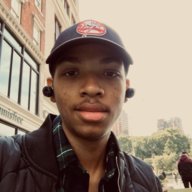
Especially with COVID 19 and seeing essential workers breaking there back, making sure we stay somewhat afloat I was like look at that I’m working towards a degree in a field that I struggling right now that won’t be back in full swing until next year. At this rate what if something in this scale happens again as a music major? Then what will I do to live? As mentioned before I’ve always liked science when I was younger and more recently I’ve became more interested in how to diet can cure some many of our health problems. This was fueled more by my Nutrition class from this semester which taught me a lot and proven many things I already knew and things I didn’t.
 
I love making music and bass and was one of the most knowledgeable musicians of my music club/band in high school even surpassing the knowledge of the club director and after that I was like I love music and performance and or teaching is something I would love to do.
Once I started to learn I was disadvantaged by being a mostly pick player with some palm muting “proto”finger style guitar playing. After that I busted my butt so hard to play with my fingers and I some what lost the fun of playing.This doesn’t mean my finger playing can’t serve but the endurance level is smaller than that with a pick.
It’s just I’m in a bit of a cross of what’s expected of me and what works for me. Now I have been in situations where I was considered for playing in band recently (I am still on stand by and the guy is bad at communicating when I ask question) as a second bass player. This is because the main guy plays his bass like a distorted guitar rather than bass. So we started talking and then next minute he told me a bit of what he was going to play. Then next minute we were grooving.
The one thing that came out of this is that surprising me he was like I had good groove and that him and his band like jamming with guys like me. Just to think I was only playing three notes on a P bass worth not that two paychecks, playing with a pick, but yet grooving.
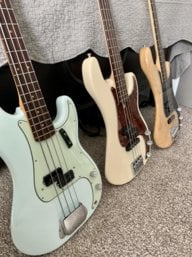
Equipment matters very little, but if you can only have one, a solid working man's P bass is never the wrong choice. And there are a lot of groove players who use a pick, and they use them for the same reason you do...they're better with a pick than fingers. I'm one of them, too. I can't play as fast for as long with fingers as I do with a pick, either. So use the fingers when you can, use the pick when you can't. People will understand as long as you're contributing a positive vibe to the proceedings.
 

I finally watched the video! Although the sound is muddy, you and the drummer seem good to me! You also show a confidence and ability in your movements on the stage.

Also: there's nothing wrong with playing with a pick no matter what anyone says (though you have to be aware of anti-pick prejudice too). I consider myself 50% pick/50% fingers. I used to practice pick lines my fingers and finger lines with pick to try and become more adaptable at both.

Finally: whatever career you end up with, I think it's best to be as well-rounded as you can be. Learn about business, how to utilize social media, history about a variety of subjects, mathematics (ties in to business), science, writing, etc. And also learn how to get along with people. There are plenty of examples of musicians who may not be the absolute "best" technically but are easy to get along with and work for the sake of the group, not their own egos.
 
  • Like
Reactions: Jalen Fuller
Equipment matters very little, but if you can only have one, a solid working man's P bass is never the wrong choice. And there are a lot of groove players who use a pick, and they use them for the same reason you do...they're better with a pick than fingers. I'm one of them, too. I can't play as fast for as long with fingers as I do with a pick, either. So use the fingers when you can, use the pick when you can't. People will understand as long as you're contributing a positive vibe to the proceedings.
That's what I've been doing and there's a part of me that's like not that many people have complained about me being a predominately being a pick player, but the thing is would it be enough to help me especially when I would be sitting in class with guitarist who can literally do what I'm doing?
 
  • Like
Reactions: JimmyM
but the thing is would it be enough to help me especially when I would be sitting in class with guitarist who can literally do what I'm doing?

If all that separates you from a guitarist is your use of fingers, you're in trouble.

But I don't think you're in trouble! Playing bass, whether by a bassist, or guitar player who finds himself with a bass in his hand, is all about a frame of mind! The bass' role is entirely different. Learning how to be the best bassist is what will differentiate you, not your method of plucking the strings!
 
If all that separates you from a guitarist is your use of fingers, you're in trouble.

But I don't think you're in trouble! Playing bass, whether by a bassist, or guitar player who finds himself with a bass in his hand, is all about a frame of mind! The bass' role is entirely different. Learning how to be the best bassist is what will differentiate you, not your method of plucking the strings!
True.
 
My writing does need help, I typically don’t de well with Essays or writing which was another reason I went the course of majoring in music

I'm not suggesting that English/ writing be your major so as to allow you to go into teaching, simply that it's a life skill that will serve you well regardless of which profession you enter. Also, saying you're not good at writing, as if it's in your genes, is incorrect. Writing is a learned skill, a skill you can improve on by studying its rules and reading and analyzing how good writers write.

Nobody is born able to write, it's learned in school then honed throughout one's life.
 

Latest posts