• TalkBass has been independent since 1998. Add your voice.
    Create a free account to reply to discussions, view embedded media, and browse with fewer display ads.
    Join freeLog in
    Want zero display ads or expanded classifieds tools? Compare plans.

I think my jazz bass needs something

I knew someone would call me out on that. I still say it's not a real word, and so does TB spell check.
Lol....usage defines language. It's an ever evolving paradigm. I've studied a lot of different languages, and I've come to appreciate that, there are no rules in language that are set in concrete.

As for the OP....have you had someone else play your bass? Does it still not sound like you are looking for?
 
Might need one of these.
10pylb4.jpg
That oughta do it right there. Yep. Mmmhmm...
 
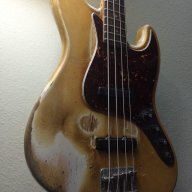
ash body, maple neck and fingerboard, standard jazz controls 2 volumes 1 tone, aftermarket high mass bridge standard fender tuners, custom shop 60s pickups. not a string through.

Very unusual, the ash/maple wood combo with the fender cs single coils/high mass bridge should sound pretty bright and punchy. My stock '78 ash/maple natural fender jazz bass (same wood combo as your bass) sounds freaking awesome, especially for slap! (I don't slap at all :D)
 
Very unusual, the ash/maple wood combo with the fender cs single coils/high mass bridge should sound pretty bright and punchy. My stock '78 ash/maple natural fender jazz bass (same wood combo as your bass) sounds freaking awesome, especially for slap! (I don't slap at all :D)

Actually I did slap on this clip (ink below). The bass is my '08 american standard jazz bass (alder body/rosewood fingerboard) with the stock 7 year old strings!

(sorry for my crappy slap technique)

Playing slap sound 2 by flaked beans - picosong

PS.
I recorded the same clip with my '78 j as well but can't find the link right now.
 
It's had a pro setup, I use rotosounds, but they only sound good for about 3 days. Every time I see a jazz at the store I play it, and all of them just sound miles ahead of mine. Pickups aren't the problem because they are the same type that Geddy Lee uses. I always set my amp flat. Pickups are as high as i can get them without the string dragging across the magnets and making that terrible sound. I know I may sound like a lunatic but I think it has something to do with the bass itself. It sound the same way unplugged. It's olympic white and I already switched to a tortoise guard and that didn't help a bit.
Well, just tossing out a couple of thoughts...

You say pro setup, and that's great, but it can mean many things. If you built the bass, then you need to look at some of the more subtle construction details such as bridge position and neck angle.

Bridge positioning is ultra important. If the base plate is set too far towards the neck, then what happens when the saddles are properly intonated is that the break angle over the saddle ends up being larger than necessary. Large break angles lead to significant deformation in the hardened string core, which will kill the overtones in the string. The bridge is properly set for longest string life when the base plate is set further back towards the strap button such that the G string saddle just intonates before going off the base plate. that minimizes the break angles. If you are stringing through body, don't. Same thing.

Neck angle can be pretty tricky because you are dealing with height in the neck pocket and tilt angle. You have to shim both of those until the bridge saddles are sitting intonated with their height adjustment screws roughly flush with the surface of the saddles and the strings are sitting at the correct heights above the pickups - 7/64" at the neck pup and 3/32" at the bridge pup. Getting all that right can take a lot of putting the instrument together and then taking it apart again. But, you can't give up, because the bass won't play right until all that stuff lines up.

All of these aspects get more or less worked out on the production instruments. So, the ones in the store will play well, if they are adjusted correctly.
 
Well, just tossing out a couple of thoughts...

You say pro setup, and that's great, but it can mean many things. If you built the bass, then you need to look at some of the more subtle construction details such as bridge position and neck angle.

Bridge positioning is ultra important. If the base plate is set too far towards the neck, then what happens when the saddles are properly intonated is that the break angle over the saddle ends up being larger than necessary. Large break angles lead to significant deformation in the hardened string core, which will kill the overtones in the string. The bridge is properly set for longest string life when the base plate is set further back towards the strap button such that the G string saddle just intonates before going off the base plate. that minimizes the break angles. If you are stringing through body, don't. Same thing.

Neck angle can be pretty tricky because you are dealing with height in the neck pocket and tilt angle. You have to shim both of those until the bridge saddles are sitting intonated with their height adjustment screws roughly flush with the surface of the saddles and the strings are sitting at the correct heights above the pickups - 7/64" at the neck pup and 3/32" at the bridge pup. Getting all that right can take a lot of putting the instrument together and then taking it apart again. But, you can't give up, because the bass won't play right until all that stuff lines up.

All of these aspects get more or less worked out on the production instruments. So, the ones in the store will play well, if they are adjusted correctly.

I used to have a shim in the neck, in the form of a pick, but I recently took it out and just angled the neck pocket. My bridge it placed just how you described and my saddles are pretty close to floored.
 
Revisiting the thread after being told that my first post within it has been re-quoted several times.

There are some body wood and pickup combinations that don't seem to work out too well. I had DiMarzio Model J's in an ash-bodied instrument, and there was an overload of low mids. I put in a DiMarzio Ultra Jazz set, and hit pay dirt. Likewise, my QMT-over-alder instrument sounded a bit wimpy with the Ultra Jazzers, but found it's balls with the Model J's. Both basses in this scenario were USA G&L JB-2s.

I share this, to add more to what has already been said, here, although I understand that the OP has decided to address the variable of a different neck, as a first measure. Don't give up on the instrument, yet. More trial and error may be needed to get you where you want to be, but when you get there, you'll know it. The instrument will then deliver the goods consistently. All of the advice in my prior post, and those that have tangented off of it, still applies.
 
  • Like
Reactions: Jake Kinsch
I used to have a shim in the neck, in the form of a pick, but I recently took it out and just angled the neck pocket. My bridge it placed just how you described and my saddles are pretty close to floored.
By "floored," do you mean the height adjustment screws are backed out and the barrels are almost against the base plate? If so, your neck is angled upwards from the body too far. Those saddle barrels should be well off the base plate such that the set screws are nearly flush with the top surface of the saddle barrel.
 
By "floored," do you mean the height adjustment screws are backed out and the barrels are almost against the base plate? If so, your neck is angled upwards from the body too far. Those saddle barrels should be well off the base plate such that the set screws are nearly flush with the top surface of the saddle barrel.
Hey guys- my opinion on this is- set up your bass every time you change strings/ or 5000 miles which ever comes first. Step one- tighten truss rod if needed (ask I'll give details) with old strings still on bass in order to achieve minimal string clearance without major buzzing. Then replace strings and stretch them out. Use a harmonic tuner to be sure they are all holding pitch after playing. Now raise or lower saddles to get the string height to "your" liking. Finally- move the saddle forward or backward to get each individual strings intonation set. Using the tuner, hit open string, tune it up, compare that to the note on 12th fret (one octave), then move saddle up or back until in tune. You will end up with high or low bridge saddles depending on the instrument. Joel
 
Hey guys- my opinion on this is- set up your bass every time you change strings/ or 5000 miles which ever comes first. Step one- tighten truss rod if needed (ask I'll give details) with old strings still on bass in order to achieve minimal string clearance without major buzzing. Then replace strings and stretch them out. Use a harmonic tuner to be sure they are all holding pitch after playing. Now raise or lower saddles to get the string height to "your" liking. Finally- move the saddle forward or backward to get each individual strings intonation set. Using the tuner, hit open string, tune it up, compare that to the note on 12th fret (one octave), then move saddle up or back until in tune. You will end up with high or low bridge saddles depending on the instrument. Joel
No offense intended; but, your suggestion applies to a bass that was properly constructed to begin with. The OP's bass is a parts bass that he put together. I agree that setting the action is a players personal pref; but, if the OP has his saddles bottomed out against the bass plate with a bolt on neck, then there is an issue with the neck angle in the pocket. That is all I was getting at.
 
No offense intended; but, your suggestion applies to a bass that was properly constructed to begin with. The OP's bass is a parts bass that he put together. I agree that setting the action is a players personal pref; but, if the OP has his saddles bottomed out against the bass plate with a bolt on neck, then there is an issue with the neck angle in the pocket. That is all I was getting at.
That makes total sense. I guess I wasn't paying close attention to the post.
 

Latest posts