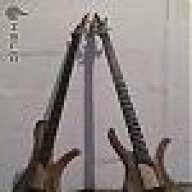
Since there if very little about the Ibanez Affirma series on the 'net, thought i'd share some photos of my two babies.

The one on the left (s/n #920/1000) has a Hawaiian Koa wood body, while the one on the right (s/n #757) has a Hawaiian Saman wood body.

basses swapped positions, #757 on left and #920 on right.
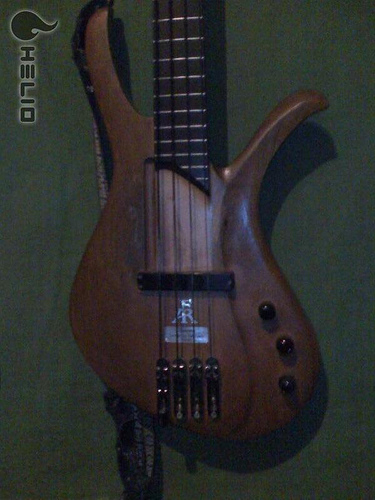
and a close up of the body of #920.
ok quick history of the Ibanez Affirma series:
Attempting to break into the high-end boutique bass market in the early 90s, Ibanez launched the Affirma series designed by Swiss Luither, Rolf Spuler Link Removed.
Per Rolf's bio on his website:
"in 1990 ibanez launched the afr affirma bass, of which some 750 units were built until 1996. the instrument was totally my creation and manufactured under exclusive license in ibanez custom shop at fujigen, japan.
my relationship to ibanez remains on best terms to the day. i particularly appreciate their generous return of the copyright which enables me to continue producing afr basses."
The Affirma series was offered in either 4-string (AFR-104) or 5-string (AFR-105), fretted or fretless(F), and came in following body woods: Kao, Saman, Kralo Walnut, or Flamed Maple.
other stats
NECK - 1Pc MAPLE AFR HALF THRU
FRETBOARD - EBONY
INLAY - PEARL DOT
BRIDGE - TAILPIECE / NUT MONO RAIL w/STAY D-TUNE
HARDWARE - COSMO BLACK
PICKUP CONFIG - PICKUP'S AFR 4 SPECIAL POLYPHONIC PIEZO
CONTROL - AFR 2 BAND
This has to be one of the most light weight, ergonomic bass i've ever played. And the piezos give it such a warm sound. also the Stay D-Tune drop-D turner located on that bridge is handy placement.
Ibanez went on to recreate the Affirma series with Luthite bodies as their mass-produced Ergodyne EDA series of basses.
a few photos of the Affirma series from the Ibanez catalog can be found here:
http://www.ibanezregister.com/cpg148/index.php?cat=172
The one on the left (s/n #920/1000) has a Hawaiian Koa wood body, while the one on the right (s/n #757) has a Hawaiian Saman wood body.
basses swapped positions, #757 on left and #920 on right.
and a close up of the body of #920.
ok quick history of the Ibanez Affirma series:
Attempting to break into the high-end boutique bass market in the early 90s, Ibanez launched the Affirma series designed by Swiss Luither, Rolf Spuler Link Removed.
Per Rolf's bio on his website:
"in 1990 ibanez launched the afr affirma bass, of which some 750 units were built until 1996. the instrument was totally my creation and manufactured under exclusive license in ibanez custom shop at fujigen, japan.
my relationship to ibanez remains on best terms to the day. i particularly appreciate their generous return of the copyright which enables me to continue producing afr basses."
The Affirma series was offered in either 4-string (AFR-104) or 5-string (AFR-105), fretted or fretless(F), and came in following body woods: Kao, Saman, Kralo Walnut, or Flamed Maple.
other stats
NECK - 1Pc MAPLE AFR HALF THRU
FRETBOARD - EBONY
INLAY - PEARL DOT
BRIDGE - TAILPIECE / NUT MONO RAIL w/STAY D-TUNE
HARDWARE - COSMO BLACK
PICKUP CONFIG - PICKUP'S AFR 4 SPECIAL POLYPHONIC PIEZO
CONTROL - AFR 2 BAND
This has to be one of the most light weight, ergonomic bass i've ever played. And the piezos give it such a warm sound. also the Stay D-Tune drop-D turner located on that bridge is handy placement.
Ibanez went on to recreate the Affirma series with Luthite bodies as their mass-produced Ergodyne EDA series of basses.
a few photos of the Affirma series from the Ibanez catalog can be found here:
http://www.ibanezregister.com/cpg148/index.php?cat=172











 ) As I recall the only two issues BP had with it was that only having the one J-type magnetic pickup led to some "wimpy" tones, that there was a fair amount of piezo quack, and that the inlaid "Thumb Groove/Rest" was too close to the E-string. However, I think this would make a fantastic bass for Ibanez to reissue as a J-Custom or some other Limited Edition bass with the few issues fixed: Going to 2 pickups or 1 large Dual-Coil in the "sweet spot", using the advances in piezo designs to remove the "quack", and moving the Thumb Rest up 1/4th to 1/2".