

Enjoy the benefits of a premium membership!
Upgrade Account
-
TalkBass has been independent since 1998. Add your voice.
Create a free account to reply to discussions, view embedded media, and browse with fewer display ads.
Join free Log in
Want zero display ads or expanded classifieds tools? Compare plans.
You are using an out of date browser. It may not display this or other websites correctly.
You should upgrade or use an alternative browser.
You should upgrade or use an alternative browser.
I'm not sure I could ever get into more than 4 strings..
- Thread starter glocke1
- Start date
More options
Who Replied?

I too have really been on the fence lately as to if I want a fiver. Part of me wants to offer a good home to a Yamaha TRBX305, it felt wonderful in the store.
@Nephilymbass @FerK
Do you recall the scale length(s) of your dingwall?
@Nephilymbass @FerK
Do you recall the scale length(s) of your dingwall?

Here you go. This is the longer Dingwall scale. The super series p and j basses are a little shorter I want to say the low b on those is 35 1/2”I too have really been on the fence lately as to if I want a fiver. Part of me wants to offer a good home to a Yamaha TRBX305, it felt wonderful in the store.
@Nephilymbass @FerK
Do you recall the scale length(s) of your dingwall?



String thru jusr your B for tension, try tapered strings, mix in a specific B into your favorite 4-string set, play thru a rig that competently reproduces that Eb - C - etc.
I mean there's a lot you can do that isn't rocket science to try to balance a B......like P guys way back when would try to balance EA to DG.
I mean there's a lot you can do that isn't rocket science to try to balance a B......like P guys way back when would try to balance EA to DG.
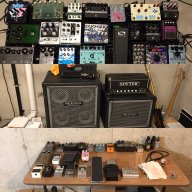
Try a Dingwall. The B is solid on those.
That said, if you don't need a 5, then you don't need a 5. I have one, never use it. I don't hate them and I've had many of them, I just don't use it. I don't need it right now. If I did, I'd use it. lol
That said, if you don't need a 5, then you don't need a 5. I have one, never use it. I don't hate them and I've had many of them, I just don't use it. I don't need it right now. If I did, I'd use it. lol

Try a Spector. One of the nicest tensioned low B strings you’ll find anywhere. It was a Spector that sold me on getting a fiver. Both for the feel of the llw string abd the string spacing which is a bigger concern of mine since I prefer to play fingerstyle and only use a pick when it’s absolutely called for.
The advice to not think of it as “a 4-string with an extra string”is spot on the sugar. If you approach a 5-string as its own thing and think of it more as an entirely different instrument that shares similarities with a 4-string bass, you’ll start to see it in an entirely different way. Sounds silly but it’s true.
The advice to not think of it as “a 4-string with an extra string”is spot on the sugar. If you approach a 5-string as its own thing and think of it more as an entirely different instrument that shares similarities with a 4-string bass, you’ll start to see it in an entirely different way. Sounds silly but it’s true.

If you are finding floppy B's on an instrument that is properly set up, then you need to try something else. I agree with Sadowsky that 35" messes with your G string. There are so many basses made in the world, and , truthfully most of them are pure crap. The 35" scale argument is not a good one. For example, there are plenty of great 5 string basses where you will not find a floppy B string. I have several Warwick basses. Not one floppy B string and they are ALL 5 strings, All 34" scale and I use light gauge strings on all of them. Each of them, if you tried them would make you switch. Modulus makes great basses, some great Laklands too.
Now, I simply have no use for a 4 string.
Here's my rule: Don't pick up a piece of crap and you won't be let down.
Good luck.
Now, I simply have no use for a 4 string.
Here's my rule: Don't pick up a piece of crap and you won't be let down.
Good luck.

BobDeRosa
Commercial User
- May 16, 2012
- 2,445
- 4,403
- Disclosures
- Owner, Tritone Jazz Fantasy Camps
Hey glocke1, you said you've "debated" getting a 5-string, but who are you debating with? I don't see anywhere in your post a compelling reason for having a 5-string except maybe a desire to expand the herd. Are you in a group where a 5-string is required? Do you want to hear lower notes, or, as a couple TBers suggested, want to expand your technical range? If you feel meh, what's your motivation for the "debate"?
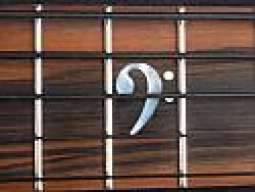
I own four 5 strings with Low B.
All 34 " scale and all have good B strings.
All 34 " scale and all have good B strings.

If you have the dough, try this: For Sale/Trade - Like new Custom Devon Classic J5 Spalted Maple Loaded
I've got his last three cast-offs and each one is a superbly playable work of art. And in as new condition too.
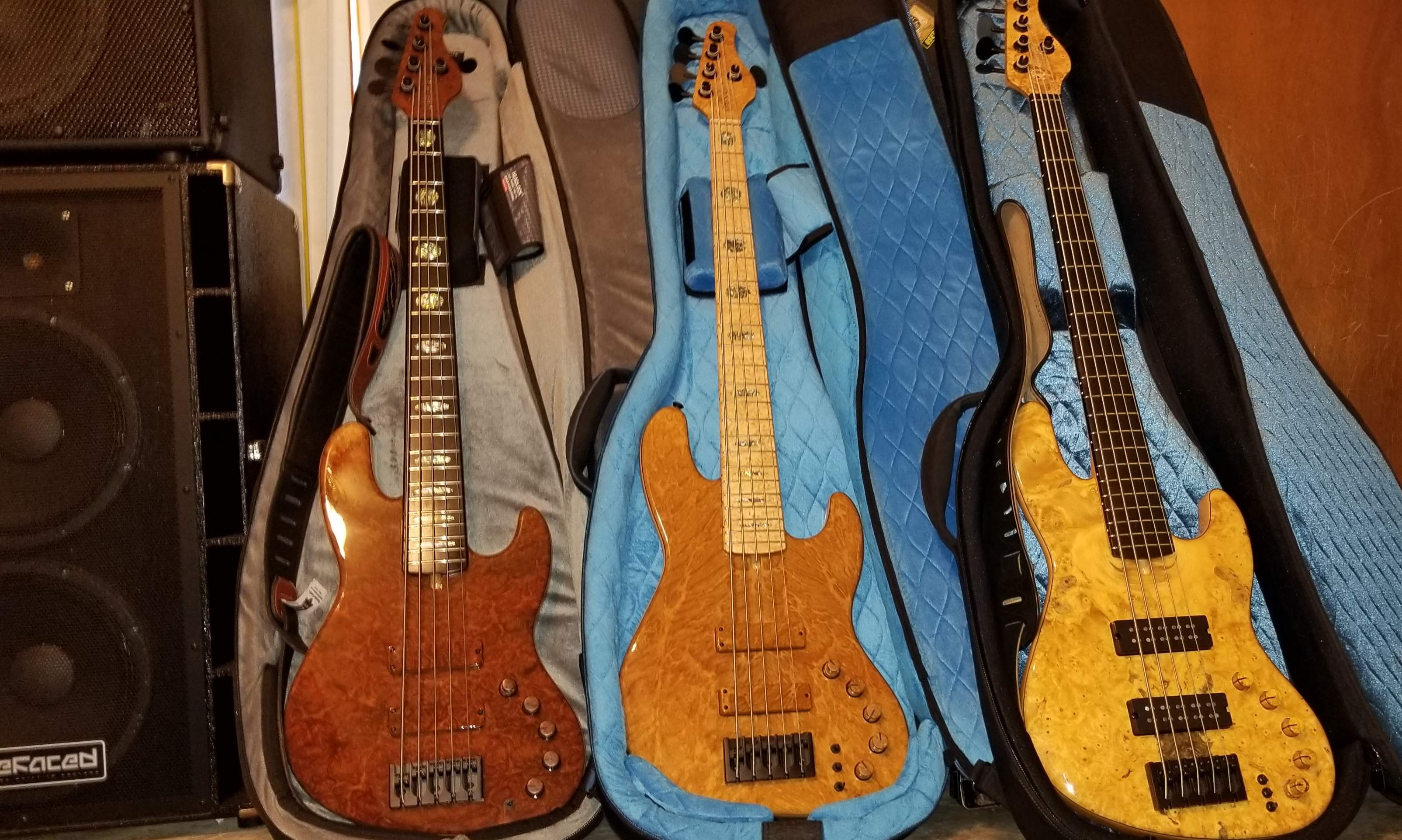
I've got his last three cast-offs and each one is a superbly playable work of art. And in as new condition too.

My "Aha!" moment on a 5 string came when I stopped trying to play it like a 4 string. I am a lover of short scale basses and when I realized that playing on a 5 string around the 5th fret instead of down near the nut was far more comfortable, I then felt at home with the bass.
5 strings are still a minority (2 out of 14) at my place but I do think that the next purchase will be either a 5 or 6.
Exactly the same experience here. My 4 strings are also all short scale. I tried a 5 string to see what it would be like if I played some patterns in E on the 5th fret of the B string and it all clicked for me. The other two points I realised (several basses later!) were that the advantages of a fiver fall away if the B string is weak above the 5th fret, and also that my brain struggles if the string spacing is tighter than my 4 strings (so my 5s like my 4s are 19mm not 16.5 or 17 like a couple of Ibanez I’ve owned). I’ve ended up with a Sandberg California VM5 (which I love) and a Gibson EB5. Now GASing for a 5 string fretless... the new Sires look great. One other observation is that a 35” isn’t necessarily better than a 34” to get a good tight B. It depends a lot on string type and gauge. I have TI flats on my Sandberg and Chromes on the Gibson... both are 34” and both have a good solid B.

1st, to each its on. OK to stay with a 4.
2nd, a 5 string needs to have active pickups (active preamp) to clean up the sound if the 5th string.
3rd, I have a tendency to play a few frets up on the neck. A 5 works well for me.
4th, I am back playing a 4 because of the very small with no drummer venue I play at.
2nd, a 5 string needs to have active pickups (active preamp) to clean up the sound if the 5th string.
3rd, I have a tendency to play a few frets up on the neck. A 5 works well for me.
4th, I am back playing a 4 because of the very small with no drummer venue I play at.
Setup is huge.
Bike analogy not a car one!
Every year I was in the same bike shop. I kept taking the new Cannondale Volvo Jekyll for a test ride. Hated it. Kept leaving with a pocket full of money unspent.
I was in said shop and told a salesman about my test ride fails.
My bike was in the shop for an adjustment. The salesman says to the techs, “make this bike the Jekyll like his bike!” They rushed over took every measurement of my bike. They adjusted the Jekyll to the exact specs. Test ride. Bam! My bike but wayyyyy better. Two bikes went home that day.
Bike analogy not a car one!
Every year I was in the same bike shop. I kept taking the new Cannondale Volvo Jekyll for a test ride. Hated it. Kept leaving with a pocket full of money unspent.
I was in said shop and told a salesman about my test ride fails.
My bike was in the shop for an adjustment. The salesman says to the techs, “make this bike the Jekyll like his bike!” They rushed over took every measurement of my bike. They adjusted the Jekyll to the exact specs. Test ride. Bam! My bike but wayyyyy better. Two bikes went home that day.

My first 5-string was a great deal on a beefy Ibanez ATK, and it was mostly to lay interesting lines in a studio. I ended up, inadvertently, gigging it on a local guy's original set that didn't NEED a 5-string by any means, but the lines felt better midway up the neck and hitting notes on the low B, and not really knowing what I was doing, I was getting great use out of the bass.
It was heavy as hell so had to go buuuut I've now got another fiver that's my "studio baby", and occasionally gets in these streets for extra fun on sets with space to roam. The bottom string takes practice to learn, for sure, but has a whole 24 frets' worth of alternate timbre and flexibility.
Also, 5-strings are generally active, and if you happen to be used to passive basses, just the tone of one will be something to get used to. More recently, when I brought home an embarrassingly far-reaching extended range bass from Ibanez, part of testing whether it'd work for me was if I could make the preamp approximate P & J tones OR get a good passive all-around tone from it, since I'd likely want to work with sounds I'm used to when re-learning songs on it.
All that said, I'm starting to outgrow my main 4-string...and want to upgrade to a sexy hotrod 4-string. There's room for both 4 and 5 in our lives
It was heavy as hell so had to go buuuut I've now got another fiver that's my "studio baby", and occasionally gets in these streets for extra fun on sets with space to roam. The bottom string takes practice to learn, for sure, but has a whole 24 frets' worth of alternate timbre and flexibility.
Also, 5-strings are generally active, and if you happen to be used to passive basses, just the tone of one will be something to get used to. More recently, when I brought home an embarrassingly far-reaching extended range bass from Ibanez, part of testing whether it'd work for me was if I could make the preamp approximate P & J tones OR get a good passive all-around tone from it, since I'd likely want to work with sounds I'm used to when re-learning songs on it.
All that said, I'm starting to outgrow my main 4-string...and want to upgrade to a sexy hotrod 4-string. There's room for both 4 and 5 in our lives

I played a fiver for a bunch of years but eventually went back to a four string. I've got small hands, so a wide neck five was a little much, but otoh a narrow neck five irritated me.

What Schecter do you have? I had a similar experience with my Invalid Link Removed. 35" scale and a 130 B string. Not string through but a really nice bridge. If you consider Schecter entry level, than I'd say they probably make the best entry level 5 (of the limited leftys I've had the chance to play).Felt the same way about 5 strings. Finally ended up buying a 5 string Schecter and fell in love with both the sound and feel.
I started out with a cheapo P clone and traded it for a Carvin LB75. I thought I was 'supposed to' move to a 5 at some point. I played it like a 4 with an extra string at first and wasn't sure I could get used to it. Putting a thicker B string on helped, changing the bridge & making it string through helped more.
Tapered strings may also be an option for you. Pickup selection is a major difference maker also. To me, the 5 string split P doesn't make a B string sound good at all. J, MM, or EMG would be my choices. However, the biggest difference in making a 5 string work is the right cab. To a degree the head can make a big difference too, but the cab is the biggest difference I have found in terms of the sound of the B string. Doesn't make it play any better but you will still hate an instrument that sounds bad no matter how it feels.
Certain riffs if the whole song is above the 5th fret it cramps my forearm, having the 5 gives an option to move your hand. Also gives you the option to play in Eb, D, Db, or C with a capo. Even though I don't play my 5 very often, it's good to have one around and therefore it's good to spend the time to find one you can live with.

I've debated getting a 5 string for awhile now, but every time I go into a music store to try one I am always left feeling "meh".
The B strings generally feel floppy and sound undefined/muddy to me is the largest issue I am running into.
Nothing wrong sticking w/ 4 string - A lot of players could probably get by just fine with just 3 strings! You can always add a Hipshot detuner to to you E to get some lower notes. D in particular is nice to have and they work great ime.
I like both personally. The two 5ers I've had have been 34" scale, which I prefer. The Music Man was decent but my current Elrick has a phenomenal low B (at 34" scale). You do often get what you pay for.
Bottom line, don't follow what you think you should be doing or what is trendy. If you are not gonna use those lower notes - if you don't feel a need for them - just stick with a 4. Folks have done it that way for a long time.

Ya gotta try more than Fenders or Ibanez. Musicman Stingrays are generally awesome. Some Schecter models are quite good too. But I understand where you’re coming from.
I feel the same way every time I pick up a 6 string. I give it a chance, and then go back to my 5s lol. After 20 years of only owning 5 strings, I could never go back to 4s.
I feel the same way every time I pick up a 6 string. I give it a chance, and then go back to my 5s lol. After 20 years of only owning 5 strings, I could never go back to 4s.

Try looking for a fiver with a 35" scale too. That tends to tighten up the b-string sound. And believe me, once you grab that low D a few times, you'll be hooked!
This, soooo much this! I play mainly 5 (but am looking to get a 6 soon) and easily one of my favorite things about it is being able to shift up and down octaves (especially when playing redundant parts) and not having to re-tune when a guitarist wants to use an alternate tuning. Next song's in Drop D down a half step, no problem; Drop C after that, too easy; now you want to play a 7 string? Took you long enough to get on my level!


