• TalkBass has been independent since 1998. Add your voice.
    Create a free account to reply to discussions, view embedded media, and browse with fewer display ads.
    Join freeLog in
    Want zero display ads or expanded classifieds tools? Compare plans.

I'm the new guy, so hello and I have a question...

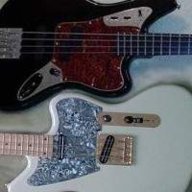
The decision to play a bass VI is yours, I'll stay out of it, but I suggest you invest in a 4 stringer also. A nice Squier VM or CV would be nice and reasonably priced. I had a Squier Bass VI for a month or so. Had to try it but it wasn't for me. I also had to turn the bridge around to intonate properly, and shim the neck to get a good setup. Added some heavier gauge Kalium roundwound strings and that added a bit of tension, but it's still going to be a bit floppy. Wasn't getting the deep bass sound out of it that I wanted, but if you like bands like the Cure or Surf music it will fit in nicely there. As far as playing regular old blues or classic rock I personally don't feel like it quite gets you there, but others will disagree.
 
Not sure if this is really a bass question or a string question so apologies if this is not the right place.

Firstly, hello everybody, I'm Bob and I'm a newbie here. A newbie musician as well (at the ripe old age of 44!). I've been playing guitar for about 9 months, drums for 3, and just got a bass yesterday. My question of course pertains to the bass...

So it's a Squire Bass VI, and I got it tuned up. Now, I'm used to strumming guitar strings. That being said, I started plucking the low E and compared to a guitar it seems kind of like floppy. I saw one review on the bass where the reviewer said the same, so here are my questions:

1. Is this characteristic of all basses? Or is it the Squire in particular?
2. If I change the strings from the stock to the Labella flat wounds designed for the bass VI, is the string still likely to be floppy?

Thanks for the input guys. See ya 'round!

Bob
Change the strings to a heavier gauge. I had a Squier bass vi for a short time, and was amazed at how unplayable it was out of the box. New strings is definitely step one.
 
Thanks to those who answered my questions.

And for the advice and criticism... duly noted.

First welcome,

On learning guitar, bass and drums 'simultaneously':
- Who here has heard Bob play drums? Guitar? Bass? Right, so where do you get off critiquing his method? Yes everyone is entitled to an opinion, but it's useful to know when your opinion is informed, and when it is not, and often an uninformed opinion is best left unexpressed...the old adage about opening your mouth and removing all doubt applies. To make it completely clear to some of you, unless you are Bob's instructor, your opinion is uninformed, thanks for playing.
- The house rule says you can't call someone's baby ugly. Do we really need to restate it so that it's absolutely clear? Does the rule really need to be rewritten to specifically state "If you don't have something nice to say about someone's baby, go browse the classifieds?" Do we? I'd hope not, but seriously people, we have DB players, we have EUB players, we have guys who play sticks, we have guys who play basses with more strings than an autoharp, we have at least one cellist, and at least one tuba player. We don't tell all those people "Go get a standard bass" so where do you get off telling the guy who bought a Bass VI?
 
Welcome to TB. You'll learn a lot about basses and music in general here. As mentioned, take all advice here in context. No two people are alike, so our preferences are all a bit different. Also, be careful, may new members start owning one instrument when they arrive. Shortly thereafter, you'll own 5 of everything and will be looking for a new house to store your gear.

I am a guitarist that converted to bass. I think you're good for now with the bass VI. Upgrading the strings from the stock set will almost always improve the playability. You started on guitar, so you probably think like a guitarist. To play bass convincingly, you need to think like a bass player. You can learn that with a bass VI. Heck, you can learn that on guitar, but we're bass players here, so that's bad advice. If you enjoy bass playing, and thinking like a bass player, you will eventually progress to a traditional bass. But do it at your own speed.

I don't have any advice for learning multiple instruments at once. Different strokes for different folks. In the end, you'll be better off for it if you devote a decent amount of time to it. Don't forget to learn how to sing. Harmonies especially.

BTW, I played tuba too, so, I guess there's two of us.

Good luck, and welcome to the Low End!
 
  • Like
Reactions: bob72
They can really shine in those genres as a layering piece. Doubling a bass part or doing counter melody with a guitar.

You can't replace either a bass or a guitar with a VI but it can compliment both in a great way.

I love the way they sound and they are pretty cool with effects like reverb too. It just didn't gel with me being strictly a bass player. What it did do for me though was get me somewhat interested in guitar, so I picked up an acoustic and taught myself basic open chords and barre chords. Thats about as far as I went with it however. Maybe I'll pick it up again at some point, but bass is home for me! Oh yeah the tictac bass stuff from early country music ala Patsy Cline was pretty cool too, but the bass VI makes me think of surf music first and foremost! Really love some good surf stuff!
 
  • Like
Reactions: lz4005
Just wanted to share some more Bass VI love. Mine is nearly always out and ready for some impromptu noodling.

My cat is always grumpy. Take no notice of him.

20160603_114400.jpg
 
  • Like
Reactions: bob72
Hello and welcome @bob72 good to have you on Talkbass!
I am in my late 40s myself and would welcome a conversation via the TB message system to give you the benefit of 35 years of experience playing multiple instruments and chasing sounds.
I promise no intentionally condescending remarks because, frankly, I might be experienced but I am not that good.
Hit me up. We'll chat, commiserate if necessary and maybe it'll be of help.

James of '67
 
  • Like
Reactions: Leiria and bob72
Thirty some years ago I was newly into music production using synths and in short order also voice, guitar, bass and percussion and probably other stuff besides. I know I had tracks featuring soprano recorder. And many hybrid sounds using a vocoder. The blown bottle modulating a square wave remains a classic.

It would have amused me if someone who didn't know my musical goals had suggested that I refrain from playing any particular instrument, or to play only one instrument, but I wouldn't have paid them any heed nor would it have been useful to do so.

I suppose this is largely a forum of bass players, but some of us play bass and many things besides, and that is OK, too.

Otto
 
@bob72

Hi Bob, and welcome!

Just a thought here. You have chosen to try and learn two rhythm section instruments and one lead instrument. Might I suggest you give up the guitar, and keep the drums and bass.

Timing on drums will definitely improve your bass playing. Plus they're just loads of fun as I well know. Guitar will not really help you with either bass nor drums.

Finally, get a 5 string bass. You can always ignore that low B or use it as a thumb rest, but you can never add it.
 
Last edited:
I wonder if the OP is going to keep checking in...

Anyway, I don't get the dumping on the bass VI. If the OP likes it, he likes it. It's not the USUAL instrument, but that's no reason not to play one. And frankly, if he's learning guitar first, then guitar technique would carry over to the VI pretty easily, whereas learning traditional four-string bass is really calling for a new set of techniques.

Yes, LaBella flats do help, IMO. I had that Squier VI at one point, there's always a bit of rattle on the E string but it's way better with LaBellas compared to the stock strings.

A baritone guitar is 27" or 28" scale and normally tunes A-a or B-b. A bass VI is 30" scale normally tuned E-e. It's basically a short-scale six-string bass with really narrow string spacing. The narrow spacing makes it harder to play fingerstyle. It's a really interesting instrument. I really liked it, only sold mine because I needed money for other things and wasn't really finding a niche for one at the time.
 
I wonder if the OP is going to keep checking in...

Anyway, I don't get the dumping on the bass VI. If the OP likes it, he likes it. It's not the USUAL instrument, but that's no reason not to play one. And frankly, if he's learning guitar first, then guitar technique would carry over to the VI pretty easily, whereas learning traditional four-string bass is really calling for a new set of techniques.

Yes, LaBella flats do help, IMO. I had that Squier VI at one point, there's always a bit of rattle on the E string but it's way better with LaBellas compared to the stock strings.

A baritone guitar is 27" or 28" scale and normally tunes A-a or B-b. A bass VI is 30" scale normally tuned E-e. It's basically a short-scale six-string bass with really narrow string spacing. The narrow spacing makes it harder to play fingerstyle. It's a really interesting instrument. I really liked it, only sold mine because I needed money for other things and wasn't really finding a niche for one at the time.
Here's an example of what can be done with a VI if you add a looper and some well-chosen electronics:


....and if you add another bass player....

 
  • Like
Reactions: hrodbert696
Hello, Bob! Welcome to TB!

If you were 15 years old, I would tell you to focus on one instrument. But you're a grown man who's got a goal, so keep at it. Some people want to be (multi-instrumentalist) musicians, not just bass players!

If you really want to play bass though, I will have to agree with everyone saying to trade the bass VI for a traditional bass. It's too niche, you'd get accustomed to techniques that don't transfer over to a traditional bass, and miss out on learning techniques that only apply to a traditional bass.
 
The world is full of people who will try to tell you to conform to the majority. They will tell you this is the "right" way to do things, the "right" things to own and the "right" way to look and act while doing it. Things are done that way for a reason and if doing it some other weird way was better then everyone would be doing that.

Don't listen to them.

If it weren't for people who bucked the trend and adopted the weird, the odd, and the illogical and experimented with doing new things in new ways then we'd all still be in our caves banging on rocks with sticks. While you may risk a bit of alienation for being the oddball that no one understands, you also stand a chance for doing something original that changes the game for others.

So do what you want to do. If you want to play a bass VI and learn multiple instruments at once, do so. If you want your strings to be less floppy then get less floppy strings. Enjoy the journey out exploring the wilderness and discovering the things few other people will ever know.