• TalkBass has been independent since 1998. Add your voice.
    Create a free account to reply to discussions, view embedded media, and browse with fewer display ads.
    Join freeLog in
    Want zero display ads or expanded classifieds tools? Compare plans.

I'm Thinking of a Fretless

Would you explain why? It would help those of us without experience in this area.
Maybe I should have said, "this is terrible advice for a first-time fretless player."

Because...
  1. a perfectly good bass is ruined
  2. there goes the resale value
  3. there's no guarantee the conversion will be playable or desirable
  4. oops, they forgot to file the nut, etc.
  5. more trouble and cost than it's worth vs getting a factory fretless especially for a first-time fretless buyer
+1 for buying used, though.
 
  • Like
Reactions: sonojono and Lackey
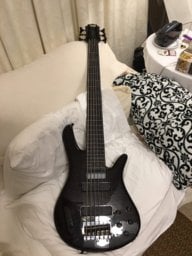
Hey Willy Wonka, where'd you get that Eagle? It looks almost like the one I owned except for the chrome knob caps. It was my first fretless.

Screen Shot 2020-06-20 at 3.59.16 PM.png
 
  • Like
Reactions: james condino
Maybe I should have said, "this is terrible advice for a first-time fretless player."

Because...
  1. a perfectly good bass is ruined
  2. there goes the resale value
  3. there's no guarantee the conversion will be playable or desirable
  4. oops, they forgot to file the nut, etc.
  5. more trouble and cost than it's worth vs getting a factory fretless especially for a first-time fretless buyer
+1 for buying used, though.

Agree with crankypants on all points.

It's not necessarily the case that the conversion will fail and ruin the bass, but a defang of a fretted bass should only be considered for very specific reasons.

I've done several conversions myself and I only chose to do it because the risk was worth it. A defang isn't easy and quick to do; it requires a good set of tools, materials and a lot of good ol' elbow grease. Among other things, it should only be done on a bass that has enough adjustment to deal with the missing height of the frets. Meaning at the nut, the bridge and the pickups - there has to be enough room there to accommodate the frets going bye-bye and the strings dropping by the missing fret height. It should also have a finish put on the board afterwards, for the reasons I mentioned earlier, which takes even more skill and work to do correctly.

So not only does the bass have to be chosen correctly, the work to defang it is going to cost a fortune if your luthier really knows what he's doing and is equipped to do it right.

On a first bass, then, don't even think about it :). Just get a factory FL to begin with.

L
 
I'm Thinking of a Fretless

I'm a P bass player for 50+ years and am thinking of buying my first fretless. The Player fretless looks good, but I wonder if something more would make me happier. The Jaco model will obviously mot make me play like him, but are there advantages to spending more money? A few Ibbies look pretty good too>

That is a good thought.
 
I'm a P bass player for 50+ years and am thinking of buying my first fretless. The Player fretless looks good, but I wonder if something more would make me happier. The Jaco model will obviously mot make me play like him, but are there advantages to spending more money? A few Ibbies look pretty good too>
Disregard our opinions and Use Your ears and $.., you'll make the best decision and we'd love to hear which you chose !
 
  • Like
Reactions: Watchootognbout
Agree with crankypants on all points.

It's not necessarily the case that the conversion will fail and ruin the bass, but a defang of a fretted bass should only be considered for very specific reasons.

I've done several conversions myself and I only chose to do it because the risk was worth it. A defang isn't easy and quick to do; it requires a good set of tools, materials and a lot of good ol' elbow grease. Among other things, it should only be done on a bass that has enough adjustment to deal with the missing height of the frets. Meaning at the nut, the bridge and the pickups - there has to be enough room there to accommodate the frets going bye-bye and the strings dropping by the missing fret height. It should also have a finish put on the board afterwards, for the reasons I mentioned earlier, which takes even more skill and work to do correctly.

So not only does the bass have to be chosen correctly, the work to defang it is going to cost a fortune if your luthier really knows what he's doing and is equipped to do it right.

On a first bass, then, don't even think about it :). Just get a factory FL to begin with.

L

It's not a job you do yourself without quite a bit of experience, that's why I take it to a luthier. The last de-fret cost me £90/$111. He was happy with it, so was I. He used a picture of it as an example of his work on his site.
 
Maybe I should have said, "this is terrible advice for a first-time fretless player."

Because...
  1. a perfectly good bass is ruined
  2. there goes the resale value
  3. there's no guarantee the conversion will be playable or desirable
  4. oops, they forgot to file the nut, etc.
  5. more trouble and cost than it's worth vs getting a factory fretless especially for a first-time fretless buyer
+1 for buying used, though.


I'd love to find a luthier who would do a pro defret, finish and proper setup for 100 USD. I don't think I could find one near me that would. I think it's too much effort, risk, and cost when there are so many great fretless basses around.

YMMV
 
I'd love to find a luthier who would do a pro defret, finish and proper setup for 100 USD. I don't think I could find one near me that would. I think it's too much effort, risk, and cost when there are so many great fretless basses around.

YMMV

Agree; if he's only charging you $100, he probably ain't doing it right... :).

In saying that, the most critical part of the job is getting the fingerboard flat with no divets or bumps in it when strung and tuned to pitch. So what you really need at a minimum just for that part of the job alone is a neck jig and a good radius beam. By good I mean a full length aluminum beam of the correct radius, not the small one made out of wood.

And that's just the fingerboard. The cost and tool requirements only go up from there... :)

L
 
  • Like
Reactions: crankypants
Maybe I should have said, "this is terrible advice for a first-time fretless player."

Because...
  1. a perfectly good bass is ruined
  2. there goes the resale value
  3. there's no guarantee the conversion will be playable or desirable
  4. oops, they forgot to file the nut, etc.
  5. more trouble and cost than it's worth vs getting a factory fretless especially for a first-time fretless buyer
+1 for buying used, though.
Thanks for the explanation. :thumbsup:
 
  • Like
Reactions: crankypants
I would strongly suggest a lined fretless bass.

I strongly disagree. After 18 or so years of playing mainly 5 string fretted basses (most of which, a Marcus Miller Fender Jazz) I went and bought a Tony Franklin sight unseen. Still do not miss fret lines. All it takes, is setting aside the fear of going unlined. Now, if you prefer lines, go for that.
 
I strongly disagree. After 18 or so years of playing mainly 5 string fretted basses (most of which, a Marcus Miller Fender Jazz) I went and bought a Tony Franklin sight unseen. Still do not miss fret lines. All it takes, is setting aside the fear of going unlined. Now, if you prefer lines, go for that.

It has nothing to do with fear. There are many playing situations where one cannot hear well (or at all) that will necessitate lines to ensure accuracy.

I play primarily fretless bass and there have been many occasions I've been very thankful to have lines. There has never been a time that I thought "I really wish I didn't have lines on this thing" except perhaps moments of extreme vanity.
 
I have played quite a few fretless basses made by many brands, including Fender, Warwick, Ibanez, Aria, Taylor, Godin.
None were really difficult to play but the one I personally found to sound and feel the best and was reasonably priced was an Ibanez SRH500F. It was not the most expensive, nor the most known but sounded good and was very easy to play. It is a semi hollow, piezo equipped instrument. They also make an Ibanez SRF700 which is a solid body that has neck and bridge magnetic pickups as well as a piezo pickup.
The only way to really know is to play them.
I also really like the Godin A4/5 but in my country they are really expensive.
 
  • Like
Reactions: Lackey