
Perhaps because personal anecdotal evidence is all most understand in todays narcissistic cultural bent. If they can get their nose outta their phones.
I did a double blind, once... I realized, 'Hey, I can see, after all!'.

TalkBass has been independent since 1998. Add your voice.
Create a free account to reply to discussions, view embedded media, and browse with fewer display ads.
Join free Log in
Want zero display ads or expanded classifieds tools? Compare plans.
Perhaps because personal anecdotal evidence is all most understand in todays narcissistic cultural bent. If they can get their nose outta their phones.
"If one is not feeling song, stand closer to amp."


my drummer hits so hard that it doesn't even matter if I'm in tune, much less if my strings are through the bridge or the body..
Guys, am I missing something? How would an extra inch of string on the other side of the witness point cause an increase in the tension of the string between the nut and bridge? I think some of you really need to read a science book.

How can it not, it's science and science is absolute. A stronger connection and the instrument acts more as one.

That's what I'm talking about.Perhaps a better test would be to hear the same bass strung through the body and through the bridge. I mean who's to tell what a through-body sounds like if you only hear it through the bridge?
Still the question remains - is there an audible difference? Or is it all in the feel? Or in your head? Is it perceptible to the audience? Is the music better with thru-body stringing?
Agreed. Especially after going through something like this (see below). I mean, what's the point in picking out a specific bass? Once your signal goes through all this crap, it doesn't matter if you're playing a Yamaha, Musicman or Zon (as far as tone);Let's take it a bit further.
I'd like to see a sound test where someone has to identify the bass being played behind a wall.
How well it "sits in the mix"
So that they cannot judge the bass by it's appearance.
Or the name on the headstock.

In my opinion once the string passes the saddle it doesn't really matter where it's attached to, because there's nothing happening there. Look at violins, and other stringed instruments through history...if there was a sonic benefit we would see it everywhere.

Exactly!Agreed. Especially after going through something like this (see below). I mean, what's the point in picking out a specific bass? Once your signal goes through all this crap, it doesn't matter if you're playing a Yamaha, Musicman or Zon (as far as tone);



As a cellist I can tell you it's a very important factor - on a cello the string length between bridge and tailpiece/anchor point resonates and if it isn't tuned properly it produces discordant wolf notes. Which is why you see a lot of cellos with little weights or dampers on that very string length. Incidentally on a full size cello these wolf notes almost always come out when you play F or F# in concert pitch so probably an inherent design issue, but it's still that string after-length that is the problem.




There's a lot more things at play than simply whether or not Vibrations are happening behind the bridge and/or saddles. There's also the potential fact that now a significantly thicker (and more even from saddle to nut) part of the string is vibrating. There's also the fact that there is more tension across the string when strung thru, according to some. I'm sure there are lots of others that the more scientific among us could mention but none of that matters a whit, as far as I, or my post are concerned.
I'm talking about how perception changes reality. If I BELIEVE that running my bass string thru is gonna make it sound and feel better, then I will FEEL and PLAY better each and every time I pick that instrument up, and THAT is what is quantifiable, as captured on a recording. That is where a double blind test would need to be done to settle this once and for all but frankly, almost nobody outside of talkbass gives a poop about this stuff, so it'll almost certainly never happen.
This debate will likely continue thru the ages, or until a DJ comes and takes all of our jobs away while we were all busy not practicing. Lol

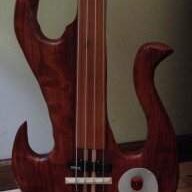
I can tell you why. The same reason why people want and builders use multi laminate necks. When everything is one piece, like so many people think they want, there often exists dead spots. When instruments have more parts, like bolt on, multi laminate necks and multipiece bodies, they come together as one and, a much more useable resonance is created, instead of having all your "eggs in one basket". Dead spots and "sonically poor" parts of the wood become less of a factor.
I personally have found all of the neck thru basses that I've ever played to be somewhat dull.