
• TalkBass has been independent since 1998. Add your voice.
    Create a free account to reply to discussions, view embedded media, and browse with fewer display ads.
    Join freeLog in
    Want zero display ads or expanded classifieds tools? Compare plans.

Impossible question!

Bose killers
[Invalid or Expired Link Removed]
[Invalid or Expired Link Removed]
Because of the way line arrays work, you can usually put these on stage behind the band facing forward. Use them for stage and FOH. Feedback is controllable as it not a loud point source. Sound is very balance on stage and out in the audience for folk, bluegrass levels.

If you want bass, you can add a sub later.

Unless those things are much shorter than they look, i have to think portability would be an issue. Looks to me like you'd need at LEAST a full size minivan with the seats taken out to move them.

Might not be a consideration, but it could be.
 
Unless those things are much shorter than they look, i have to think portability would be an issue. Looks to me like you'd need at LEAST a full size minivan with the seats taken out to move them.

Might not be a consideration, but it could be.
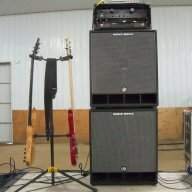
They aren't as tall as they might look. They are loaded with 2 or 2 1/2 inch speakers.
 
The reviews are from idiots that wouldn't know what a real PA sounds like. Kustom sucks. I recommended the stagepas 600i and that would be the cheapest I would go with. If the OP wants to spend some money then an unpowered mixer and some decent powered speakers would be better.

Agreed. I might even pick Behringer over that Kustom stuff. At least the Behringer would sound a little decent until it commits suicide in the middle of a gig.
 
What you mentioned would work fine. And if you play a larger room, just have the bass player bring a rig. All you have to do is make sure that your speaker ohm load matches up with the amp. It would probably be a lot easier just to get a used powered mixer rather than a separate mixer and amp. Used Carvin stuff can be had for a song.
 
What you mentioned will be fine. I have done the 50-250 person venues in both country and rock bands with the following:

* powered mixer - at least 8 "real" channels and 400W a side (currently Carvin XP1000L)
* 2xmains usually 15" (I prefer 12")
* 2xmonitors (currently two Peavey PV112M)
* don't forget all the cables... they really add up

I say "real" channels because some 8 channel mixers are 4 mono and 2 stereo channels. I want 8 channels with at least a couple stereo. One stereo for mp3 player between sets and one for keyboard if necessary.

I like a powered mixer that fits on top of the bass amp since the small clubs generally have *no* extra space.

We run vocals and acoustic guitars through the PA. I also hook up the bass, but only for emergencies and sometimes for a little help at the end of the night when things get stupid loud.
 
Unless those things are much shorter than they look, i have to think portability would be an issue. Looks to me like you'd need at LEAST a full size minivan with the seats taken out to move them.

Might not be a consideration, but it could be.

Dimensions: 31.5" high x 5" wide x 5.25" deep

Small really, but think that they work like an elongated speaker. Not a point source like normal cabinets. Wide dispersion. For small acoustic type groups they can have a lot of placement options.

Digital mixers were mentioned. Very smart idea. Most now do wifi and let someone walk out into the audience to remote control it. Snakes and remote consoles aren't needed.

Mackie has some interesting options
dl806 or dl1608
 
Mackie ProFX 12 (6 mic inputs) or ProFX 16 (12 mic inputs), two JBL PRX612M mains. JBL PRX618 sub optional. Mics and cables. That's what my acoustic trio uses. We can set it up in twenty minutes and tear it down in fifteen, and the sound is pro level. The Mackie board has built-in effects and graphic EQ and the ProFX 16 even has four channels with compression. We haven't had a gig yet that the volume was inadequate.

Buy once, cry once. You won't be disappointed with this and end up selling it to get something better.
 
I say "real" channels because some 8 channel mixers are 4 mono and 2 stereo channels. I want 8 channels with at least a couple stereo. One stereo for mp3 player between sets and one for keyboard if necessary.

Stereo channels are a relative newcomer on the scene (relative to me, anyway), and they exist to save money in production. I'd much rather have two real channels that I can use as a stereo pair, or not, depending on what I need for the gig.
 
Stereo channels are a relative newcomer on the scene (relative to me, anyway), and they exist to save money in production. I'd much rather have two real channels that I can use as a stereo pair, or not, depending on what I need for the gig.

I am a big fan of stereo channels... but not too many ;) I quite often use an mp3 player between sets and the stereo channel is handy since I don't have to play with separate volumes per side. Same with keyboard, I just have one volume knob.

But I could see an advantage to all mono channels. If you don't need stereo, you get two channels rather than one.
 
I am a big fan of stereo channels... but not too many ;) I quite often use an mp3 player between sets and the stereo channel is handy since I don't have to play with separate volumes per side. Same with keyboard, I just have one volume knob.

But I could see an advantage to all mono channels. If you don't need stereo, you get two channels rather than one.
And what used to be a 16 channel mixer is now a 12 with two stereo with no XLR or mic preamp, but they still call it a 16. I hate that.
 
Hi.

Stereo channels are a relative newcomer on the scene (relative to me, anyway), and they exist to save money in production.

Today perhaps, but in the stone ages of mixing consoles they were included for greater versatility and for reducing console width (/getting more channels on the standard frame).

Of course, on the era I'm talking about nearly all consoles were channel strip style and You could buy the strips separately, swap 'em, and mod the console to better suit your needs.
Most also had the same EQ and routing options as the MIC channels, not the bare basics or none as it's often the case today..

I sure miss those old desks.
NOT the weight though ;).
Luckily for me, I still have some :).

As for the channel count, for me, only the full feature mic channels matter, and the number of those determine the useablity of the said mixer. In-line channels, aux channels, stereo channels, tape returns, etc. are counted for their use. Regardless of what the marketing department wants to call it.

Regards
Sam
 
As for the channel count, for me, only the full feature mic channels matter, and the number of those determine the useablity of the said mixer. In-line channels, aux channels, stereo channels, tape returns, etc. are counted for their use. Regardless of what the marketing department wants to call it.

Regards
Sam
I agree totally. If you want to include some extra inputs in the master section for tape inputs (remember tape? :D) and FX returns, that's cool, but if you are going to call it a 16 channel board, please give me 16 fully function, pannable channels with mic preamps. Is that too much to ask? :D
 
I am a big fan of stereo channels... but not too many ;) I quite often use an mp3 player between sets and the stereo channel is handy since I don't have to play with separate volumes per side. Same with keyboard, I just have one volume knob.

But I could see an advantage to all mono channels. If you don't need stereo, you get two channels rather than one.

Most of the boards I've seen have separate RCA inputs for the mp3 player so you don't have to waste channels. The Mackie ProFX stuff makes it so the mute switch kills everything but the tape input so you can kill the PA to those who would hijack a mic on breaks, but still have music.
 
I agree totally. If you want to include some extra inputs in the master section for tape inputs (remember tape? :D) and FX returns, that's cool, but if you are going to call it a 16 channel board, please give me 16 fully function, pannable channels with mic preamps. Is that too much to ask? :D

I'm with you on that. We almost always run a mono mix, so there's no need to have stereo channels. If the keys or something have a stereo out, I run it to a Radial JDI in stereo and merge the inputs to a single channel.
 
An audio engineer recently recommended any book written by Paul White:

http://www.amazon.com/Basic-Live-Sound-The-Series/dp/1860742718/ref=pd_sim_b_2

I was calling him to express my frustration that I could not control the monitor mix that I was hearing in the monitors. The issue turned out to be that the Mackie mixer we were using didn't have enough "auxilary sends" to be able to control the specific instrument/vocal levels that I needed at my monitor. "Pro" mixers have 2, 4, 6, 8, etc. "auxilary sends" so that each monitor can have it's own mix.

All of the other issues like power handling and main speakers can be worked out ala carte.
 
As an Amazon Associate, TalkBass may receive commissions from qualifying purchases made via links on this site.
An audio engineer recently recommended any book written by Paul White:

http://www.amazon.com/Basic-Live-Sound-The-Series/dp/1860742718/ref=pd_sim_b_2

I was calling him to express my frustration that I could not control the monitor mix that I was hearing in the monitors. The issue turned out to be that the Mackie mixer we were using didn't have enough "auxilary sends" to be able to control the specific instrument/vocal levels that I needed at my monitor. "Pro" mixers have 2, 4, 6, 8, etc. "auxilary sends" so that each monitor can have it's own mix.

All of the other issues like power handling and main speakers can be worked out ala carte.

Pros have a completely separate mixer running monitors off a snake split.
 
As an Amazon Associate, TalkBass may receive commissions from qualifying purchases made via links on this site.
An audio engineer recently recommended any book written by Paul White:

http://www.amazon.com/Basic-Live-Sound-The-Series/dp/1860742718/ref=pd_sim_b_2

I was calling him to express my frustration that I could not control the monitor mix that I was hearing in the monitors. The issue turned out to be that the Mackie mixer we were using didn't have enough "auxilary sends" to be able to control the specific instrument/vocal levels that I needed at my monitor. "Pro" mixers have 2, 4, 6, 8, etc. "auxilary sends" so that each monitor can have it's own mix.

All of the other issues like power handling and main speakers can be worked out ala carte.

Also, "going pro" means spending $2,500 each just for 12-inch monitors. Mains and subs are more. There are plenty of excellent consumer boards out there. There's no need to buy a Midas Heritage. Actually, Midas (now owned by Behringer) has some fairly economical digital boards, as do PreSonus, Mackie, Yamaha, Allen & Heath and many others.
 
As an Amazon Associate, TalkBass may receive commissions from qualifying purchases made via links on this site.
Most of the boards I've seen have separate RCA inputs for the mp3 player so you don't have to waste channels. The Mackie ProFX stuff makes it so the mute switch kills everything but the tape input so you can kill the PA to those who would hijack a mic on breaks, but still have music.

My Carvin has this too. The last stereo channel is either tape in (RCA), stereo, or mono. They call the mute switch a "music break" switch.
