
• TalkBass has been independent since 1998. Add your voice.
    Create a free account to reply to discussions, view embedded media, and browse with fewer display ads.
    Join freeLog in
    Want zero display ads or expanded classifieds tools? Compare plans.

In the 70s we had rock gods...

  • Thread starter Thread starter Deleted member 165050
  • Start date Start date
There's plenty of Rock Gods still around: U2, Foo Fighters, Metallica, Aerosmith to name a few. Granted, it looks bleak after that class with the exception of maybe Pear Jam however a lot of that has to do with people and their lack of interest in music and their general lack of attention span. Back in the day we didn't have internet, on demand entertainment, video games and computers in our pockets to distract us.
 
Maybe...

Well partly that, but largely a comment on how little real musical development there has been in the last 30 years and how everything has become so safe and bland. Everything is derivative, or is the past "rediscovered". And the stars of today just aren't like they were in the old days :)

I suppose with so many more people and so much music being created everything just gets diluted.

The only thing that changes is your focus. You are looking back. In those days you focused on the NOW.
 
I saw a little of it.
What award shows consider "rock" is laughable. My heavier when I'm tuning than anything you will see on an award show. That doesn't mean great rock isn't out there, it means mainstream (I hate using the word now) outlets don't have more than a keyhole view of the musical landscape.
Walmart music.

They'll go laugh on mattress made of $ while artists go starve on their integrity.
 
There's plenty of Rock Gods still around: U2, Foo Fighters, Metallica, Aerosmith to name a few. Granted, it looks bleak after that class with the exception of maybe Pear Jam however a lot of that has to do with people and their lack of interest in music and their general lack of attention span. Back in the day we didn't have internet, on demand entertainment, video games and computers in our pockets to distract us.

I'm pushing 40 and was around for all of those artists prime years (with the exception of Aerosmith, though they kicked butt in the 90's), and with all due respect I can't say I'd put any one of them on my Mt. Rushmore. I didn't have a phone to distract me back then and I didn't have a computer until I was about 20. All of those artists were practically shoved down our throats and if one of us wasn't living in a big town or city, it might have been our entire musical universe. I get that. Most people had no idea there was anything outside of what they heard on the radio until they got to college.
 
I'm pushing 40 and was around for all of those artists prime years (with the exception of Aerosmith, though they kicked butt in the 90's), and with all due respect I can't say I'd put any one of them on my Mt. Rushmore. I didn't have a phone to distract me back then and I didn't have a computer until I was about 20. All of those artists were practically shoved down our throats and if one of us wasn't living in a big town or city, it might have been our entire musical universe. I get that. Most people had no idea there was anything outside of what they heard on the radio until they got to college.

My point was really more the fact that bands used to have label and fan support so bands could make it past 4-5 albums. Outside of the Stones, the next tenured rock band is Aerosmith, followed by U2 then Metallica and the PJ and Foo's.

With the change in the industry it will be rare to see another mainly original member band have mainstream success past a couple of albums.

There are always the ones that have a moderate underground following like Tool etc...
 
Thoroughly enjoying the thread, y'all. Thanks OP :)

My two bob's worth,

If all of this rock god (idol) worship is artificially derived, as many have argued quite convincingly, here and elsewhere, what are we actually achieving by seeking to reinforce these derivative, arbitrary constructs? With a focus on the sixties and the seventies, it's not so easy to comprehend all the artifice but, if you care to look, it's there.

All this enterprise — and just to qualify, enterprise in our age — probably started many decades earlier, with the mass-produced minting of a torrent of 'Pennies from Heaven' …

… penny ballads, are single sheets of paper with printing normally on one side only. Broadside ballads were popular songs, sold for a penny or half-penny in the streets of towns and villages around Britain between the sixteenth and early twentieth centuries. These songs were performed in taverns, homes, fairs, or wherever a group of people gathered to discuss the day's events or to tell tales of heroes and villains.


IFPB00003.jpg


Broadsides and Penny Ballads (1600s - 1800s)
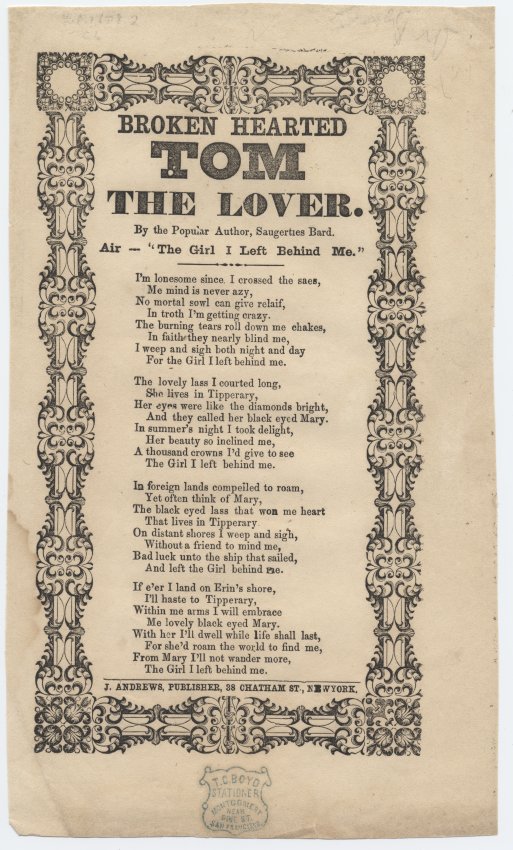
… and that spirit gained a focus, eventually, towards a material desire simply to flog all that mass produced sheet music, initially the one and only form of recorded music, on a grand scale. There was a lot of money to be made if you could make tunes POPular. And that trend has persisted, and has always demanded refinement — for a number of reasons, some not immediately obvious. And so the clouds roll in, and more pennies fall.

Someone very wise once said, the true greats — the so-called 'gods' — for the most part, exist elsewhere, beyond the limelight. They're above commercialization. We rarely get to hear from them because, for the most part, they steer clear of the snap, crackle, and pop. Their music, in that sense, to them, is much too important :) yet they would never labor that point.


But, the upshot, today, for us dolorous denizens of post truth downtown Tunetown, is that a lot of this music is now finding its way, somehow, into the wider world. It's a glory. Just don't expect it to be readily served up to you on a plate, by the usual suspects and their coterie. Every time it rains, it rains pennies from heaven. But that rain, if it's going to quench your thirst, you've got to catch in your own hat. 'Twas ever thus.
 
Last edited:
  • Like
Reactions: Basshappi
Was rock really as popular as everyone says it was? It seems like charts in the 1970s were dominated by lots of pop and softer music and rock was there but a bit of its own niche. Sure, big acts had big audiences then, but I see plenty of younger guitar based bands today with festival sized audiences that average people may not have heard of. The listening public is more fragmented but seems like it's just overall bigger, too.
 
In the pre-internet days of monthly music magazines, there was a greater mystique about artists. Negative press was practically non-existent, except for bad reviews, and most articles amplified the mystique with exaggerations.

 
  • Like
Reactions: ficelles
Nowadays there seems to be minimal talent in the Pop or Pop/rock genres. My wife and I were in a store and they were playing what sounded like America's Ventura Highway and all of a sudden this squawky voice starts rapping hip hop lyrics over the top of it. Sounded like :poop:. I guess they couldn't write their own music so they butchered a classic. Boy times have changed.
 
In the pre-internet days of monthly music magazines, there was a greater mystique about artists. Negative press was practically non-existent, except for bad reviews, and most articles amplified the mystique with exaggerations.

Very good point, the limited communication of the time most certainly enhanced mystique and made artists appear different to ordinary people. Coupled with the limited supply of new music, and of course the fact that world population was half what it is now.
 
I guess would Dave Grohl be the last rock god? Or is he derivative now too?

The only original people to ever have existed were the baby boomers, everyone before them were a big bunch of squares. Everyone after them are just moochers off the glory days and the best people to ever have lived. Remember that one song that went "I hope I die before I get old?" Well, it turns out they wanted to die before they get old to see how crappy everybody after their generation -the objectively, scientifically best generation - turned out to be, not because old people are just generally crotchety old farts. GenX was alright, because they're weren't TOO derivative, maybe, I guess. But even they just pale in comparison. I'm sorry but nobody was creative before the Beatles were, like Charles Mingus or Woody Guthrie, and nobody will ever be creative after Woodstock ever again like witchdr or Johnny hobo or whatever - it doesn't matter because none of those guys are creative.

Also, Dave Grohl is poopy too ;)
 

Latest posts