• TalkBass has been independent since 1998. Add your voice.
    Create a free account to reply to discussions, view embedded media, and browse with fewer display ads.
    Join freeLog in
    Want zero display ads or expanded classifieds tools? Compare plans.

In the 70s we had rock gods...

  • Thread starter Thread starter Deleted member 165050
  • Start date Start date
QUOTE: "I would disagree with setting an end date to the Age of Idols in 1977. I mean, come on, the 80s had Billy Idol! Seriously, though, I think acts like U2 and Van Halen still carried the sense of "rock idols" that had existed earlier. As an 80s teen, me and my friends certainly looked at them that way. And 80s artists were, if anything, MORE obsessed with incorporating new influences - reggae, African music, and for that matter the 80s guitar shredders were rediscovering classical music and going back to Bach for ideas in a way that had been foreign to rock and roll until then. @tb4sbp above set the Age of Idols as 50s to 90s, and I think that's accurate; I would argue Kurt Cobain was the Last New Rock Idol."

Yes, artists in the 80s and 90s certainly did incorporate new colors into the rock palate. But the palate itself already existed by then as a thing, having been created by a fusion of multiple musical influences in the years roughly 1962-77.
1977 is about the time of the maximum natural expansion of the U.S. economy based on the momentum coming from post WWII expansion (when the US grew more wealth than any country in history). After this point a consolidation and sell off process began that fueled great asset growth until the much needed tech boom and about the time the always mutating music industry began to actually self produce artists other than rely on discovering home grown talent and do what was necessary to survive into the digital mass media age. (Consolidate and get rid of physical products) There's no money for anything else.

We've now had 2+ generations in a row that share the same culture and technology. My parents were in a different universe than I was...they were pre TV. They believed whatever the President or the Doctor said. The bands and artists I followed in the 60s 70s were all self produced, self created, and a complete bafflement to the industry guys of the time who's template was Sinatra or Mitch Miller.

Rock Godhood is part of the Dionesian process that Rock music serves in society. It's a healthy outlet and keeps the kids interested.
 
Last edited:
  • Like
Reactions: bassobrutto
So this is really about your longing for world since-past rather than a commentary on today's youth?

You have a point, and maybe we do, guilty as charged. But keep in mind, just because something is new, does always mean it's improved.

As for the OP, the real performance gods are ones that could go on stage will minimal support, and hold an audience spellbound for hours. Alicia Keyes, James Taylor, Carole King, and further back, guys like Tony Bennett to name a few. I never worshiped any of them, by certainly appreciated their talent, more so than today's Brittany Spears sort than needs all sorts of pirotechniques, and 20 dancers to distract you from a serious lack of talent.
 
Panic at the Disco reminds me of Queen or Guns N' Roses.
The kids are alright.
Berlin and Phantagram are on the same playlist.
Sam Smith and Marvin Gaye mash up seamlessly.

I think that a lot of the mystery that used to exist is completely void in today's instant gratification world.
 
Like the oft common metalheadz delusion that they are the second coming of Mozart Beethoven?
Or the Soggy Bottom Boys nu rap hootenanny's?

I said rock, but I am metalheadz, actually. I think that says more about how the metal musician demographic is mostly younger guys who are passionate about music, but don't yet have the experience of life to show them that they're probably average at best.

What I was really getting at is that it's not hard to see how things like classical music and blues (and whatever rap came from) eventually became rap and metal because kids kept trying to play what came before them, but couldn't recreate it exactly.
 
  • Like
Reactions: Fab Superlative
I don't understand this. I guess John Mayer is a pushover if you assume the only thing he's ever done was "Your Body is a Wonderland", but it's not. He's an acclaimed guitarist and very well respected by many of the typical "rock gods" including Clapton himself.

When it comes to rock and blues guitarists, he's undoubtedly going to be remembered as one of the greats.

IMO, SRV, Gary Clark Jr., and Davey Knowles have it all over John Mayer.
 
  • Like
Reactions: juancaminos
I think if anything virtuosos have gotten more impressive over the decades. Look at guys like Guthrie Govan, Buckethead, Nick Johnston, and countless others.


And here's a great jam band with one of my favorite guitarist pairs:

 
Oh boy, "rock-used-to-be-so-much-better" thread #87,563. OK, I'll play.

In the '60s and '70s, rock bands had a huge ready-made audience (thanks to the Baby Boom--birth rates have been much lower for a long time now) to buy their albums and tickets to their concerts.
In the '60s and '70s, people had far fewer entertainment choices--no internet, no online games, no movies you could watch at home, no shows could be recorded, only three channels plus some snowy UHF instead of 500+.
In the 60s and '70s, concert tickets were cheap!
In the '60s and '70s, record companies served as gatekeepers, so only a limited number of artists could really have their music distributed--so not only did you have a far bigger audience, you had far less competition.
In the '60s and '70s, record companies lavishly supported their artists with massive promotions and huge recording budgets. If Steely Dan started today, no way could they afford to hire five full bands worth of the best studio musicians in the world to record a single track.
In the '60s and '70s, people had to pay for your recordings, so you made a lot more money.
In the '60s and '70s, there was no social media to track every single move a musician made--far fewer "sins" were exposed, and pictures and video were far more rare. Thus rock stars seemed more mystical and bigger-than-life. Today, if a famous musician goes out to the grocery store in sweats and a ballcap, 10 people are going to snap a picture on their phones before the person is 5 steps from their car.

The people haven't changed, just their circumstances.

Good post Craig. Although I do honestly believe overall talent has deteriorated, and I think you nailed the root cause, it's caused by dilution. Heck, even a schlep like me has 4 CDs on I-tunes.

I've said this many times, the biggest risk to live performance is basically free streaming music. The consumer can get exactly what he wants, when he wants it, played exactly the way he wants to hear it played. The buying public is voting and it's voting for canned music.

Back in the day, you couldn't walk two city blocks without hearing a band playing in some basement or garage, and most of them were gigging. Today, far fewer venues, and forget about making any sinificant money working with a band with more than 5 members. More than 5 and you're lucky if you make enough for your bar tab.
 
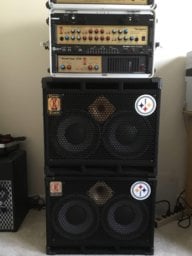
+1 on the Eden rig the bassist used on Smoke on the Water. Yes, it really is worth hauling it around.

I was eying an Eden head for sale locally the other day, not the first time either. They make some sweet stuff. Definitely tempted me even though I really don't need a new head. It's the WT400.

Also side note, that bassist is easily one of the most controversial I've seen on youtube. He has such a weird playstyle it seems like 90% of the comments either hate him or love him :roflmao:

Another side note, that Asian guitarist is a classical metal guy who's done some crazy stuff with orchestras. Here's a video of him and 4 other crazy Asian guitarists doing a Gary Moore tribute:

 
What I was really getting at is that it's not hard to see how things like classical music and blues (and whatever rap came from) eventually became rap and metal because kids kept trying to play what came before them, but couldn't recreate it exactly.

Fair enough. And here's the thing, each generation moves the music in a different direction as a natural progression of change.
But- and here is where most folks struggle = if you are making new music that the older generations don't necessarily approve of, or care for much= then that means you are doing it right. Because that is exactly the same time tested method that has been used since forever.

Some folks say 'these modern singers can't carry a tune in a bucket' are they referring to Bob Dylan or Brittany Spears? does it really matter?

I'm a child of the 60's - 70's. But I still listen to, and actually like a wide variety of music that has come out since- as well as even the older contemporary and classic music that has been pressed since the invention and wide spread distribution of vinyl records. I'm one of those kooks that finds it counterproductive to be so deeply rooted and attached to one particular genre or time period when it comes to the 'all you can listen to smorgasbord of music.'

And since we're talking about Rock here, and the whole Rock iz Ded thang.
Going to tell you a secret. I'd say that it's still very much alive, and still Kicking it Out!