• TalkBass has been independent since 1998. Add your voice.
    Create a free account to reply to discussions, view embedded media, and browse with fewer display ads.
    Join freeLog in
    Want zero display ads or expanded classifieds tools? Compare plans.

Industrial Strength Industries?

If you are going to provide an SPL chart there is a standard format in which it should be presented, half-space anechoic. I don't think there's need to go into fine detail with a myriad of information that only an engineer would understand, but SPL charts aren't all that arcane. They're just unknown in the electric bass genre.

Hi Bill,

I prefer full anechoic space as it is "worst case" of what you can have; having done PA speakers for several "transparent" stage setups (where the floor was soft enough - or in the case of an outdoor venue made of actual perforated steel - it offered no real gain at lower frequencies), I prefer to show the worst a person would get. In the low frequencies, in the typical location of the bassist (stand in the back corner, over there), you're probably going to see 1/4 space a fair amount - giving a solid 12 dB more sensitivity.

Dan
 
I prefer full anechoic space as it is "worst case" of what you can have

I prefer that too, though I do not have enough "space" to do such a measurement. Most of the time I measure the response below 200hz very close to the woofer, the problem is that it only works (pretty)accurate with closed cabinets or 4th order bandpass enclosures (bassreflex only when you have the port very close to the woofer). I also prefer to combine simulations and measurements. Measurements for 200hz and up and simulations below 200hz. A good sim program can give you pretty accurate results about the low frequency response (full- and half anechoic space). Btw IMHO I think that the "room" has such a big influence on the low frequency response that for me it's more then enough to know how the cabinet behaves when simulated.
my 2 cents
 
And engineers do a lot more listening than you give them credit for, too. It's just silly to think that gear is produced simply by doing charts and never listening. It's not an either/or situation ever. Of course the final test is listening, but behavior can be predicted with a fine tooth comb, so why not take advantage of that, and then use the listening to fine tune it? Just remember that the best sounding gear on the market was designed by engineers, not listeners.


+1

In my case, I'm building/designing loudspeakers for 25 years now. The first 17 years I did this totally by ear (and using the knowledge I got from experimenting and books), the last 8 years I have the measuring equipment and simulation programs. I can tell you that my loudspeaker designs sound better now I have the extra "tools". For me it's still 50/50, part listening part measuring. And, I allways let my better half listen to my creations first...:cool:
 
Hi Bill,

I prefer full anechoic space as it is "worst case" of what you can have;
What's pertinent is that half-space is the engineering community standard, be it in measured response charts or software modeling, so that comparisons between different cabs are valid.

From a practical standpoint there's no such thing as full space loading in pro-sound. Bass cabs and subs are almost always ground stacked, and where PA main cabs are concerned even when fully flown they're still in half-space above their baffle step frequency. In hi-fi the baffle step may be well above 1kHz, but in pro-sound it's seldom higher than 500Hz, and that's with a single box on a stick; stack a second box and you're down to 250Hz. It all can get very complicated of course, but there's a simple way to remove any confusion: measure half-space. That's why the AES long ago settled on this protocol.

I applaud your actually posting charts, but the last thing the electric bass community needs is another instance of a manufacturer using their own set of standards. Specs are only useful when everyone adheres to the same set of rules.
 
What's pertinent is that half-space is the engineering community standard, be it in measured response charts or software modeling, so that comparisons between different cabs are valid.

From a practical standpoint there's no such thing as full space loading in pro-sound. Bass cabs and subs are almost always ground stacked, and where PA main cabs are concerned even when fully flown they're still in half-space above their baffle step frequency. In hi-fi the baffle step may be well above 1kHz, but in pro-sound it's seldom higher than 500Hz, and that's with a single box on a stick; stack a second box and you're down to 250Hz. It all can get very complicated of course, but there's a simple way to remove any confusion: measure half-space. That's why the AES long ago settled on this protocol.

I applaud your actually posting charts, but the last thing the electric bass community needs is another instance of a manufacturer using their own set of standards. Specs are only useful when everyone adheres to the same set of rules.

Hi Bill,

We use IEC 60268-5 for measurements, since ISI does have an international presence. And to the best of my knowledge, AES-4id does not require any specific test environment, but a minimum of half-space used for measurements (along with specified scattering and absorption coefficients at specified angles).

The intersection of '2658-5 and 4id led us to use 2.83 Vrms input with full-space measurements.

Regards,

Dan
 
I prefer that too, though I do not have enough "space" to do such a measurement. Most of the time I measure the response below 200hz very close to the woofer, the problem is that it only works (pretty)accurate with closed cabinets or 4th order bandpass enclosures (bassreflex only when you have the port very close to the woofer). I also prefer to combine simulations and measurements. Measurements for 200hz and up and simulations below 200hz. A good sim program can give you pretty accurate results about the low frequency response (full- and half anechoic space). Btw IMHO I think that the "room" has such a big influence on the low frequency response that for me it's more then enough to know how the cabinet behaves when simulated.
my 2 cents

At my web page, I've got a description of a method that might help for ported cabs. Basically, I take the near-field response curve, and fill in the "hole" left by the port, using the math formula that comes out of the basic theory. I'd call it "semi empirical," but I'll bet it's pretty accurate.

Amusingly, the curve with the "hole" is what you get if you let the sound guy stick a mic in front of your speaker.
 
Hi Bill,

We use IEC 60268-5 for measurements, since ISI does have an international presence. And to the best of my knowledge, AES-4id does not require any specific test environment, but a minimum of half-space used for measurements (along with specified scattering and absorption coefficients at specified angles).

The intersection of '2658-5 and 4id led us to use 2.83 Vrms input with full-space measurements.

Regards,

Dan
IMO Tom Danley sets the standard for measurement. Outdoors, at 10m/100w, which gives a far more accurate real world result than small signal nearfield, and where pro-sound is concerned 1m is nearfield. Ground plane for below the baffle step, the cab facing up with the mic suspended above for above the baffle step, splicing the two.
I use the same protocol except for distance and power. My yard is too small to measure at 10m without introducing a major boundary, my house, so I measure at 4m. I can't do more than 5.6v either, with horns even that is enough to seriously upset the neighborhood.
 
IMO Tom Danley sets the standard for measurement. Outdoors, at 10m/100w, which gives a far more accurate real world result than small signal nearfield, and where pro-sound is concerned 1m is nearfield. Ground plane for below the baffle step, the cab facing up with the mic suspended above for above the baffle step, splicing the two.
I use the same protocol except for distance and power. My yard is too small to measure at 10m without introducing a major boundary, my house, so I measure at 4m. I can't do more than 5.6v either, with horns even that is enough to seriously upset the neighborhood.
Hi Bill,

Is that an industry standard?

The issue with debating standards are that there are many and conflicting - and all are valid for their use. We chose anechoic as it's a worst case scenario - you'll only get better from there on up.

Having a large space (my measurement room is around 14,000 cubic feet and in an industrial area so loud volumes aren't really an issue) ameliorates much of the issues for most measurements, but ultimately it comes down to what standard or what TO measure.

Anyway, I've stated what we measure and why we measure it, if there are other things people would like to see in terms of measurement I'd be happy to run them, but I think we'll end up going nowhere debating which of a dozen published or preferred standards and approaches are better.

Regards,

Dan
 
To interject a thought here......

The vast majority of bass cab manufactures advertise so-called "specs" that are misleading at best, bold-faced lies at worst or just plain absent and/or unquantified. Pushing these manufacturers to reveal more technical data about their products isn't going to work if there isn't a set standard to use, it'll just lead to more misleading information.

Left as is, we'll see no end to people blowing their money on some speaker because the ad says stuff like 28hz and 104db with no clue as to how those numbers were arrived at or if they were even "arrived at" at all.
 
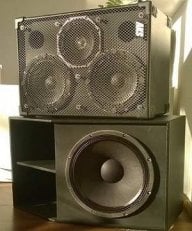
In this last NAMM (2012) I had the privilege to test these cabinets. I spent a lot of time in their booth. I can't give you a lot of detailed tech specs, but one thing I'm certainty: They sound amazing!! The low B is just incredible! These cabinets have a very clear sound with high definition. I definitely recommend them and actually... I want one!!!
 
In this last NAMM (2012) I had the privilege to test these cabinets. I spent a lot of time in their booth. I can't give you a lot of detailed tech specs, but one thing I'm certainty: They sound amazing!! The low B is just incredible! These cabinets have a very clear sound with high definition. I definitely recommend them and actually... I want one!!!


I agree They did sound very nice.


Here's Big Mickey C giving them a spin.

NAMM 2012 Bass Big Mikey C - YouTube
 
Hi Bill,

Is that an industry standard?
It gives a true half-space result, so in that respect it meets the de facto industry standard that JBL and EV and every other major player in pro-sound have used for decades. But most companies measure at only 2 meters, and at small signal levels. By measuring at 10 meters coloration of the results by the nearfield condition are avoided, while the 100 watt signal gets a result much closer to real world usage than a watt or two. The only thing Tom doesn't yet do is to measure maximum output, rather than use a calculated figure that of course doesn't account for power compression. I suppose he doesn't do so for the same reason I don't measure at 100 watts, his neighbors would not be happy.
 
It gives a true half-space result, so in that respect it meets the de facto industry standard that JBL and EV and every other major player in pro-sound have used for decades. But most companies measure at only 2 meters, and at small signal levels. By measuring at 10 meters coloration of the results by the nearfield condition are avoided, while the 100 watt signal gets a result much closer to real world usage than a watt or two. The only thing Tom doesn't yet do is to measure maximum output, rather than use a calculated figure that of course doesn't account for power compression. I suppose he doesn't do so for the same reason I don't measure at 100 watts, his neighbors would not be happy.

I agree about that the big pro stuff should be measured at 10mtrs distance with 100watts (or even more). For basscabinets I think 1 or 2 meters will be adequate, but manufacturers should also be honest about the max spl, 99% are not. The numbers they show are for the midfrequencies and not the bass. Maybe there should also be a standard in the pro sector for the max spl limit. For individual drivers(woofers) 10% of harmonic distortion is the limit for the xmax, then there's the question if it's 2e or 3rd order harmonic distortion which yield different coloration. What is also important is how fast the distortion increases, does it increase gradually or exponentially. When it increases gradually the driver will still sound ok beyond xmax and shows the driver can also handle peaks in the signal.

The other problem with most basscabinets is that the designs (the multiple mid/woofers+tweeter cabs) also have a totally different off-axis response (though it can be very profitable when the vertical dispersion is limited). So measuring(and showing) only the on-axis response gives a totally wrong image of how the speaker will sound in a room/on stage. This is mainly the case with the mid to high frequencies. IMHO this region of the basssound is very important, when you have a smooth power response and very little phase shifts (at different angles) you're sound will be very tight and accurate and thus will make you more audible(cut through) on stage.
 
Amusingly, the curve with the "hole" is what you get if you let the sound guy stick a mic in front of your speaker.

Thats one of the (several) reasons why I will not let any soundguy mike my cabs (maybe only to get a bit of midrange "bark" to mix with the DI signal)
They will even have more trouble now with my 2x10 with the 8" coaxial driver, then they need at least two mikes to get my sound. I only give them the DI (post-preamp)-output signal from my amp. Thats also why I want my cabinet as neutral as possible. :ninja:
 
Yep.

Thats one of the (several) reasons why I will not let any soundguy mike my cabs (maybe only to get a bit of midrange "bark" to mix with the DI signal)
They will even have more trouble now with my 2x10 with the 8" coaxial driver, then they need at least two mikes to get my sound. I only give them the DI (post-preamp)-output signal from my amp. Thats also why I want my cabinet as neutral as possible. :ninja:
 
Thats one of the (several) reasons why I will not let any soundguy mike my cabs (maybe only to get a bit of midrange "bark" to mix with the DI signal)
They will even have more trouble now with my 2x10 with the 8" coaxial driver, then they need at least two mikes to get my sound. I only give them the DI (post-preamp)-output signal from my amp. Thats also why I want my cabinet as neutral as possible. :ninja:

This is how I roll too. Accurate cabs, post-Pre DI signal, no matter how many people will tell you the sky is falling if you use a post-pre send.

On the occasion I have been mic'ed they've used both my DI line and also a mic on my mid.
 
Just got through playing a local festival where the FoH engineer kept me from running my post-pre signal to him. Was kind of 'prickly' about telling me that it was the only truly professional way to run bass to mains.

Needless to say, a fellow bassist out in the crowd said it was one of the few times he'd heard me that I didn't have "my sound".

Oh well. :hmm:
 
The charts are fabulous, I think it's great.

My next two issues on the site:

"Our use of patented XBL™ technology (US Patent 7,039,213 and others pending)"

It's not ISI's patent. Other companies can use drivers with XBL or XBL^2 technology. Or maybe ISI is the only company licensed to use this patented technology in Bass cabinets?


"A unique combination of AlNiCo and Neodynium: that's what we call Al-Neo™"

This obviously comes from the driver manufacturer but I call "gimmick".
When you see one such statement, it really lowers the whole site credibility to me. Reference "the switch"

Either there's measurement that prove some benefit, or a double blind test if some sound quality difference.

Or it's just a gimmick. Average user visiting the site may believe. Talkbass skeptic - no way.