• TalkBass has been independent since 1998. Add your voice.
    Create a free account to reply to discussions, view embedded media, and browse with fewer display ads.
    Join freeLog in
    Want zero display ads or expanded classifieds tools? Compare plans.

Industrial Strength Industries?

billfitzmaurice said:
Their entire website is devoted to the supposed engineering superiority of their cabs. Those of us who are engineers see right through those claims.
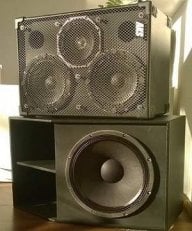
Hi Bill, I'm sure you remember me...;) I'm the engineer who designed the drivers and cabs perhaps I can shed some light on what we're doing - and clarify that it's not smoke and mirrors and nothing to be seen through. It is pretty rare to see actual measured frequency responses for bass cabs posted, but that response is accurate - measured in an anechoic chamber (anechoic down to 45 Hz), spliced near-field at 70 Hz, good equipment used, etc.

KJung said:
My impressions at NAMM are similar to yours. I would point out though that there are a lot of guys playing relatively quiet gigs who value a full range tone. This cab again reminds me of the early EA VL cabs, and especially the Acme B series II cabs (actually more the Acme's than the VL's, due to the extreme low end extension and the resulting 'polite' feeling of the upper mids and treble).

Definitely a niche product, as you suggest, but there might be a place for it. Watts are cheap now, so the low SPL is not much of an issue at this point for those types of players who want a wide tonal footprint and play at moderate volumes.
Precisely. We've identified a niche of players looking for very neutral, clean (uncolored) output in a small package. And with the advent of very small and affordable high-power amps, we can use Hoffman's Iron Law tradeoffs to our advantage in this application.

We've been pretty up-front with people who've checked it out - it's not for everyone. It's for the working bassist who values small size, extremely low frequency extension, and very clean and neutral sound. For those, it's a great choice. If those criteria aren't your priorities, however, then we'd definitely recommend looking elsewhere.

Regards,

Dan Wiggins
ISI
 
Hi Bill, I'm sure you remember me...;) I'm the engineer who designed the drivers and cabs perhaps I can shed some light on what we're doing - and clarify that it's not smoke and mirrors and nothing to be seen through. It is pretty rare to see actual measured frequency responses for bass cabs posted, but that response is accurate - measured in an anechoic chamber (anechoic down to 45 Hz), spliced near-field at 70 Hz, good equipment used, etc.
Hi Dan. Is the base measurement half-space anechoic? If so what is 'extension on floor'? Quarter-space? You're the last one who should need to be told how measurements should be quantified, so I'm a bit surprised as to the vagueness/deviation from the norm here. It's true that the average bass player doesn't know half-space from the man on the moon, but those who do know how to read SPL charts would also be familiar with the rest of the terminology, so I wouldn't 'dumb it down'.
 
The good news is they have SPL charts. The bad news is that they reveal that these are loaded with hi-fi subwoofer drivers that have 10dB less sensitivity than musical instrument drivers. That means what they'll do with 1,000 watts a musical instrument driver will do with 100.

yeah, that was the first thing that came into mind too when reading about these drivers. I think one needs a couple of class-D power amps to drive them, hoping to be heard in the audience and hoping that the amps will not suck all of the current out of the venues electricity network.
 
DanWiggins, what is the crossover point of the 10" coaxial driver? I read you use a 1.75" compression driver (guess it's the size of the voice coil, 44mm).
My main concern with such a coaxial driver you use is the "moving" throat. I have just build a 2x10 with a separate 8"+ 1.75"coaxial driver, the 8" part takes over at approx 400hz which is high enough to not make the cone move that much and thus keeping the mid and high frequencies clean.
 
yeah, that was the first thing that came into mind too when reading about these drivers. I think one needs a couple of class-D power amps to drive them, hoping to be heard in the audience and hoping that the amps will not suck all of the current out of the venues electricity network.

The Acme's are similar. Pretty easy to find a 600-900 watt micro amp these days that draws very little power. Zero issue IMO, again, for those who don't need to pound volume as much as needing/wanting a very deep, full, smooth tone (i.e., jazz players, small group folk players, etc.).

Again, seemed like a pretty good product to me for the niche it was designed for. Not particularly my thing, but I get it, and assuming the drivers have the mechanical specs to handle the power needed to get them going, it seems like a legit design to me.
 
I think the acme's have a slightly better efficiency, remember that an increase of 3dB takes double the amplifier power.

Again, power is lighweight and cheap per watt these days. The relatively high powered Gk heads in the booth seemed to to a pretty good job with these cabs.

+1 though. Definitely not for everyone. There are some gigs where my Acme 112 sounds fantastic, even though it takes MUCH more power to get up to moderate volume than any of my other cabs.
 
Hi Bill,

Full space measurement above 70 Hz, half-space below 70 Hz but shifted down and spliced to match. So this measurement represents what you get in full anechoic space.

A single unit on the floor has plenty of extension; you tend to get a good 1/3rd octave extension as well as a gain below ~600 Hz.

We're not trying to dumb it down, but looking at the bass cabs out there - precious few have more than a listed (often 1 kHz) efficiency and bandwidth rating; how many actually show measured responses? It's a pretty accurate expression of what a person will hear.

We are using drivers that borrow a lot from the HiFi world; however, our take is that the cab isn't really where the "magic" happens in terms of sonic creation. Our concept is that the cab shouldn't be part of the instrument - but the device to hear your instrument. The bass, the head, the effects, the player - that's where the music is made, and the cab should just let that come through.

Given that idea/concept, neutrality of sound and flat frequency response is a logical step for the driver. It's not for everyone, but for those who see logic in that approach, it's a good step.

Hi Arjank,

The XO is different - the 10" (or the 8", in the case of the bigger unit) is run full-range! It's a VERY well damped cone with no breakup mode, and with the very low inductance (even with the 3" voice coil) bandwidth on the 10" is usable to 6 kHz. We bring the CD in at that point with a 2nd order XO. That also helps immensely with the power handling of the CD.

IMHO, motional-based IMD from a single cone really isn't much of an audible issue; I've been doing transducer design professionally for the better part of 2 decades, including many well-regarded recording monitors (for example, the Event Electronics Opal) as well as too many full-range speakers to count (Audience, CSS, etc), and in my experience a lot of the "bad sound" associated with wider bandwidth speakers that is attributed to IMD is actually cone breakup, not motional based IMD. Limiting bandwidth of the driver fixes the sound not by reducing the IMD but reducing the cone breakup to start with.

Consider the prevalence of 2 way recording monitors - every single one "suffers" from measurably high motional IMD, yet none have the sonic issues that most MI speakers exhibit from just 4-5mm of excursion - the cones are better damped. Ringing and nonlinear frequency response issues are the big challenge in dynamic operation of the cone.

Now, well damped cones and surrounds can tame your resonances - but they come with a cost: efficiency. Higher mass. If you're chasing every dB of efficiency, then you get stuck between the rock and hard place of efficiency and good cone behavior, and are pretty much forced to compromise between the two. Eliminating one of those as a consideration greatly alleviates the issue.

We chose to eliminate efficiency - if we're going to play low in a small box, then there simply is no way to maintain high efficiency. So use this fact to spend the mass on better damped drivers and allow cleaner response overall. Leverage your limitations to enhance the overall package.

KJung,

Precisely - it's not for everyone and we make no claim to it. We were, in fact, quite vocal about this. If you need more than 118-120 dB SPL peak, then by all means look at bigger cabs. We think you should consider the house PA at that time, but that's for the user to ultimately choose.

But if you want a very compact, extremely wide bandwidth rig without a real "sound" of its own, I think a person would be hard-pressed to find an alternative.
 
Hi Arjank,

The XO is different - the 10" (or the 8", in the case of the bigger unit) is run full-range! It's a VERY well damped cone with no breakup mode, and with the very low inductance (even with the 3" voice coil) bandwidth on the 10" is usable to 6 kHz. We bring the CD in at that point with a 2nd order XO. That also helps immensely with the power handling of the CD.

Great to hear that you could keep the inductance low (is it an underhung voicecoil?) Impressive that you can keep the cone break-up-free up to 6khz.

IMHO, motional-based IMD from a single cone really isn't much of an audible issue; I've been doing transducer design professionally for the better part of 2 decades, including many well-regarded recording monitors (for example, the Event Electronics Opal) as well as too many full-range speakers to count (Audience, CSS, etc), and in my experience a lot of the "bad sound" associated with wider bandwidth speakers that is attributed to IMD is actually cone breakup, not motional based IMD. Limiting bandwidth of the driver fixes the sound not by reducing the IMD but reducing the cone breakup to start with.

Consider the prevalence of 2 way recording monitors - every single one "suffers" from measurably high motional IMD, yet none have the sonic issues that most MI speakers exhibit from just 4-5mm of excursion - the cones are better damped. Ringing and nonlinear frequency response issues are the big challenge in dynamic operation of the cone.

Do you have any IMD measurements of the 1.75 driver when the 10" woofer is moving like +/- 10mm? This is a change of 20mm, I can not believe that it wil not have any impact on the 1.75" drivers performance. I still believe that a dedicated coaxial unit from say 300hz and up is the way to go.
 
Our concept is that the cab shouldn't be part of the instrument - but the device to hear your instrument. The bass, the head, the effects, the player - that's where the music is made, and the cab should just let that come through.

Thats exact my philosophy, only my design is a bit different. I still try to focus on the frequencies from 45hz and up and keep the efficiency ok. My 2x10 cab is "only" 97dB/2.83v/1mtr, while most of these 2x10 cabs claim to have 102.
The fact is that these 2x10's have this high spl only on-axis, off-axis the picture is totally different which makes for a bad power response.
 
Hi Bill,

Full space measurement above 70 Hz, half-space below 70 Hz but shifted down and spliced to match. So this measurement represents what you get in full anechoic space..
IMO a full space measurement is doing yourself a disservice, since it makes sensitivity appear low, and no one plays a cab suspended twenty or more feet in the air. I'd do the charts in a standard half-space anechoic format. At the least it would eliminate questions about the measurement protocol.
 
It's great to see actually measurements and discussion going on about how best to do them!

Bill has designs that are highly efficient (Sensitivity) but with trade offs and benefits.

ISI has opposite designs, with other trade offs and benefits. For another part of the market.

Having measurements works for both. Low efficiency, High efficiency, high power, low power, ... Measurements allow you to scale up and down. It will get people to stop thinking in "Watts", and actual SPL as needed. You don't always need high.

It makes no sense to invest in cabinets from manufacturers that treat the customer like they don't need to know.

Now the AlNiCo/Neodymium mixer Marketing is a worthless - unless you can provide measurements that show it's superior over just Neo. :D:hiding:
 
Hi Dan. Is the base measurement half-space anechoic? If so what is 'extension on floor'? Quarter-space? You're the last one who should need to be told how measurements should be quantified, so I'm a bit surprised as to the vagueness/deviation from the norm here. It's true that the average bass player doesn't know half-space from the man on the moon, but those who do know how to read SPL charts would also be familiar with the rest of the terminology, so I wouldn't 'dumb it down'.

im too lazy to find it, but werent you the one in bass uniques thread basically telling him to dumb it down, that most of us were not sophisticated enough to need all the extraneous technical info?

this seems to contradict earlier statements.
 
im too lazy to find it, but werent you the one in bass uniques thread basically telling him to dumb it down, that most of us were not sophisticated enough to need all the extraneous technical info?

this seems to contradict earlier statements.
If you are going to provide an SPL chart there is a standard format in which it should be presented, half-space anechoic. I don't think there's need to go into fine detail with a myriad of information that only an engineer would understand, but SPL charts aren't all that arcane. They're just unknown in the electric bass genre.
 
ah, found the quote:

Originally Posted by billfitzmaurice
When explaining basic engineering concepts to non-engineers you can go into excruciatingly fine detail, and quickly lose your audience, or you can KISS (Keep It Simple, Stupid) and actually pass on some useful knowledge. I prefer the latter.
 
ah, found the quote:

Originally Posted by billfitzmaurice
When explaining basic engineering concepts to non-engineers you can go into excruciatingly fine detail, and quickly lose your audience, or you can KISS (Keep It Simple, Stupid) and actually pass on some useful knowledge. I prefer the latter.

I think Bill does a great job of talking about all these complex issues in a simple way that most of us can understand. I agree, there is a fine line between 'not enough info' and 'too much info'.

Bill's main, general point on this site is that the simple 'one or two numbers' (like a low end roll-off that typically is not identified as -3db or -10db), and sensitivity measured at 1K is probably not very useful or idicative of performance. On the other hand, a whole page of complex specifications will probably make most buyers numb.
 
ah, found the quote:

Originally Posted by billfitzmaurice
When explaining basic engineering concepts to non-engineers you can go into excruciatingly fine detail, and quickly lose your audience, or you can KISS (Keep It Simple, Stupid) and actually pass on some useful knowledge. I prefer the latter.

Check out Billfitmaurice.com
Every one of his designs has a chart and on the chart is a reference to another "well known" cabinet in the industry.
KISS - one glance and you can see the differences.

Engineers read these charts and hear it in their head. Like some people read music and hear it in their head.

Consumers can read them too - it's not rocket science.
 
I just think it's funny that the Home page for ISI has basses misspelled ("bases") and talks at length about their product's usefulness with ERBs then has a picture of a 4-string.

And I'm really glad to have people like BFM and DanWiggins (and many others) on here that are so technically knowledgeable and willing to try to educate us mo' ignert folks. ;)