
Enjoy the benefits of a premium membership!
Upgrade Account
-
TalkBass has been independent since 1998. Add your voice.
Create a free account to reply to discussions, view embedded media, and browse with fewer display ads.
Join free Log in
Want zero display ads or expanded classifieds tools? Compare plans.
You are using an out of date browser. It may not display this or other websites correctly.
You should upgrade or use an alternative browser.
You should upgrade or use an alternative browser.
infamously low action
- Thread starter R0VER
- Start date
More options
Who Replied?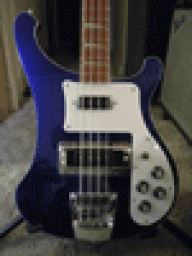
A properly setup Ric can have extremely low action. Factory recommends as little relief as possible. When sighting the neck mine has no relief. Very low easy action with absolutely no buzzing.

My favorite bass that never needed any adjustment off the shelf was a SGC Nanyo Bass Collection SB301. Nice low action and never any fret-buzz on any of the ones I have owned.
I have "tweaked" my latest one to get the action even lower, but it was almost negligible.
The bad news is that you either have to hunt one down (the sought after Japanese models haven't been made since 97) or go for the bass it was modeled after, a Bass Maniac by Tune, which is reported to have an excellent neck and low action- but I have not seen one in person to verify.
I have "tweaked" my latest one to get the action even lower, but it was almost negligible.
The bad news is that you either have to hunt one down (the sought after Japanese models haven't been made since 97) or go for the bass it was modeled after, a Bass Maniac by Tune, which is reported to have an excellent neck and low action- but I have not seen one in person to verify.

Most boutique companies plane their fingerboards to perfection and meticulously level the frets (if fretted). The pitch of the neck also contributes. Fingerboard radius doesn't come into play like it does on guitar. The idea that any SX can be set up to play like a Fodera is wishful thinking.
That being said, I'll second the Peavey Cirrus as the lowest possible action on a stock instrument without modification.
That being said, I'll second the Peavey Cirrus as the lowest possible action on a stock instrument without modification.

Plek vs hand done fret jobs:
Plek doesn't insure great playability. I've had two plek'd basses that required followup by hand. The machine is only as good as it's operator, and maintenance.
Furthermore, good fretwire is hardened, and a plek job that is "making up for bad work milling the neck and fingerboard to true" is going to knock off a lot of the fret that you're gonna wish you had, later.
+1
Factors for low, even action, IMO:
is the neck blank worked to truly level across it's length?
is the fingerboard blank worked to truly level across it's length?
Fret work...if the two factors above are done well, and the frets are installed well, you won't need lots of fret dressing...
Is the neck butt level to the fingerboard?
Is the neck pocket level to the fingerboard?
If these are off, you'll have to dress the frets differently at one end, compared to the other, to make up for it.
+1


Ric5
Inactive
- Jan 29, 2008
- 29,772
- 30,452
- Disclosures
- I like 5, 8, 10, and 12 string basses
Im aware that the action on a bass is subjective from a few views such as those of players and technicians, but what brands and models of basses are infamous for that super low action without any modifications?
To get really low action you need to:
1 - flatten out the neck
2 - cut the nut low
3 - have good level frets
4 - have a good straight neck
5 - adjust the bridge
There is no one brand of bass that will give you low action. It is about a good quality bass with a good neck and a good setup.
A good setup will only last 6 months. As the seasons change and temperature and humidity changes the bass will need to be tweaked at least twice a year to keep the action low.

I was about to comment when I saw Pete himself chimed in.My Skjold basses have had the lowest action while being actually playable of any basses that Ive ever owned.Im always trying to get my other basses lower-Pete shipped my new LP and I actually raised it a touch.My FBass and Lakland basses are go pretty darn low also,but not as low as my Skjold.
To get really low action you need to:
1 - flatten out the neck
2 - cut the nut low
3 - have good level frets
4 - have a good straight neck
5 - adjust the bridge
There is no one brand of bass that will give you low action. It is about a good quality bass with a good neck and a good setup.
A good setup will only last 6 months. As the seasons change and temperature and humidity changes the bass will need to be tweaked at least twice a year to keep the action low.
Agreed-well said.

With any bass that you are able to level the neck as flat as possible without running into fret buzz or other issues the bridges on most any bass will allow you to lower the action to a desireable level.
I play finger style with a fairly light touch so I like a very low action. On many of the Fender Basses I've owned including the Squier CV I have now a modest neck angle adjustment was needed to wring the most out of the bridge that I could get. The finish and level of the frets needs to be spot on as well.
The lowest action I've ever been able to get was on my Modulus 5 string. The graphite neck and fretwork permitted an very flat neck and very low action. That was probably the nicest playing bass I've ever owned. It's always been tough to get any Fender Bass that low.
I play finger style with a fairly light touch so I like a very low action. On many of the Fender Basses I've owned including the Squier CV I have now a modest neck angle adjustment was needed to wring the most out of the bridge that I could get. The finish and level of the frets needs to be spot on as well.
The lowest action I've ever been able to get was on my Modulus 5 string. The graphite neck and fretwork permitted an very flat neck and very low action. That was probably the nicest playing bass I've ever owned. It's always been tough to get any Fender Bass that low.

low action on any bass is the same recipe regardless of cost or name on the headstock.
I just bought a Ibanez GIO-SR206 for $120 that was intended to be defretted and used as a knock-around fretless.
The neck fret board is true and the frets were tightly seated and even. Adjusted the nut, the bridge and added a little relief and the actions is 3/64th straight across at the 17th fret. Plays out nice and even. Upgraded the bridge and it plays wonderfully.
It is too nice to defret. This, I think, just happened to be a freak situation...
I just bought a Ibanez GIO-SR206 for $120 that was intended to be defretted and used as a knock-around fretless.
The neck fret board is true and the frets were tightly seated and even. Adjusted the nut, the bridge and added a little relief and the actions is 3/64th straight across at the 17th fret. Plays out nice and even. Upgraded the bridge and it plays wonderfully.
It is too nice to defret. This, I think, just happened to be a freak situation...
With any bass that you are able to level the neck as flat as possible without running into fret buzz or other issues the bridges on most any bass will allow you to lower the action to a desireable level.
I play finger style with a fairly light touch so I like a very low action. On many of the Fender Basses I've owned including the Squier CV I have now a modest neck angle adjustment was needed to wring the most out of the bridge that I could get. The finish and level of the frets needs to be spot on as well.
The lowest action I've ever been able to get was on my Modulus 5 string. The graphite neck and fretwork permitted an very flat neck and very low action. That was probably the nicest playing bass I've ever owned. It's always been tough to get any Fender Bass that low.
Any bass can be set to have the lowest possible action that it will allow. When you expect X to play like Y, things start getting tricky.

My Carvin and Yamaha TRB's have had great fretwork / fingerboards and I have them setup with pretty low action no problem.
It's been said, but I will echo: Skjold
Mine is very low and perfectly playable. Pete is also a pleasure to deal with, and can set his basses up at whatever height you prefer.
Mine is very low and perfectly playable. Pete is also a pleasure to deal with, and can set his basses up at whatever height you prefer.

That shouldn't matter for low action. The string make contact with the fret, not the fretboard. The distance from the bottom of the string to the top of the fret is usually what people refer to when talking about action.
Sorry I wasnt more clear: the Cirrus bass has the closest attention to fret deviation in production basses. Better?

Special order Peavey Cirrus fretless 4, and my Moonstone Flying "V" fretted 4. The latter was a puzzler. Passive with extremely hot Barts, meticulous attention to detail, top shelf materials and components across the board. This freakin' thing played nice, like it was from another Solar System. Played standing, with a strap, it was an absolute torture rack.

Sorry I wasnt more clear: the Cirrus bass has the closest attention to fret deviation in production basses. Better?
Just curious how you determined that?
I just wanted to be sure. Were you commenting my post? If you were, I wasn't referring to the Bass Collection SX series basses that I believe are still being made today (by Rondo).Most boutique companies plane their fingerboards to perfection and meticulously level the frets (if fretted). The pitch of the neck also contributes. Fingerboard radius doesn't come into play like it does on guitar. The idea that any SX can be set up to play like a Fodera is wishful thinking.
That being said, I'll second the Peavey Cirrus as the lowest possible action on a stock instrument without modification.
I was talking about the Bass Collections Basses from SGC Nanyo. There is a world of difference between the 2.
Ask anyone that has one about the neck and the action. It's very low and Buzz free to the 24th fret.


