• TalkBass has been independent since 1998. Add your voice.
    Create a free account to reply to discussions, view embedded media, and browse with fewer display ads.
    Join freeLog in
    Want zero display ads or expanded classifieds tools? Compare plans.

Inline pedal power ammeter?

Jun 14, 2005
591
1,148
Atlanta
Does anyone make an ammeter that you could hook inline with your pedal power supply to show the current draw in real-time? Seems like something like that would be useful, to see how much each of your pedals draw, and if you're getting near the rated limit of your power supply. I found something called a "Batt-O-Meter" that looks like a similar concept, but is apparently out of production.

I may try making one, using something like this:
Mini Digital Voltmeter Ammeter - 100V 10A - Voltage Current Meter w/ LED Display | eBay
Wired up with a 2.1mm female and male connector so I can put it on a single effect or on the whole chain.

Anyone ever tried that?
 
As an eBay Associate, TalkBass may earn a commission from qualifying purchases.

Better to check the max draw of each individual pedal with a clamp meter and avoid overloading individual channels. Don't overload the channels individually and you're probably not overloading the overall capacity of the psu.

Thanks. I'm guessing you're talking about one of those higher-end power supplies, with a separate channel for each pedal. I'm just using a single 9V supply with a daisy-chain cable. It's rated at 1,670 ma, and I don't use that many pedals, but I'm mainly just curious to see how much each pedal draws, and if that changes much when kicked in or as various parameters are changed.

(do they make a clamp meter for DC? I thought that was only for AC, but maybe not)
 
  • Like
Reactions: BlueTalon
Don't know if most clamp multimeters measure dc current (not something I do much) but my old Fluke does. And yeah I did assume a multi port supply.

I use those one-spot wall wart supplies quite a bit these days. I've never bothered to measure current draw just write the manufacturer spec draw on all my pedals. Simple addition from there. Those things are at least 1200mA and the 3-4 pedals I use on a heavy pedal night never comes close to maxing it out.
IMG_3711.jpeg
 
and if that changes much when kicked in or as various parameters are changed.
It really depends. Some pedals, particularly digital ones, will tend to use the same amount of power regardless of what the pedal is doing. I do know, however, that there are some analog pedals that can use a bit more or less power depending. Not a huge amount, but potentially enough to cause a fault condition in a PSU if you're working on a shoestring budget for mA.
 
  • Like
Reactions: rodak and HolmeBass
Almost every cheap voltmeter/multimeter measure amps. You just hook it in series with the + or - of the power cord. That may require making some jumper cables with the proper jack and plug to go in series with the main power cord.

i.e. $6.99 at Harbor freight -
View attachment 5138697
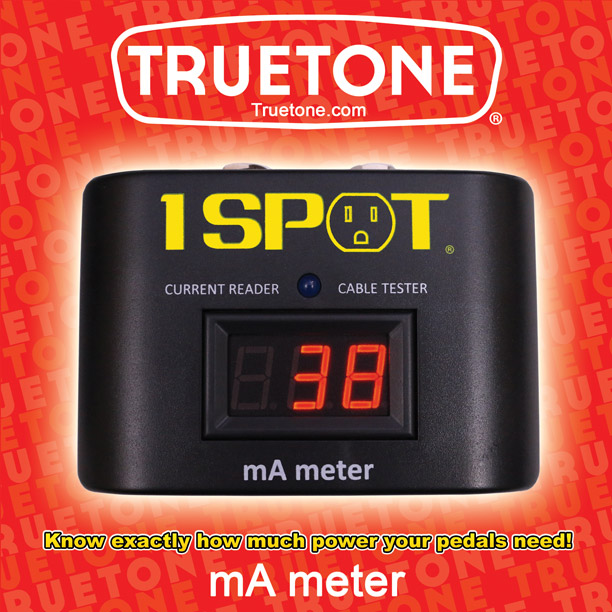
Yeah, I know that, I have two or three meters already. I just wanted something dedicated to pedals, with 2.1mm connectors, that could be easily hooked up as-needed, and even left in place, if-desired. That Truetone fills the bill perfectly. Ordered one from Sweetwater just now.
 
Yeah, I know that, I have two or three meters already. I just wanted something dedicated to pedals, with 2.1mm connectors, that could be easily hooked up as-needed, and even left in place, if-desired. That Truetone fills the bill perfectly. Ordered one from Sweetwater just now.

Yeah - it is a clever, easy solution. Being a techie, I am naturally drawn to making my own gadgets! I think now I have to buy a little ammeter module and build it into my pedalboard!
I looked - a little voltmeter/ammeter module is only about $7 with shipping on eBay.

Also - pretty sure that clamp-on meters only work with AC.
 
Last edited:
Yeah - it is a clever, easy solution. Being a techie, I am naturally drawn to making my own gadgets! I think now I have to buy a little ammeter module and build it into my pedalboard!

And that was my first idea - the ones on ebay are cool, because they display both voltage and current, and some even display power - neat looking display (that's satisfying to my own techie sensibilities), but for a few bucks more, the pre-fab solution works for me - getting lazy in my old age (and have more disposable income now).
 
  • Like
Reactions: mikewalker
Yeah - it is a clever, easy solution. Being a techie, I am naturally drawn to making my own gadgets! I think now I have to buy a little ammeter module and build it into my pedalboard!
I looked - a little voltmeter/ammeter module is only about $7 with shipping on eBay.

Also - pretty sure that clamp-on meters only work with AC.
I've had a Hall effect clamp-on for decades that measures DC.
 
Last edited:
  • Like
Reactions: JKos
I stuck to using the mathy method of adding the max amp draw specified by pedal manufacturer and the power output ratings on the power supplies that I use. For the sake of argument, I did a random sampling from my pedals using the in-line ammeter method and not a single one was close to the rated power draw, all being comfortably on the lesser side of the rating, some ridiculously less.
 
Better to check the max draw of each individual pedal with a clamp meter and avoid overloading individual channels. Don't overload the channels individually and you're probably not overloading the overall capacity of the psu.
Measuring DC current with accuracy at the low end of the scale is best accomplished with an oscilloscope and Hall effect probe.
A special, dedicated in line device is more realistic in the OP's case.
In a lab, a precision resistance is put In series with the load and voltage across the resistor is measured with an oscilloscope-
Then simple math (ohm's law) is used.
 
  • Like
Reactions: rodak