Enjoy the benefits of a premium membership!
Upgrade Account
-
TalkBass has been independent since 1998. Add your voice.
Create a free account to reply to discussions, view embedded media, and browse with fewer display ads.
Join free Log in
Want zero display ads or expanded classifieds tools? Compare plans.
You are using an out of date browser. It may not display this or other websites correctly.
You should upgrade or use an alternative browser.
You should upgrade or use an alternative browser.
Inside The Secret Underground Laboratory
- Thread starter Bruce Johnson
- Start date
More options
Who Replied?

Well that makes three of us with ties to Pt Mugu. Though I was just there as a contractor for NAVFAC. I can tell you all about how much gas they used in their trucks and lawnmowers, but they didn't let us near the fun stuff that floated or flew.
I worked for Lockheed in the late '80's; I wrote about that on this thread a few pages back. I designed specialized heavy ground support equipment for Navy birds, and did some testing at Mugu.

Going through all of Mike Lipe's junk box parts, I found this today. A box full of about 50 brass truss rod cover plates. They are solid brass, polished up. Some are real clean, others are a little scratched but could be re-polished. A flat, sharp pointed triangle, about 1.4" x 2.2", three holes. I don't know what they are for/from. Maybe a batch of custom parts from Mike's days at Ibanez?
I have no use for them. If any of you can use them for your projects, you can have them for just the postage. You know where to reach me.
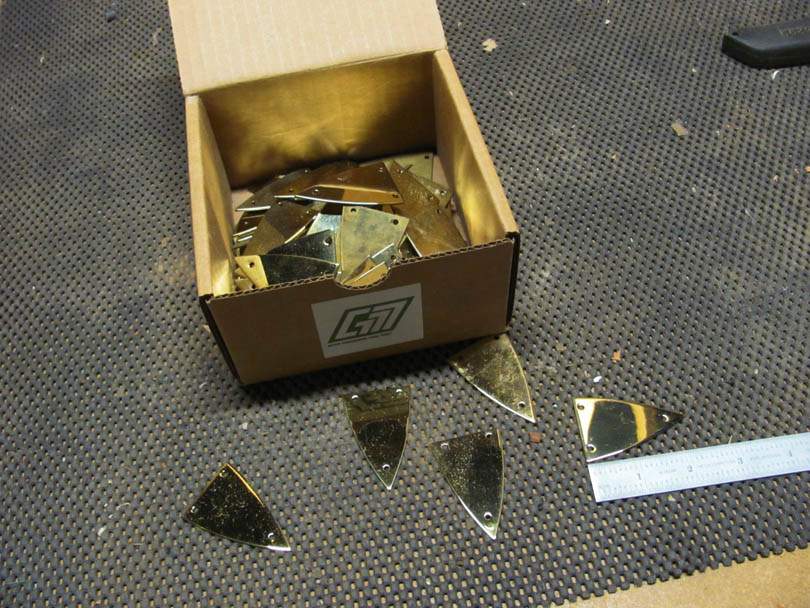
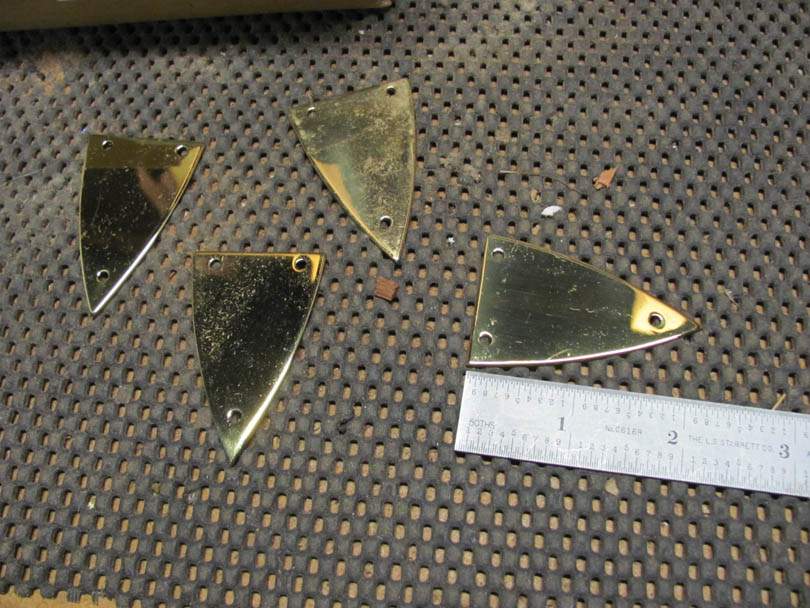
I have no use for them. If any of you can use them for your projects, you can have them for just the postage. You know where to reach me.
Welcome back Bruce, glad to hear everything worked out ok.

You may already be aware of this, Bruce but you got a tertiary mention in the June Vintage Guitar as the maker of Paul Slagle’s truss rods. Hopefully it is ok to post the picture here.

You may already be aware of this, Bruce but you got a tertiary mention in the June Vintage Guitar as the maker of Paul Slagle’s truss rods. Hopefully it is ok to post the picture here.
View attachment 3414867
Cool! Paul had said that Vintage Guitar was doing an article on one of his guitars, but I didn't realize he was going to mention me. Yep, all of Paul's guitars and basses use my truss rods, and a few other parts I make. Most of the recent truss rods are installed in the neck by my buddy across the hall Keith Horne. I've been teaching Keith my whole process of making and installing the truss rods. He now comes over in my shop and uses my lathes and mills to make the metal parts too.
Paul's Pittman basses are right there with the very best Fender-style boutique basses available.

Glad to hear you're back and progressing to full-strength!
Still wishing you all the best!!
Diego
Still wishing you all the best!!
Diego
I haven't updated this thread in a while. Lots of things have been happening here in the Secret Underground Lab. I've been back to good health and working long hours getting caught up on all the projects. I haven't had much time to write about it all.
We have several more Luthiers talking seriously to us about moving in here. I won't name names until leases are signed, but we're working on getting them in here. Still some battles with the Fillmore City Building & Code department holding us up, but we're making progress toward resolving that. In another year or two, we could end up being the largest assembly of Luthiers on the west coast. Hidden away in the little town of Fillmore!
Lots of events and public tours, and being part of the city culture. I'm personally getting involved in forming up the Fillmore Association of Businesses, and working with the Planning Commission and City Council, to revitalize Fillmore. I'm pushing the theme of building Fillmore up as the City Of Craftsmen. Trying to bring small craftsman-type businesses in to fill up all the old vacant historic buildings, like ours. I'm investing myself personally in this city, trying to make this all happen.
But meanwhile, back in my own little world, it was New Old Machine Day! It's been a while since I've acquired another antique machine to squeeze into my shop.....
My buddy Thomas is our in-house expert welder/fabricator/machinist with a shop in a big trailer right next to our building. Yesterday he told me about a friend of his with a small machine shop in nearby Santa Paula, who was clearing out of his building on a short schedule. Thomas said that he had this sweet little old metal shaper that he had to get rid of, fast. It needed a home, or it was going to the scrap yard (shudder!). I've always wanted a metal shaper.....How could I resist? I offered him $100 for it, sight unseen. Thomas said that he was happy to sell it to me for that price, because I'll give it a good home.
Thomas went down there and fetched it this afternoon, towing it back on a trailer pulled by his 2CV Van. A very cool and almost comical sight in itself! Around here, we all just have this thing for crazy old machinery. Thomas has two of these 2CV's that he's been restoring.
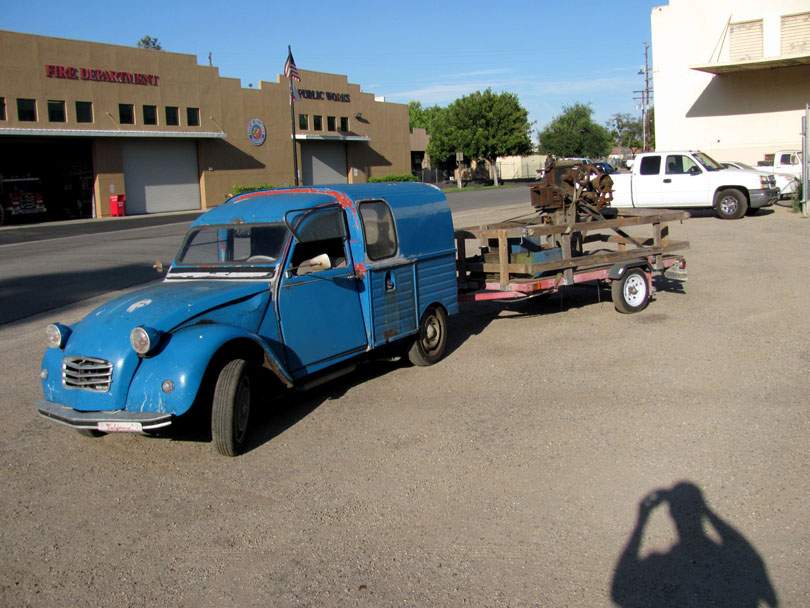
We backed it down into the Underground Lab, where it was nice and cool, and lifted it off the trailer with my handy gantry crane.
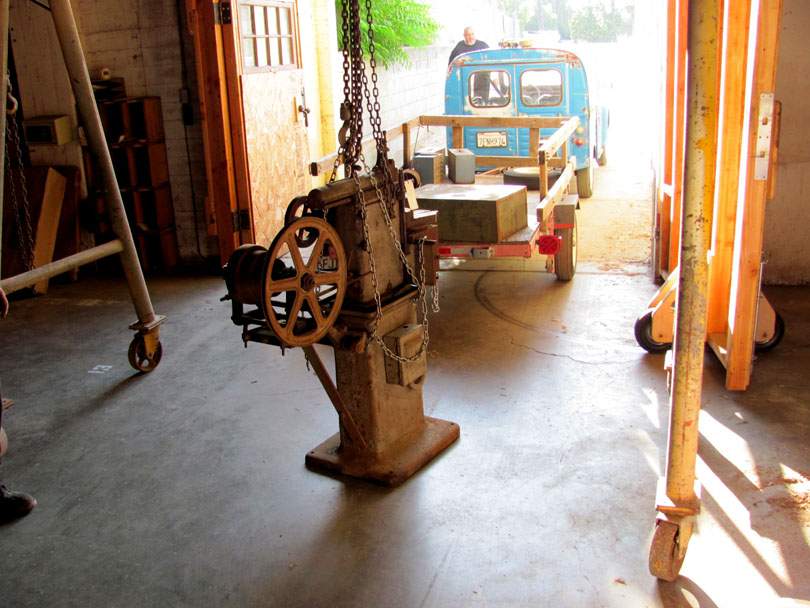
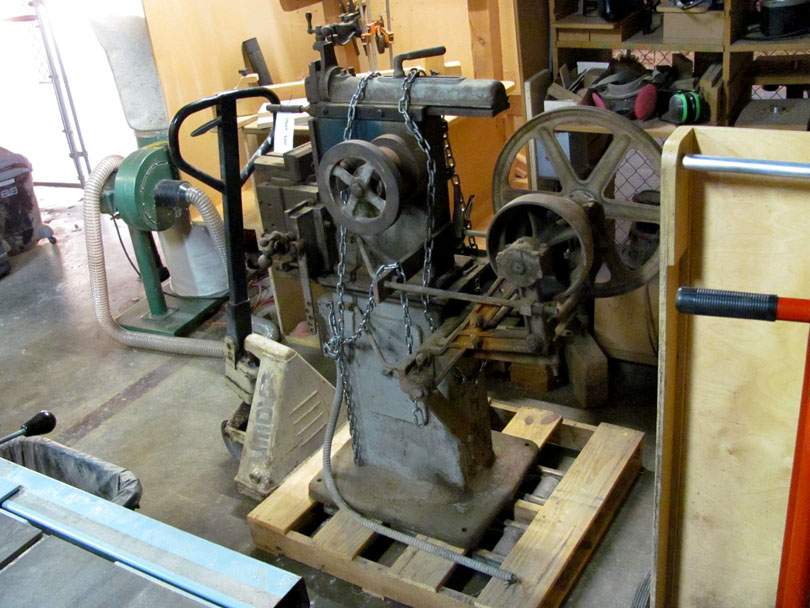
And there it is! Another gorgeous old machine, saved from the scrapyard, to join my shop and antique machinery collection. It's a Rhodes Shaper, a fairly rare machine. Much older than I thought.
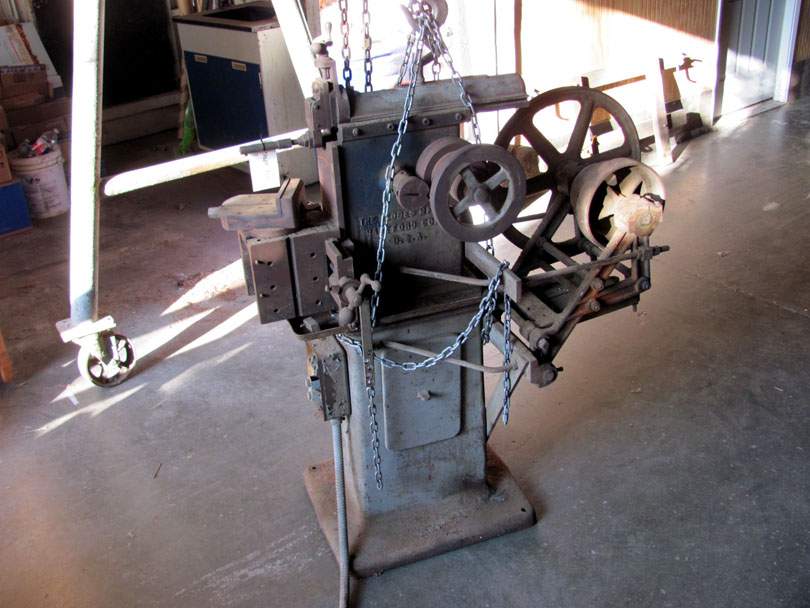
I quickly set it on a pallet, and moved it into my shop to get a good look at it.
For those of you unfamiliar with old metalworking machines, a Metal Shaper is one of the oldest types of metal cutting machines, with the earliest ones going back to the early 1800's. They were the predecessors to Milling Machines. Back then, it was called a Shaper, but these days we call it a Metal Shaper so not to confuse it with a modern woodworking shaper.
A Metal Shaper has a cutting bit like a lathe, a single square block of tool steel sharpened to an edge. One tooth, and it doesn't spin. It's pushed forward in a straight line, and then retracted for the next stroke. The big ram up on top of the machine slides forward horizontally, pushing the tool bit across the workpiece, then quickly slides back. It's all driven by a big gear crank mechanism inside, which is adjustable to change the length of the stroke. There's also a ratcheting feed mechanism which moves the front table sideways a little bit, with every stroke of the ram. The workpiece is clamped in the vise mounted on the table.
A metal shaper can be set up to do all kinds of precision cuts, from planing flat surfaces to cutting slots and gear teeth. But it's very slow. One tooth going back and forth, a tiny cut with each stroke. Very precise, but slow. Then they figured out how to make round milling cutters from tool steel, which led to milling machines, with spinning cutters! For most precision metal cutting operations, a milling machine is an order of magnitude faster than a shaper.
By WWII, metal shapers were nearly obsolete, and only a few companies were making them. But there are a few operations that a metal shaper can do, which cannot be easily done on a milling machine (or even a CNC mill). Because of its linear motion, a metal shaper can cut a slot with blind square-cornered ends. It can also cut square keyways through the hub of a gear or pulley. And it can cut complex shapes like herringbone gears. There are even some cuts on my musical instrument parts where this machine will be very useful.
Anyway, this shaper was made by Rhodes Mfg in Hartford, Conn. They made them from around 1900 to the late 1930's. I believe this one is from the 1910's or 1920's. It was originally made to be driven by a flat belt from an overhead line shaft, turning that stepped flat belt pulley behind the flywheel on the machine itself. The assembly of brackets and pulleys on the back was added later by someone, to convert it to electric motor drive. Those parts came from big old 1930's lathe.
As I restore it, I'm probably going to take all that stuff off of the back. I'll build a nice wooden base for it, which has an overhead frame with a mock line shaft section driven by a hidden electric motor. A single leather belt coming down from above, driving the shaper as it was originally.
This machine appears to be in good condition overall. Nothing major broken or missing. The previous owner had been using it to cut keyways in gear hubs. It mostly needs a good cleaning and oiling and hookup to power.
I have a growing collection of about 12 metalworking machines from the 1905 to 1930 era. They are mostly smaller size machines, all flat belt line shaft driven. All about in the same general condition as this one. I have them all parked in an area next to my shop, where they are safely and patiently waiting for me to restore them. We call the area Dinosaur Row. I'll post some pictures of them all someday soon. My plan is to get them all cleaned up and running, and make up a nice little 1920's machine shop. Not a static museum display, but a functional old machine shop that I can use, when I feel like it, to make instrument parts and other things. Building up that shop is my personal hobby project.
We have several more Luthiers talking seriously to us about moving in here. I won't name names until leases are signed, but we're working on getting them in here. Still some battles with the Fillmore City Building & Code department holding us up, but we're making progress toward resolving that. In another year or two, we could end up being the largest assembly of Luthiers on the west coast. Hidden away in the little town of Fillmore!
Lots of events and public tours, and being part of the city culture. I'm personally getting involved in forming up the Fillmore Association of Businesses, and working with the Planning Commission and City Council, to revitalize Fillmore. I'm pushing the theme of building Fillmore up as the City Of Craftsmen. Trying to bring small craftsman-type businesses in to fill up all the old vacant historic buildings, like ours. I'm investing myself personally in this city, trying to make this all happen.
But meanwhile, back in my own little world, it was New Old Machine Day! It's been a while since I've acquired another antique machine to squeeze into my shop.....
My buddy Thomas is our in-house expert welder/fabricator/machinist with a shop in a big trailer right next to our building. Yesterday he told me about a friend of his with a small machine shop in nearby Santa Paula, who was clearing out of his building on a short schedule. Thomas said that he had this sweet little old metal shaper that he had to get rid of, fast. It needed a home, or it was going to the scrap yard (shudder!). I've always wanted a metal shaper.....How could I resist? I offered him $100 for it, sight unseen. Thomas said that he was happy to sell it to me for that price, because I'll give it a good home.
Thomas went down there and fetched it this afternoon, towing it back on a trailer pulled by his 2CV Van. A very cool and almost comical sight in itself! Around here, we all just have this thing for crazy old machinery. Thomas has two of these 2CV's that he's been restoring.
We backed it down into the Underground Lab, where it was nice and cool, and lifted it off the trailer with my handy gantry crane.
And there it is! Another gorgeous old machine, saved from the scrapyard, to join my shop and antique machinery collection. It's a Rhodes Shaper, a fairly rare machine. Much older than I thought.
I quickly set it on a pallet, and moved it into my shop to get a good look at it.
For those of you unfamiliar with old metalworking machines, a Metal Shaper is one of the oldest types of metal cutting machines, with the earliest ones going back to the early 1800's. They were the predecessors to Milling Machines. Back then, it was called a Shaper, but these days we call it a Metal Shaper so not to confuse it with a modern woodworking shaper.
A Metal Shaper has a cutting bit like a lathe, a single square block of tool steel sharpened to an edge. One tooth, and it doesn't spin. It's pushed forward in a straight line, and then retracted for the next stroke. The big ram up on top of the machine slides forward horizontally, pushing the tool bit across the workpiece, then quickly slides back. It's all driven by a big gear crank mechanism inside, which is adjustable to change the length of the stroke. There's also a ratcheting feed mechanism which moves the front table sideways a little bit, with every stroke of the ram. The workpiece is clamped in the vise mounted on the table.
A metal shaper can be set up to do all kinds of precision cuts, from planing flat surfaces to cutting slots and gear teeth. But it's very slow. One tooth going back and forth, a tiny cut with each stroke. Very precise, but slow. Then they figured out how to make round milling cutters from tool steel, which led to milling machines, with spinning cutters! For most precision metal cutting operations, a milling machine is an order of magnitude faster than a shaper.
By WWII, metal shapers were nearly obsolete, and only a few companies were making them. But there are a few operations that a metal shaper can do, which cannot be easily done on a milling machine (or even a CNC mill). Because of its linear motion, a metal shaper can cut a slot with blind square-cornered ends. It can also cut square keyways through the hub of a gear or pulley. And it can cut complex shapes like herringbone gears. There are even some cuts on my musical instrument parts where this machine will be very useful.
Anyway, this shaper was made by Rhodes Mfg in Hartford, Conn. They made them from around 1900 to the late 1930's. I believe this one is from the 1910's or 1920's. It was originally made to be driven by a flat belt from an overhead line shaft, turning that stepped flat belt pulley behind the flywheel on the machine itself. The assembly of brackets and pulleys on the back was added later by someone, to convert it to electric motor drive. Those parts came from big old 1930's lathe.
As I restore it, I'm probably going to take all that stuff off of the back. I'll build a nice wooden base for it, which has an overhead frame with a mock line shaft section driven by a hidden electric motor. A single leather belt coming down from above, driving the shaper as it was originally.
This machine appears to be in good condition overall. Nothing major broken or missing. The previous owner had been using it to cut keyways in gear hubs. It mostly needs a good cleaning and oiling and hookup to power.
I have a growing collection of about 12 metalworking machines from the 1905 to 1930 era. They are mostly smaller size machines, all flat belt line shaft driven. All about in the same general condition as this one. I have them all parked in an area next to my shop, where they are safely and patiently waiting for me to restore them. We call the area Dinosaur Row. I'll post some pictures of them all someday soon. My plan is to get them all cleaned up and running, and make up a nice little 1920's machine shop. Not a static museum display, but a functional old machine shop that I can use, when I feel like it, to make instrument parts and other things. Building up that shop is my personal hobby project.
Last edited:

I haven't updated this thread in a while. Lots of things have been happening here in the Secret Underground Lab. I've been back to good health and working long hours getting caught up on all the projects. I haven't had much time to write about it all.
We have several more Luthiers talking seriously to us about moving in here. I won't name names until leases are signed, but we're working on getting them in here. Still some battles with the Fillmore City Building & Code department holding us up, but we're making progress toward resolving that. In another year or two, we could end up being the largest assembly of Luthiers on the west coast. Hidden away in the little town of Fillmore!
Lots of events and public tours, and being part of the city culture. I'm personally getting involved in forming up the Fillmore Association of Businesses, and working with the Planning Commission and City Council, to revitalize Fillmore. I'm pushing the theme of building Fillmore up as the City Of Craftsmen. Trying to bring small craftsman-type businesses in to fill up all the old vacant historic buildings, like ours. I'm investing myself personally in this city, trying to make this all happen.
But meanwhile, back in my own little world, it was New Old Machine Day! It's been a while since I've acquired another antique machine to squeeze into my shop.....
My buddy Thomas is our in-house expert welder/fabricator/machinist with a shop in a big trailer right next to our building. Yesterday he told me about a friend of his with a small machine shop in nearby Santa Paula, who was clearing out of his building on a short schedule. Thomas said that he had this sweet little old metal shaper that he had to get rid of, fast. It needed a home, or it was going to the scrap yard (shudder!). I've always wanted a metal shaper.....How could I resist? I offered him $100 for it, sight unseen. Thomas said that he was happy to sell it to me for that price, because I'll give it a good home.
Thomas went down there and fetched it this afternoon, towing it back on a trailer pulled by his 2CV Van. A very cool and almost comical sight in itself! Around here, we all just have this thing for crazy old machinery. Thomas has two of these 2CV's that he's been restoring.
View attachment 3486205
We backed it down into the Underground Lab, where it was nice and cool, and lifted it off the trailer with my handy gantry crane.
View attachment 3486206
And there it is! Another gorgeous old machine, saved from the scrapyard, to join my shop and antique machinery collection. It's a Rhodes Shaper, a fairly rare machine. Much older than I thought.
View attachment 3486207
I quickly set it on a pallet, and moved it into my shop to get a good look at it.
View attachment 3486208
For those of you unfamiliar with old metalworking machines, a Metal Shaper is one of the oldest types of metal cutting machines, with the earliest ones going back to the early 1800's. They were the predecessors to Milling Machines. Back then, it was called a Shaper, but these days we call it a Metal Shaper so not to confuse it with a modern woodworking shaper.
A Metal Shaper has a cutting bit like a lathe, a single square block of tool steel sharpened to an edge. One tooth, and it doesn't spin. It's pushed forward in a straight line, and then retracted for the next stroke. The big ram up on top of the machine slides forward horizontally, pushing the tool bit across the workpiece, then quickly slides back. It's all driven by a big gear crank mechanism inside, which is adjustable to change the length of the stroke. There's also a ratcheting feed mechanism which moves the front table sideways a little bit, with every stroke of the ram. The workpiece is clamped in the vise mounted on the table.
A metal shaper can be set up to do all kinds of precision cuts, from planing flat surfaces to cutting slots and gear teeth. But it's very slow. One tooth going back and forth, a tiny cut with each stroke. Very precise, but slow. Then they figured out how to make round milling cutters from tool steel, which led to milling machines, with spinning cutters! For most precision metal cutting operations, a milling machine is an order of magnitude faster than a shaper.
By WWII, metal shapers were nearly obsolete, and only a few companies were making them. But there are a few operations that a metal shaper can do, which cannot be easily done on a milling machine (or even a CNC mill). Because of its linear motion, a metal shaper can cut a slot with blind square-cornered ends. It can also cut square keyways through the hub of a gear or pulley. And it can cut complex shapes like herringbone gears. There are even some cuts on my musical instrument parts where this machine will be very useful.
Anyway, this shaper was made by Rhodes Mfg in Hartford, Conn. They made them from around 1900 to the late 1930's. I believe this one is from the 1910's or 1920's. It was originally made to be driven by a flat belt from an overhead line shaft, turning that stepped flat belt pulley behind the flywheel on the machine itself. The assembly of brackets and pulleys on the back was added later by someone, to convert it to electric motor drive. Those parts came from big old 1930's lathe.
As I restore it, I'm probably going to take all that stuff off of the back. I'll build a nice wooden base for it, which has an overhead frame with a mock line shaft section driven by a hidden electric motor. A single leather belt coming down from above, driving the shaper as it was originally.
This machine appears to be in good condition overall. Nothing major broken or missing. The previous owner had been using it to cut keyways in gear hubs. It mostly needs a good cleaning and oiling and hookup to power.
I have a growing collection of about 12 metalworking machines from the 1905 to 1930 era. They are mostly smaller size machines, all flat belt line shaft driven. All about in the same general condition as this one. I have them all parked in an area next to my shop, where they are safely and patiently waiting for me to restore them. We call the area Dinosaur Row. I'll post some pictures of them all someday soon. My plan is to get them all cleaned up and running, and make up a nice little 1920's machine shop. Not a static museum display, but a functional old machine shop that I can use, when I feel like it, to make instrument parts and other things. Building up that shop is my personal hobby project.
This is pretty cool!
I’m renovating my house at present, which has been in the family since it was built in 1931. We have lots of cool old stuff, including news papers from both wars, my great grandfathers “war chest” which has a flat-packable cup and his diary.
My grandfather was a train engineer in WW2 and he made all of his tools from scratch in the yard, many of which have made it back to the house, including a set of wooden ladders he built for getting up onto the train drivers area, of which I use to this day to get into the attic.
During the renovations I came across a box of all these old hand tools with dates scribed into them from the 30’s, and another full of metal tobacco boxes (one of which will go on my pedalboard since we don’t get altoids here!)

Ah.. the 2CV van; brings back memories of living in Germany in the 70s.
More cool Gadgetry! My son has inherited my fascination with machines, love seeing these old ones restored. He’s restoring an old Milwaukee electric drill with a polished aluminum case, not rare in itself, but it was in its original box with an attachment to bolt it to a bench to use as a grinder or buffer, original owners manual in it. Maybe 1950’s? All it needed was a new cord and some buff and polish, but it was left at the dump! I see $1000 Weber stainless grilles there all the time, dumped for the want of a $25 flame element.

Bruce, you are certainly a man after my own heart. I love seeing these old machines rescued, and then put to use. In my dad's gun shop, we had an old production lathe that a machine shop was getting rid of because it couldn't chase threads. I turned many a gun barrel on that thing growing up.

WOW, those old tools are SO cool. The overhead line shaft tools bring me back to being a kid, where I was fascinated by the old tools found at Harper's Ferry (my father worked as a historian for NPS for 34 years). He'd bring us to different jobs he worked on (Springfield Armory was especially cool) but I most remember this view in Harper's Ferry, where I just stared in awe. Thank you for helping preserve and restore these awesome machines!!!

Great tools and another fantastic history lesson. Thanks Bruce. Oh, and tell Thomas, love the van!
Cool machine. Is it what I would call a ‘broacher’? Or is there a subtle difference between a broacher and a shaper?
They are similar, but not quite the same. Power broaching machines are more "modern", like 1940's. But they both operate in a linear reciprocating motion. A broach is a long bar of tool steel with a whole row of teeth. Along the length, the teeth gradually increase in height. Think of it as a special file that tapers in height. As you push the broach through a hole or along a path, each tooth in line takes a small bite. As you reach the end of the broach, the hole is at the full size. The whole cutting operation is done in one long stroke. A power broaching machine pushes the broach through the part in one powerful stroke. Very fast in mass production. Complex forms of power broaching are used extensively in automotive plants. For some operations, they are much faster than even CNC machines.
In comparison, a metal shaper has a single tooth that is pushed forward across the part, dragged back, pushed forward, dragged back, etc. Very slow.
There's a few videos on YouTube showing Rhodes shapers like mine in operation. Search for Rhodes Metal Shaper, by 175leutennant2, for a good quick one.
I love reading these posts. Makes me wonder how many of these old machines are still sitting in abandoned factories throughout New England here, especially in Bridgeport. I imagine print shops are having trouble getting rid of machinery for less than scrap. I know my boss was unable to sell a paper trimming guillotine. The thing was huge, sharp, and scary to operate, but fortunately required both hands and a foot to operate so it was nigh impossible to cut off a limb.
BTW, I was chatting with a customer of yours here in Connecticut this past weekend. I don't see him often at all, so maybe by the time I run into him again I'll be able to check out your handiwork in person.
BTW, I was chatting with a customer of yours here in Connecticut this past weekend. I don't see him often at all, so maybe by the time I run into him again I'll be able to check out your handiwork in person.