If the year is correct, the model is most likely an L1000. If the year is wrong, it’s a who knows what.
Many of these, if not all, had the rebirth of the 3 bolt neck attachment, which is probably not a problem, because most had a pretty good neck-to-pocket fit, however, the neck had the tilt system with the tilt adjustment screw a long way from the mounting screws at the top of the neck pocket. Many think this can cause the ski jump issue.
The pickup in the L1000 was very much kin to the EBMM Stingray pickup, and I think could be switched from single coil to parallel to “OMG” mode with a mini toggle. OMG is parallel humbucker mode with one coil having a cap wired to it to get rid of highs. I think it also provided a mid bump. Anyway, more of Leo’s experimenting.
The pickup placement isn’t as close to the bridge as a Stingray. It’s closer to where a Pbass pickup is located.
My experience with one is from sitting in for a bass player who let me use his bass, and this was a frequent sit in for entire sets, so I played it a lot. It was a workhorse of a bass that played & sounded good.
The ski jumps are factory fretboard leveling flaws, not related to the neck tilt device. They can show at either end of the neck – a result of uneven “follow through” past the outer limits of the fretboard during radiusing.
What you’re calling OMG mode was actually called Bass Boost. It’s not parallel coils. It’s series coils, with the rest as you described. Parallel coils with treble pulled out would not be a “boost” relative to Parallel mode.
Bass Boost was changed to Series somewhere in the late ‘90s, about (or maybe exactly) when G&L stopped using neck plates on the L-2000. Series is a simplified version, which actually lets you dial in a wider range of tones (including being able to replicate the Bass Boost sound closely enough, but without any hum).
When they’re “on,” these basses are hands down the best. But they’re also not the right basses for people who don’t
really know a lot about them, aren’t excellent at setup, and don’t appreciate and know how to work with/around their quirks. They’re 40+ years old now, and often don’t suit the setups that have become accepted as the norm today (your average shmoe likes decked action, gigantic frets, flatter and narrower boards, matte neck finishes, minimal relief, etc.). Using one of these things regularly is a lot like having a classic car as your daily driver. Not something I’d recommend for someone who isn’t totally into them, in a way that could almost be considered a “way of life.”
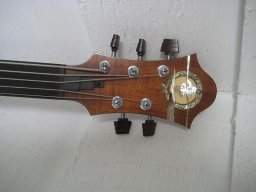
Also, of course it’s not an LB-100 if it has the early “oar style” headstock. It’s an ‘80–‘83.
These tend to go for about $700 to $1,300 locally in my area (though most of them are 2Ks, which pull $100–$200 more than 1Ks). There was recently an ‘81 1K that sat on Craigslist here for months at $800. I know for a fact that nobody touched it; the seller simply withdrew the ad, finally. The more expensive ones are very early examples and/or very rare colors. Also, be sure to subtract a few hundred dollars if the original case isn’t there (at that time, they all had a brown lining with form fitting body pads). These cases are an important part of the whole package, and almost never turn up for sale alone.
You must make sure the neck is TRULY straight and the frets don’t need to be replaced, if you are going to pay full value for one. Paying $1,200 for a common color (sunburst, natural, blue, red, black, or white) one that needs a $200–$300 fret job (which will devalue it, by the way), that doesn’t have its original case, and that has a wavy fretboard is a big mistake. For the money dumped in to that common colored, re-fretted, OHSC-less bass with a less than perfect neck, you could have picked up a stunner with all the original stuff, a straight neck, and a rarer color.