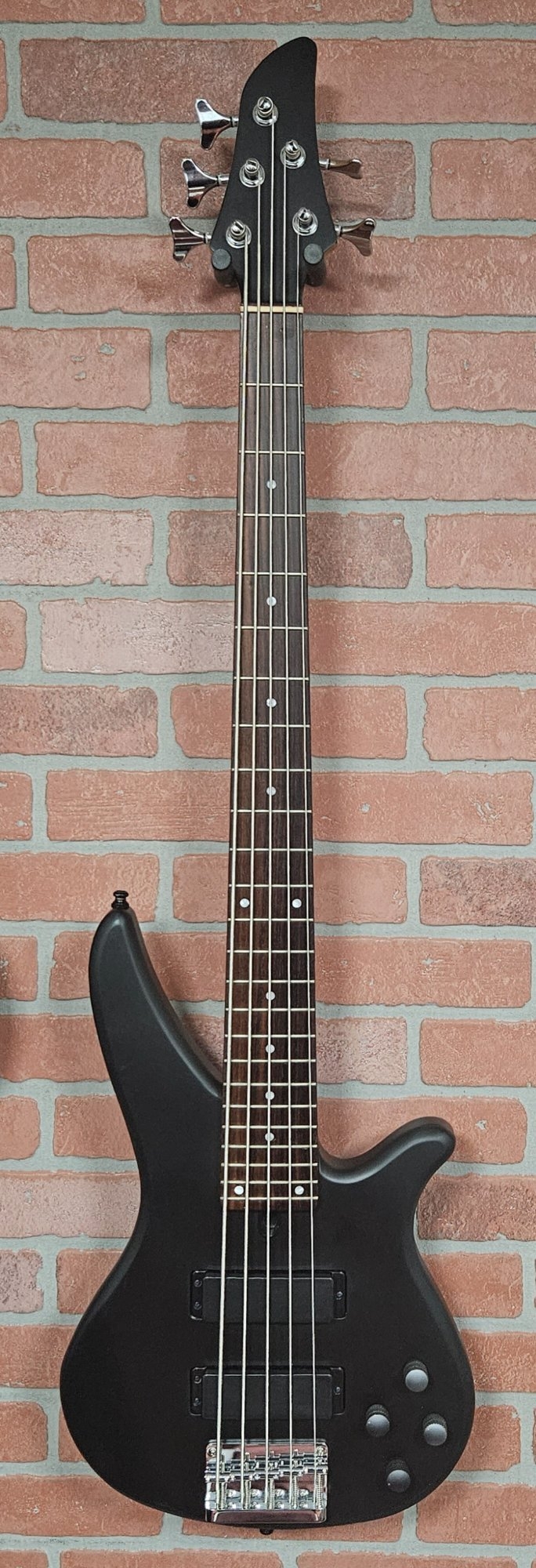
I'll have to disagree with some of you. My Yamaha 5 is perfectly aligned with the dots. My Stingray 5 was too. I've have several Fender 5s, none of them lined up. It should line up. IMO of course.

TalkBass has been independent since 1998. Add your voice.
Create a free account to reply to discussions, view embedded media, and browse with fewer display ads.
Join free Log in
Want zero display ads or expanded classifieds tools? Compare plans.

Your strings are not centered on the neck. The gaps between the neck edges and B and G strings are asymmetrical, i.e. the B string sits closer to the edge than the G string. Some people like that, some don't.I'll have to disagree with some of you. My Yamaha 5 is perfectly aligned with the dots. My Stingray 5 was too. I've have several Fender 5s, none of them lined up. It should line up. IMO of course.
View attachment 7376151
Mayday ....mayday.....Roger Sadowsky....... MaydayThis is becoming a real pet peeve of mine. After reading @jazzbass_5 's post about his crooked bridge, I thought I'd let off some steam. Three out of four of my 5-string basses have bridges that are not aligned with the centerline of the neck. I want to see the A-string go through the CENTER of the frickin' dots!
Sadowsky MetroExpress J/J
View attachment 7376037
Sadowsky MetroLine P/J
View attachment 7376040
Fender American Professional II Precision V
View attachment 7376041
Dingwall SP1 - at least they know how to do it
View attachment 7376043

I'll have to disagree with some of you. My Yamaha 5 is perfectly aligned with the dots. My Stingray 5 was too. I've have several Fender 5s, none of them lined up. It should line up. IMO of course.
View attachment 7376151

I use a slightly different method on the nut with progressively closer spacing as the strings get smaller. So 11mm B-E, 10.5mm E-A, etc. My D string is never in the middle of the nut, though it is in the middle of the bridge. My solution for dots has been to install them at a slight angle going up the fretboard so that they align directly under the D string. One customer replaced his nut and the luthier used different spacing and then he told me my dots were crooked.You came in a little hot on the subject but... it's not a stupid question!
This has been discussed in Luthier's Corner a few times. The responses from experienced builders taught me a lot.
Hi all,
I am about to start filing a nut for a 5 string bass, but in measuring and laying out the string spacing I got confused and in need of some advice or common practice..
It's a very narrow neck and bridge for a 5 string, so I need to be quite precise in measuring this.
Looking at these two options:

Option A, Consisted center-to-center string width and, due to the different string diameters, varying space in between the strings.
Option B, Constistent spacing in between the strings, resulting in varying center-to-center width.
To me, option B seems the most logical...
- Hout
- nut spacing strings
- Replies: 9
- Forum: Luthier's Corner
How much space between the edge of the fretboard and the strings? I've gotten trapped in a loop of overthinking about this.
There's this thread about string spacing at the nut -- "equal gaps" -- where spacing is uniform between string diameters -- compared to "equal centers", where spacing is uniform between string centers. It's brief but has everything you need and nothing more: Clearly stated question, clearly stated answers, OP does an experiment and explains his conclusion. That thread's OP made a useful diagram:
...
- ardgedee
- Replies: 7
- Forum: Luthier's Corner


I would do this. Just barely loosen the neck screws and yank it over. I have read that doing this under string tension also seats the neck heel in the neck pocket better and have found this to be the case on my one and only bolt on bass.A lot of Fender Jazzes are a little off, but it's not usually the bridge, it's usually the neck has just shifted a bit. You can fix this by loosening the joint and knocking it over a bit, then re-tightening. Usually it's off a bit on the G string, placing the string a little closer to the edge of the fretboard. Not a big deal. Unless you pull on your strings a lot while fretting you won't even notice it.


That doesn't work if the neck is tight in the pocket. It may also crack the finish as the finish is brittle compared to everything else. It can work if the neck pocket is loose enough and if the neck is truly out of alignment, but I don't think that's an issue here.I would do this. Just barely loosen the neck screws and yank it over. I have read that doing this under string tension also seats the neck heel in the neck pocket better and have found this to be the case on my one and only bolt on bass.

A simple solution could be fret markers that aren’t dots. Blocks, parallellograms Rick-style sharkfins etc.That would be wrong. Strings are not evenly spaced centre-to-centre on the neck. Because the strings are a graduated thickness, to keep the feel of the spacing between the strings even the nut has graduated spacing, the consequence of which is that the A string is shifter slightly to the tight of the neck's centre line. The look of it bothers lots of folks, so you are not alone. I think the builders ought to consider centring the dots under the A string, but then some OCD people will complain that the neck looks lop-sided.
I loved the sharkfins on my '72 4001, along with the heavily shellacked fretboard. Looked and sounded so cool.A simple solution could be fret markers that aren’t dots. Blocks, parallellograms Rick-style sharkfins etc.

Also OP - how about sending your question to Ernie Ball/Music Man regarding their 5 string necks with the G snugly nestled up right to the fretboard edge?!It's supposed to come after the second chorus

Except that you can plainly see that they aren't. They look aligned near the nut, but the discrepancy builds linearly over the length of the neck. The G string is 20-30% closer to the edge of the fretboard than the B string is if you look near the neck pocket. The bridge is too close to the treble side.Re the first two basses shown above: Ignore the dots and look at the strings, The B and G strings seem to be in perfect alignment with the edges of the finger board, so that suggests to me that the bridges have been installed correctly.

You must be looking at entirely different basses than the ones I'm referring to. I don't see any problem at all with the basses shown in the first post.Except that you can plainly see that they aren't. They look aligned near the nut, but the discrepancy builds linearly over the length of the neck. The G string is 20-30% closer to the edge of the fretboard than the B string is if you look near the neck pocket. The bridge is too close to the treble side.
IMO the issue with this isn't the aesthetics but the playability. My fingers expect the strings to be evenly spaced, and the edge of the fretboard is part of how my brain indexes for that. On the extreme end, you can have issues with strings slipping off the fretboard... that's the reason I got rid of my Squier VI, because the high e string was so close to the edge of the fretboard that it was not hard to make the string slip off the fretboard entirely.
Great minds.....Play a 4 string...
I'm looking at a photo of the StingRay Special 5 I stupidly sold. Looks like it's set up with equal-center spacing rather than equal gap spacing, which explains why the A-string is nicely aligned with the dots.So that's the location of the confounded bridge!!
Also OP - how about sending your question to Ernie Ball/Music Man regarding their 5 string necks with the G snugly nestled up right to the fretboard edge?!
I wish more bridges had adjustable saddle spacing, as long as the nut is spaced correctly you can fix any bridge spacing issues yourself.
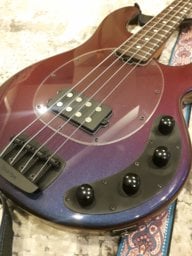
I'm looking at a photo of the StingRay Special 5 I stupidly sold. Looks like it's set up with equal-center spacing rather than equal gap spacing, which explains why the A-string is nicely aligned with the dots.
View attachment 7376287